
Natural Sound

Mr. Lamm liked his Russian tubes I guess because he was comfortable in what he knew about their performance characteristics. The 6C33c isn’t the most linear of triodes and has special heater and output transformer needs but it can sound damn good nonetheless. I have owned several amps with that tube (not a Lamm though) and still own an Ayon Spark that I use in my DIY active system.
The prettiest sounding amp I think I have owned though is my Silvercore 2A3 amp…you just melt when you hear it. Crystal clear mids with some softening of the frequency extremes…but that mid!!

Mr. Lamm liked his Russian tubes I guess because he was comfortable in what he knew about their performance characteristics. The 6C33c isn’t the most linear of triodes and has special heater and output transformer needs but it can sound damn good nonetheless. I have owned several amps with that tube (not a Lamm though) and still own an Ayon Spark that I use in my DIY active system.
The prettiest sounding amp I think I have owned though is my Silvercore 2A3 amp…you just melt when you hear it. Crystal clear mids with some softening of the frequency extremes…but that mid!!
Most set tubes last for 1000’s of hours, unfortunately the 633C isn’t one of them. The 300B, which can and was buried in the ground for telephone use can last upwards of 10,000 hours. Lamm couldn’t have foreseen the issues with Russia but I do wish he made some SET amps with more common tubes. Although I’m extremely happy with my Triode Corp 300b amps, I would have loved to try Lamm ML2’s on the Hartsfields. Too much risk now.

This is such a cottage industry/hobby, once a designer passes on, his company is essentially defunct.
 
Most set tubes last for 1000’s of hours, unfortunately the 633C isn’t one of them. The 300B, which can and was buried in the ground for telephone use can last upwards of 10,000 hours. Lamm couldn’t have foreseen the issues with Russia but I do wish he made some SET amps with more common tubes. Although I’m extremely happy with my Triode Corp 300b amps, I would have loved to try Lamm ML2’s on the Hartsfields. Too much risk now.

This is such a cottage industry/hobby, once a designer passes on, his company is essentially defunct.
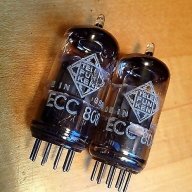
I am getting surprisingly long life from the ones in my Ayon amp…not sure why but it just works year after year…
 
  • Like
Reactions: jeff1225
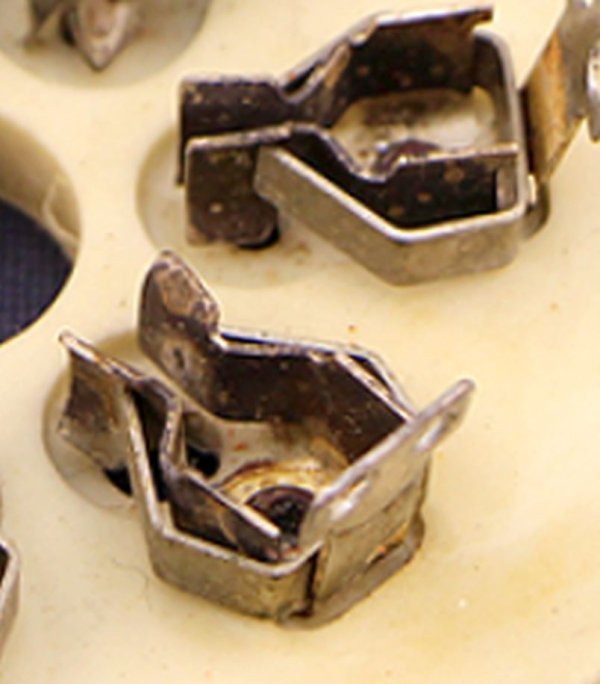
Thats the mig jet socket millitäry quality the best in a long run

Yes, probably it was the best 50 years ago ... Before it rusted miserably. Just commented on the photo in the link you posted.

BTW, as far as I have read, the fighter jet story is a non documented legend, there is no evidence of it being installed in actual fighter aircraft.
 
Yes, probably it was the best 50 years ago ... Before it rusted miserably. Just commented on the photo in the link you posted.

BTW, as far as I have read, the fighter jet story is a non documented legend, there is no evidence of it being installed in actual fighter aircraft.
Then go ahead and buy some high-end Teflon socket that will then be boiled at 300° Celsius by the 6c33. I'm not forcing anyone to buy something like that. It's a series regulator tube in the mig 25 go to an aircraft museum and you'll know where it sits
 
  • Like
Reactions: dennis h
My speakers are specified as 16 ohm with 105 dB sensitivity. I have a small room and usually listen at levels around 70 dB with peaks around 85 dB. On rare occasions, I may blast some rock and reach 95 dB. I listen mostly to small and large scale acoustic music, both classical and jazz with some classic rock. I sit about 14' from my speakers. I figure that I use less than 1 watt or about 5.5% of available power for most listening. According to the measurements in my ML2 manual, total harmonic distortion plus noise is 0.5% for 1 W from 20-20KHz. It is 1% distortion plus noise at 5 W and 2% at 18 watts, levels I never reach.

The second criticism is that SETs can not do bass, and should therefore be used for the midrange and tweeter only. My corner horns use a compression driver from 500 Hz up to about 15K Hz. The 15" paper cone woofer fires into a folded horn with open back into the front corners of my room and radiate out along the front and side walls, extending the size of the horn. I figure total extension is from the mid 30s up to around 15K Hz, though I have not measured it. At some point I may look into two subwoofers driven by my second pair of ML2 amplifiers, but I am quite satisfied at the moment.

I do not question the claimed SET limitations, but I do not hear those limitations with my amp/speaker pairing in my room. Or, it is possible that I hear them, but do not recognize them for what they are. Regardless, I enjoy what I hear. Here is a recent video of a female voice and acoustic double bass. To me, this sounds open, effortless, extended and low in distortion. I hear clarity and energy.

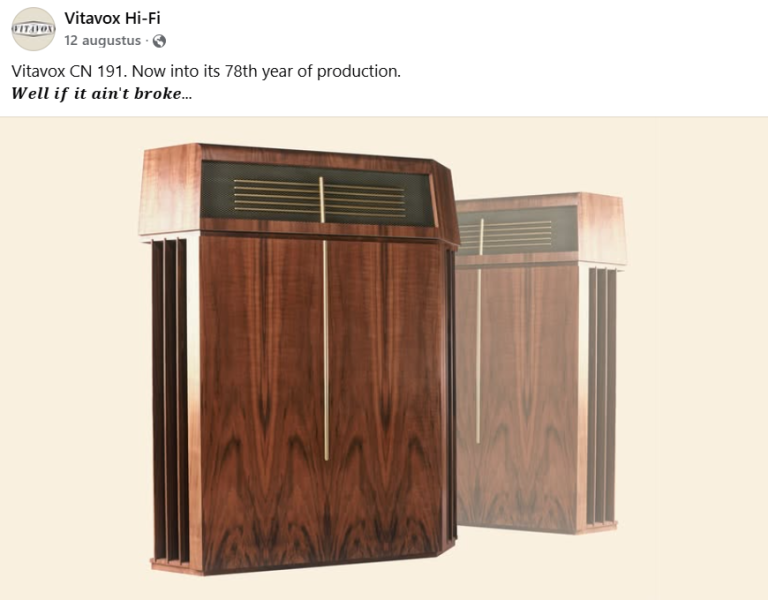
Still going strong...

1764891142012.png

The video was shot with a mobile device?
 
  • Like
Reactions: Amir and PeterA
Still going strong...

View attachment 162516

The video was shot with a mobile device?

Yes. iPhone 11. Impressive that the speakers are still in production. I’m curious how they compare to my originals. There have been a few iterations. I wonder what amps they recommend.

1764896925424.jpeg

1764896566813.jpeg
 
Last edited:
The first room in this video of the 2025 Tokyo International Audio Show features the CN-191, supposedly powered by a Shigeharu Koreeda amplifier:

 
The first room in this video of the 2025 Tokyo International Audio Show features the CN-191, supposedly powered by a Shigeharu Koreeda amplifier:

The high frequencies sound quite curtailed in this video...of course the S2 driver is rolling off already by around 9Khz I think...
 
Last edited:
Vladimir Lamm called "natural" a type of amplified sound that followed a particular type of hearing mechanism of the human ear that he had studied and developed. In many of his interviews I have read he never addressed using live music as a reference.

Using real musics as a reference for gear evaluation was a concept presented by Harry Pearson of TheAbsoluteSound almost 20 years before Lamm was founded. It had very some positive aspects - freeing audiophiles from the ultra-objective-just-measurements dictatorship of the 60's and early 70's audio magazines and launching the basis for subjective evaluation, but also a negative effect - launching audiophiles in a never ending search of changes, blindly following their master. Fortunately most of his readers could go beyond the gear reviews and understand his concepts, including the ability to express sound matters in words in a consistent way.

Fortunately you stabilized and are an happy audiophile under DDK strong guidance - thank him, not the real concerts you attempted.

Vladimir Lamm spoke of the value of using live music as the listener's reference and guide for judgement. Here is a quote from an interview from 1996, link: https://www.lammindustries.com/revi...waldorf-astoria-new-york-city-may-30-31-1996/

"VS: I have already said that a person should either be a musician or listen to live music on a regular basis, and to also remember one thing: that we are the perceivers and that the mystery is beyond us. The only thing we can do (using a servo system for analogy) is to choose a reference point based on live music and compare everything else to this point…Then, this question does not even arise.

This is an old issue, an issue of inner culture and education. We live in this world, we have certain musical instruments, we know certain music by certain composers–and we are limited by this information. Why, then imagine supernatural problems and put a heavy burden on oneself? It is important to accumulate “baggage” first–that is, to know how the real orchestra sounds."


I do not think audiophiles needed freeing from objective measurements. They were always free to simply listen. My speakers from the 1950s were designed by men who could listen and for customers who could listen. Yes, I am indeed grateful to DDK for his guidance and for exposing me to what is possible in the hobby. I have thanked him many times, but I also thanked my father for often taking me to the Chicago Symphony and later to the Boston Symphony Orchestra. Those experiences helped me to understand the experience of listening to live music. With that reference implanted in my memory, I was able to very easily grasp what I experienced when I put my LPs onto DDK's turntable and first heard his system. Again from Vladimir Lamm in that same interview:

"The problem of sound quality assessment is almost completely solved in the first 10-15 seconds of listening at the intuitive level. Any experienced listener knows that the first minute of listening is the decisive one, and the rest is simply putting the perceptions of that one minute into words; it becomes a question of terminology and method of communication."
 
Vladimir Lamm spoke of the value of using live music as the listener's reference and guide for judgement. Here is a quote from an interview from 1996, link: https://www.lammindustries.com/revi...waldorf-astoria-new-york-city-may-30-31-1996/

"VS: I have already said that a person should either be a musician or listen to live music on a regular basis, and to also remember one thing: that we are the perceivers and that the mystery is beyond us. The only thing we can do (using a servo system for analogy) is to choose a reference point based on live music and compare everything else to this point…Then, this question does not even arise

This is an old issue, an issue of inner culture and education. We live in this world, we have certain musical instruments, we know certain music by certain composers–and we are limited by this information. Why, then imagine supernatural problems and put a heavy burden on oneself? It is important to accumulate “baggage” first–that is, to know how the real orchestra sounds."

I am all for “natural”, but I have seen audiophiles with extensive experience of live music (some of them even musicians) choose very different systems. How do you explain that?

I do not think audiophiles needed freeing from objective measurements. They were always free to simply listen. My speakers from the 1950s were designed by men who could listen and for customers who could listen. Yes, I am indeed grateful to DDK for his guidance and for exposing me to what is possible in the hobby. I have thanked him many times, but I also thanked my father for often taking me to the Chicago Symphony and later to the Boston Symphony Orchestra. Those experiences helped me to understand the experience of listening to live music. With that reference implanted in my memory, I was able to very easily grasp what I experienced when I put my LPs onto DDK's turntable and first heard his system. Again from Vladimir Lamm in that same interview:

"The problem of sound quality assessment is almost completely solved in the first 10-15 seconds of listening at the intuitive level. Any experienced listener knows that the first minute of listening is the decisive one, and the rest is simply putting the perceptions of that one minute into words; it becomes a question of terminology and method of communication."

Yes, good sound can be recognized quickly (practically instantaneously).
 
Vladimir Lamm spoke of the value of using live music as the listener's reference and guide for judgement. Here is a quote from an interview from 1996, link: https://www.lammindustries.com/revi...waldorf-astoria-new-york-city-may-30-31-1996/

"VS: I have already said that a person should either be a musician or listen to live music on a regular basis, and to also remember one thing: that we are the perceivers and that the mystery is beyond us. The only thing we can do (using a servo system for analogy) is to choose a reference point based on live music and compare everything else to this point…Then, this question does not even arise.

This is an old issue, an issue of inner culture and education. We live in this world, we have certain musical instruments, we know certain music by certain composers–and we are limited by this information. Why, then imagine supernatural problems and put a heavy burden on oneself? It is important to accumulate “baggage” first–that is, to know how the real orchestra sounds."


I do not think audiophiles needed freeing from objective measurements. They were always free to simply listen. My speakers from the 1950s were designed by men who could listen and for customers who could listen. Yes, I am indeed grateful to DDK for his guidance and for exposing me to what is possible in the hobby. I have thanked him many times, but I also thanked my father for often taking me to the Chicago Symphony and later to the Boston Symphony Orchestra. Those experiences helped me to understand the experience of listening to live music. With that reference implanted in my memory, I was able to very easily grasp what I experienced when I put my LPs onto DDK's turntable and first heard his system. Again from Vladimir Lamm in that same interview:

"The problem of sound quality assessment is almost completely solved in the first 10-15 seconds of listening at the intuitive level. Any experienced listener knows that the first minute of listening is the decisive one, and the rest is simply putting the perceptions of that one minute into words; it becomes a question of terminology and method of communication."

Congratulations on being able to evaluate gear at the intuitive level in 15 seconds - experienced listeners seem to need more 45 seconds!

As I said before, the intuitive level theories in sound reproduction predate Lamm and are well known. The question is on how to create a method to apply them in system developments and evaluation. As far as I know you (and me and probably any audiophile we know about in WBF) evaluate gear in highly biased conditions - something that excludes such 15 or 60 seconds appraisals. It is why we need a more complex methodology,

For some reason Vladimir Lamm writings often refer to proper double blind testing. One point is sure - he was not interested in creating science or audio knowledge. Unfortunately as far as I can see it, his legacy will be soon lost, even his best fans seem to show little curiosity or interest for it.
 
Congratulations on being able to evaluate gear at the intuitive level in 15 seconds - experienced listeners seem to need more 45 seconds!

As I said before, the intuitive level theories in sound reproduction predate Lamm and are well known. The question is on how to create a method to apply them in system developments and evaluation. As far as I know you (and me and probably any audiophile we know about in WBF) evaluate gear in highly biased conditions - something that excludes such 15 or 60 seconds appraisals. It is why we need a more complex methodology,

For some reason Vladimir Lamm writings often refer to proper double blind testing. One point is sure - he was not interested in creating science or audio knowledge. Unfortunately as far as I can see it, his legacy will be soon lost, even his best fans seem to show little curiosity or interest for it.


Fransisco, my post was to show an example of Vladimir Lamm speaking about using live music as a reference. I was curious about your claim that he never referred to live music, so I have been reading some of his interviews and learning from his direct words.

I find it easy to tell if something sounds natural. A minute is often enough.
 
  • Haha
Reactions: Argonaut

About us

  • What’s Best Forum is THE forum for high end audio, product reviews, advice and sharing experiences on the best of everything else. This is THE place where audiophiles and audio companies discuss vintage, contemporary and new audio products, music servers, music streamers, computer audio, digital-to-analog converters, turntables, phono stages, cartridges, reel-to-reel tape machines, speakers, headphones and tube and solid-state amplification. Founded in 2010 What’s Best Forum invites intelligent and courteous people of all interests and backgrounds to describe and discuss the best of everything. From beginners to life-long hobbyists to industry professionals, we enjoy learning about new things and meeting new people, and participating in spirited debates.

Quick Navigation

User Menu

Steve Williams
Site Founder | Site Owner | Administrator
Ron Resnick
Site Owner | Administrator
Julian (The Fixer)
Website Build | Marketing Managersing