Hello
@QuadDiffuser ,
I'll try to explain a bit this fiber tech.
SFP and
SFP+ are hardware layouts, they are identical from physical point of view, SFP+ has higher electrical requirements.
SFP can handle data rates up to 1Gpbs while SFP+ can handle data up to 10Gbps.
There is another standard (SFP28 which can handle up to 25Gbps) and has the same physical configuration. It depends on the main device what speed can be achieved, but generally speaking SFP+ is backward compatible with SFP (vice-versa is not true).
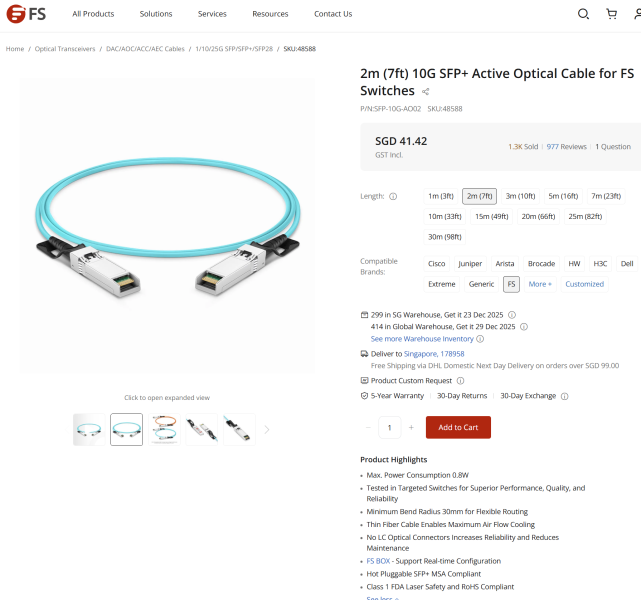
The transciever (metal module that is inserted in a SFP/SFP+ cage in a device) can be used for DAC (passive, copper cable), AOC (active optical cable, basically an easy solution for lazy people providing the fiber cable and transcievers soldered together), RJ45 output or optical output.
Fiber optic cables - there are 2 main categories:
single mode (abbreviated SM) and
multimode (abbreviated MM).
SM has one thin core and can transmit optical signal for several km while MM has a thicker core and a much lower maximum distance (550m if I'm not mistaking).
SM is more expensive but has lower attenuation, only one ray can travel across. MM is cheaper, multiple rays can travel across and has greater attenuation.
SM cables have only one
OS2 flavor (yellow jacket), while MM cables come in
OM2 (orange),
OM3 (cyan),
OM4 (magenta),
OM5 (light green) ... the higher the number after "OM" the better the cable.
Then there are the connectors for fiber, I won't get into details,
LC are the most common. There are some
grade B LC connectors that have lower insertion loss and are more reliable for data transmission.
Then, there is the angle of the "connector" (I'm missing the correct word now) which, if mismatched, can ruin the signal transmission due to reflection angles:

So, let's break down:
Fiber optic:
PROs
- great for galvanic isolation (immune to EMI and RFI)
- low footprint
- can run for long distances (single mode can run for more kilometers)
- consumes far less power than RJ45
- has lower latency than RJ45
- sounds more precise but thin
- multiple fiber optic cables on the same path add to noise filtration (but also lose some details and increase latency)
CONs
- fragile
- must have a 5cm at least as bending angle
- higher attenuation than copper
- very hard and costly to custom build (add connectors) by yourself
TIPS for buying transcievers and cables:
- SM sounds much better than MM due to lower attenuation
- 1310nm wavelength sounds much better than 850nm
- grade B LC connectors have lower insertion loss
- industrial transcievers (up to 85 degrees C operating temperature) sound more detailed than the consumer grade ones (70 degrees C)
- AOC uses MM transcievers and cables (cyan) so they are not very good for audiophiles
Direct Attach Copper (DAC)
PROs
- silver plated cores
- the fastest (lower latency) of all cables (for 0.5m run, the fiber optic has 60-70% more latency than a DAC cable)
- it transmits raw signal (like I2S) without any conversion/delays
- sounds fuller and faster
CONs
- the cable has a very high attenuation, maximum length is 7m
- cannot be custom terminated
- it transmits noise from source to destination
LE: for the SOtM switches you can use any of those SFP cables ... DAC for absolute speed and fullness, but with the drawback of noise travel from the source to the destination, optical SM + industrial 1G SFP 1310nm transcievers for best sound on galvanic isolation (blacker background, thundering bass, somewhat thinner sound).
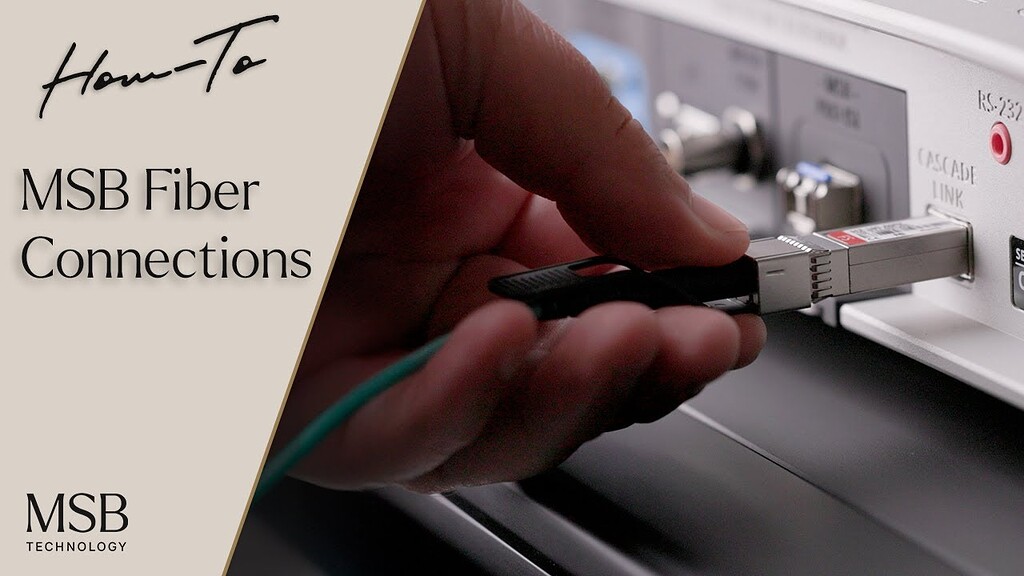
I haven't used AOC so far just because I tested MM and I want to stay away from it in the audio chain. Perhaps MSB has a point here as there are 2 junctions (where fiber meets the transcievers) that are prone to attenuation / signal loss and by having those points soldered could yield better results than with SM fiber and separate transcievers (including 2 junctions) ...
Still I would prefer to build my own with better connectors and cables, "ready to eat" is not the best recipe.