Is High End Audio Gear Worth the Money?

Seems we’re assuming we all process 3D cues alike, maybe some have a lower 3D believability thresholds than others. And what about different ear shapes?
I suspect that it is largely true that we all process the 3D largely the same.
It might have been more universally standard in the days of old, when people spent more time in cathedrals, synagogues, etc.

It also might be less universal with the young crowd spending more time with earbuds stuffed in these days, than with them getting more natural sounds.
 
I thought that they were Shieldmaidens Ralph.
If we're talking about Das Reingold, you can hear the Rhinemaidens lamenting the petty qualities of the gods just prior to when the gods cross the rainbow bridge (side 6 if playing the Decca Solti LP).
Ralph, are you saying you cannot get to "the flutes are in front of the French horns" with width and depth alone ÷ timbre?
No. Width and depth allows you to hear where the instruments are in the recording.
to the point where you feel you can reach out your arm and touch the musicians.
I recently heard a setup at Misco that used a special DSP processing system. The recording was that of someone cutting your hair. It was a bit eerie; the snip of the scissors being right by your ear and moving about your head while the voice of the barber talking to you behind you perceptually. The eerie bit was the speakers were sitting on a table in front of me; nothing to the side or the like at all.
 
Last edited:
  • Like
Reactions: tima
I recently heard a setup at Misco that used a special DSP processing system. The recording was that of someone cutting your hair. It was a bit eerie; the snip of the scissors being right by your ear and moving about your head while the voice of the barber talking to you behind you perceptually. The eerie bit was the speakers were sitting on a table in front of me; nothing to the side or the like at all.
Talk about weird audiophile test records. :) I have a very fond memory of my Dad's test record of a huffing steam engine. VERY realistic according to a neighbor who got up from his throne suddenly when he thought a train was coming through his house. Yes, my Dad could get quite the volume from a few watts of power driving his mono speakers with a one-component crossover.
 
If we're talking about Das Reingold, you can hear the Rhinemaidens lamenting the petty qualities of the gods just prior to when the gods cross the rainbow bridge (side 6 if playing the Decca Solti LP).
Damn… I’ll need to get more height out of the system.
I am totally missing the rainbow bridge as well as the unicorns. :cool:
 
Damn… I’ll need to get more height out of the system.
I am totally missing the rainbow bridge as well as the unicorns. :cool:
The rainbow bridge appears when Thor invokes the thunder on side 6 as well. The Solti recordings of the Ring Cycle feature sound effects that Wagner scored (or suggested) that usually are not heard in other recordings of these operas. Yeah, I'm a bit nerdy on this stuff...
 
  • Like
Reactions: tima and Holmz
Yes but also 2440 is available at much lower price than 375
yes,.. but with risk . most 2440s and 2441s have taken years of pounding .. and many have been passed around. my guess is that on average the 375s have had less usage and less pass-arounds. so 375 a better eco-choice. also consider the headache factor of trying out many pairs just to get a good pair. note the 2441 (orig al dia) is currently in my main horn system and is sounding real good. i am crossing at 500 but i think 450 is achievable. in the 500-1000 region you get a deep, chewy rich midrange ; in comparison, most modern compression drivers hollow out this critical region and focus their effort in shooting for the stars.
 
yes,.. but with risk . most 2440s and 2441s have taken years of pounding .. and many have been passed around. my guess is that on average the 375s have had less usage and less pass-arounds. so 375 a better eco-choice. also consider the headache factor of trying out many pairs just to get a good pair. note the 2441 (orig al dia) is currently in my main horn system and is sounding real good. i am crossing at 500 but i think 450 is achievable. in the 500-1000 region you get a deep, chewy rich midrange ; in comparison, most modern compression drivers hollow out this critical region and focus their effort in shooting for the stars.

Agree. Your system looks interesting in your profile. Do you have any pictures? Or videos playing classical?
 
Agree. Your system looks interesting in your profile. Do you have any pictures? Or videos playing classical?
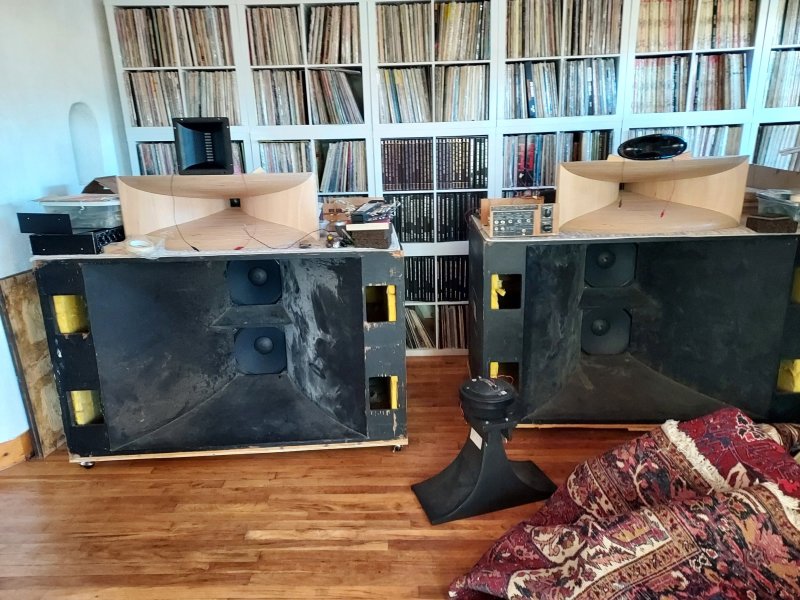
this picture is one if the pictures where i was experimenting with tweeters; here, beyma tpl-150h vs. faital104. 4-way active. marchand 126. gpa 515c woofers. here, subs not hooked up. for simple music 3-6 player ensembles ,presentation is riveting, engaging, seductive. healthy dose of vintage magic without the usual vintage wooliness. without subs, i do not find bass missing. 4550 really under-appreciated. supposedly long-throw but work well in 16x26x12 room. hard to say this with a straight face but jbl 4550 is a practical domestic solution ; especialliy, compared altec 210 cabinet. i think the difference between 4550 and altec 817 --> 100 horn cutoff versus 150 is immediately obvious. the 4550 does not have obvious shelving response that is present in both 825 and 817. also, stock, the 4550 is much more robust than any stock altec cabinet . apart from padding (2" owen-corning 700-series on 5 sides -- more than necessary i suspect - i have not done any reinforcement. i have my doubts whether this is would my preferred system for classical music- i listen to classical music differently-- pushing myself back- and an up front horn system might not be my first choice. speakers like duntech, dunlavy, magnepan, soundlabs might be better suited to my listening bias for classical music. yet to do that comparison directly.
 

Attachments

  • jbl4550_iwata-20250915_173548.jpg
    jbl4550_iwata-20250915_173548.jpg
    979.9 KB · Views: 29
I put high end audio purchases in the same category as spending money on expensive bourbon, booking a first class flight, or buying an unnecessary vehicle.
It’s worth it if it takes nothing off your or your family’s dinner table.
unfortunately, audio has become fashion. and sadly, doors are mostly closed to anyone with a young middle-class family. manufacturers now sell to a vanishing small market and feel they have to keep on going upwards in price. not really manufacturer's fault - market shrank when technology made small devices the standard. i shudder to think what i would do if i had to buy a new good system today.
 
  • Like
Reactions: Young Skywalker
unfortunately, audio has become fashion. and sadly, doors are mostly closed to anyone with a young middle-class family. manufacturers now sell to a vanishing small market and feel they have to keep on going upwards in price. not really manufacturer's fault - market shrank when technology made small devices the standard. i shudder to think what i would do if i had to buy a new good system today.
Accounting for inflation, buying a turntable sourced high-end system now is probably cheaper than it was 30 years ago. I won't mention digitally sourced systems because I've never heard one I'd like to buy.
 
  • Like
Reactions: Wutang-401`
I would love to get an old pair of KEF model 4.2 that retailed around $6k 20 years ago and compare them to the Blades that retailed at $30k 5 years later and then decide.

I would say generally speaking Hifi's a hobby like anything else. To me nothing's worth paying retail, nothing. Let the wealthy pay for innovation and folk like me can bid on last gen's sota.
 
  • Like
Reactions: cjfrbw
My 2 setups are steadily evolving into a museum display of the "good ole days" of high fidelity. My oldest component dating back to the early 1970's.

Currently my 2 setups represent formats for tubes, solid state, true analog playback for records and tape, digital playback, radio ( vintage analog dial tuners, digital format tuners, and even a modern wireless transceiver and receiver device).
 
Last edited:
  • Like
Reactions: cjfrbw
Perhaps a bit utilitarian, but certainly not typical. The original American Sound turntable from the 1970s.

View attachment 149646
i apologise for doing this months later but i am reading thru this thread and no one said anything when @PeterA posted this which seems nuts. the post after it said he would prefer it wasn't in his room!! i'm sorry. but this is a hifi forum isn't it? this is one of the most beautiful objects i have ever seen and i would do alot (wink) to own one. absolutely mammoth and hulking and gob smackingly beautiful. OP is an incredibly lucky man.
 
i apologise for doing this months later but i am reading thru this thread and no one said anything when @PeterA posted this which seems nuts. the post after it said he would prefer it wasn't in his room!! i'm sorry. but this is a hifi forum isn't it? this is one of the most beautiful objects i have ever seen and i would do alot (wink) to own one. absolutely mammoth and hulking and gob smackingly beautiful. OP is an incredibly lucky man.

I have a friend who just bought one of these. I have seen three different ones in America, but that’s all I’m aware of that exist.
 
  • Like
Reactions: Wutang-401`
I have a friend who just bought one of these. I have seen three different ones in America, but that’s all I’m aware of that exist.
the fact you have it next to a micro seiki 8000 mk2. oh boy. what a surplus of nice things. is high end worth it? 100%. for the turntables if nothing else.
 
We were talking about instrument location and presence with @PeterA . Instrument location only needs lateral and depth information. You wanted to talk about having 3-D images of instruments in your head. I introduced an article about Blumlein and the Stereo Image and how that image is recorded. It mentioned nothing about 3-D images.

Now you switch to talk about soundstage. Is soundstage equivalent to imaging instruments?

What are you after here in this discussion, Brad?

Hey, Tim. I just ran across this post and honestly, it perplexed me given your experience and the past posts I have ran across here at the WBF. You mentioned that, "Instrument location only needs lateral and depth information". I quoted your entire post here, instead of honing in on just that one phrase. This way, things won't be taken out of context.

So, instead of a 2-D vertical plane of width and height (which I call musical wallpaper), you are saying that the musical wallpaper needs to be tilted 90 degrees toward you, and that's all that is needed? Like a horizontal line of sound with no height? If I am understanding you correctly here, that is still 2-D. It's just looking at it from a different perspective. A strange one to me, honestly, but that's besides the point.

In order for one to achieve a true 3-D sound stage, wrap around and room filling sound, are you arguing that height isn't a part of the reproductive effort? If so, if you would be so kind, please clarify. I know that a recording differs from the reproductive effort, but after mastering, all 3 aspects are introduced. Instead of 2-D wallpaper, regardless of which plane it's on, wouldn't one ultimately want the final product of 3-D sound?

IMO/IME, truly palpable spatial locationality cues only come from a system that offers all 3 dimensions. Lose one and you lose the aspect that so many people who aren't audiophiles almost never get to experience. Ya' gotta have all 3. Bonus points for perceived sounds being able to whisper2" away from your ear or well behind (read 40') your listening position. I often look out toward an object, nowhere near the speakers, and I can "see" the vocalist or instrument there. I can look up, well above the speakers and very easily and distinctly follow the sound as it travels. Listening to a studio recording, then switching to a live recording (even bootleg) of a large church....you can clearly tell the size of the venue from the ambient cues. Without the 3 dimensions, this would be unattainable, no?

Tom

 
  • Like
Reactions: morricab
the fact you have it next to a micro seiki 8000 mk2. oh boy. what a surplus of nice things. is high end worth it? 100%. for the turntables if nothing else.

Sadly I returned the SX8000 II to David Karmeli when I bought the AS2000. He has both, and my other friend has the SX8000 II and the original American Sound AS1000. Nice turntables indeed.
 
Hey, Tim. I just ran across this post and honestly, it perplexed me given your experience and the past posts I have ran across here at the WBF. You mentioned that, "Instrument location only needs lateral and depth information". I quoted your entire post here, instead of honing in on just that one phrase. This way, things won't be taken out of context.

So, instead of a 2-D vertical plane of width and height (which I call musical wallpaper), you are saying that the musical wallpaper needs to be tilted 90 degrees toward you, and that's all that is needed? Like a horizontal line of sound with no height? If I am understanding you correctly here, that is still 2-D. It's just looking at it from a different perspective. A strange one to me, honestly, but that's besides the point.

In order for one to achieve a true 3-D sound stage, wrap around and room filling sound, are you arguing that height isn't a part of the reproductive effort? If so, if you would be so kind, please clarify. I know that a recording differs from the reproductive effort, but after mastering, all 3 aspects are introduced. Instead of 2-D wallpaper, regardless of which plane it's on, wouldn't one ultimately want the final product of 3-D sound?

IMO/IME, truly palpable spatial locationality cues only come from a system that offers all 3 dimensions. Lose one and you lose the aspect that so many people who aren't audiophiles almost never get to experience. Ya' gotta have all 3. Bonus points for perceived sounds being able to whisper2" away from your ear or well behind (read 40') your listening position. I often look out toward an object, nowhere near the speakers, and I can "see" the vocalist or instrument there. I can look up, well above the speakers and very easily and distinctly follow the sound as it travels. Listening to a studio recording, then switching to a live recording (even bootleg) of a large church....you can clearly tell the size of the venue from the ambient cues. Without the 3 dimensions, this would be unattainable, no?

Tom

Hi Tom -- all of this from July -- wasn't on the top of my head so I traced backwards my various posts to gain some context. Talking about psycho-acoustic effects and their causes goes all over the map in this part of this thread. I will reply using the terminology I am comfortable using, but if I say somethng confusing please feel free to follow up.

My comments came out of a discussion in this thread with Ralph Karsten about Blumein and his microphone technique.

I found a 1981 Stereophile article that talks about Blumlein's discoveries and the topic of sound source location, then gets into microphone placement.
Blumein on location 3.jpg

The article talks about defining a lateral soundstage and image depth. Best as I can read it makes no mention of three-dimensional images.

In order for one to achieve a true 3-D sound stage, wrap around and room filling sound, are you arguing that height isn't a part of the reproductive effort?

No. However I separate out the notion of locating an object or sound in space from the notion of 3D images or 3D soundstage.

As I said upthread:

.... To me, locating a sound is not the same as having a three dimensional image.

If I am looking at a stage in a concert hall with musicians on it, I only need two dimensions to specify the location of a specific muscian. I don't need height to specify his location. If there is a choir on risers behind the orchestra I need to add height to specify the location of a specific chorister. This is not an account of listening to a stereo, it's just me in the concert hall looking at the stage.

When I sit listening to music in my audio room I see my speakers and amplifiers along with the floor, ceiling and walls enclosing that gear. That is all quite dimensional. If I close my eyes and listen to my system playing an orchestral piece whatever I experience is happening in my head. It is an active experience as my perceptions occur in time.

That experience is largely a product of my current perception of the music coupled with my past experience of knowing a) about instruments and orchestras performing in a concert hall and b) what may be either an innate or learned behavior of locating objects in space. (I suspect we have the ability innately and refine it through experience, but I don't really know where that ability comes from.) What happens in my head is a product of the music, my system, my room and my imagination or thought process.

Seeing an orchestra laid before me in 'my mind's eye', it is pretty easy to locate sections and instruments in two dimensions. I have experienced most of the orchestral instruments first hand so it is easy to 'see' (imagine) them before me: trombones, clarinets, the different strings, xylophones and timpani, etc. I know where they are. I don't tend to focus on the images so much any more, it just happens -- I primarily hear the ensemble that is performing.

The more that what I hear sounds like an orchestra in hall with air and space the more realistic it is for me. That is a sense of 3D dimensionality. There are times -- and I've written about this in reviews -- when I can have a sense of individual performers more in bas relief than as three dimensional humans but occasionally I have written the word "palpable". I find that I need to focus intentionally on individual locations, individual performers to have that happen. That is active listening where I am using more of my cerebral cortex, and that tends to pull me away from the more limbic or holistic experience that I enjoy.

I realize that the psycho-acoustic experience of people playing music and seeing them within oneself is very appealing to many audiophiles. And some gauge the quality of a system on its ability to induce that experience. I tend to appreciate following the composition through tonality, dynamics and timing -- the critical elements of music -- more than my ability to imagine the performance visually though that doesn't mean it doesn't happen.
 
If I am understanding you correctly here, that is still 2-D.
I going with you didn't understand.

Its not 2D. The microphones pick up the stereo sound field. Hopefully all the phase relationships are preserved by the mics and the recording system, then also in playback. If that happens you might seem to get a sense of height as well as depth. It really is that simple.
 

About us

  • What’s Best Forum is THE forum for high end audio, product reviews, advice and sharing experiences on the best of everything else. This is THE place where audiophiles and audio companies discuss vintage, contemporary and new audio products, music servers, music streamers, computer audio, digital-to-analog converters, turntables, phono stages, cartridges, reel-to-reel tape machines, speakers, headphones and tube and solid-state amplification. Founded in 2010 What’s Best Forum invites intelligent and courteous people of all interests and backgrounds to describe and discuss the best of everything. From beginners to life-long hobbyists to industry professionals, we enjoy learning about new things and meeting new people, and participating in spirited debates.

Quick Navigation

User Menu

Steve Williams
Site Founder | Site Owner | Administrator
Ron Resnick
Site Owner | Administrator
Julian (The Fixer)
Website Build | Marketing Managersing