





power conditioner

Balanced Isolation transformers are good for most audio systems if the performance is not ultimate. For ultimate performance isolation tranaformers have some limits:
- bass is not fully extended and solid
- the ac polarity will not be correct
- dynamics are not perfect

I've heard what some people call ultimate through balanced transformers and I can't uniquely identify obvious flaws but have been able to improve the sound slightly due to a bit of resonance control pre balance. Necessary? May be situational, certainly not a waste or low end if you get a very large one. I lean towards a very minimal approach to power compared to the past. Learning to make appliances that are not as dependent on power mitigation contributions has been a big deal and nothing like any text book implies.

Regenrators and things like them (inverters) have had more sonic impact in my experience. But it depends on where you are. I once visited a really nice guy with a very nice stereo that had horrible power so the overall experience was much preferred with added stability.
 
Last edited:
  • Like
Reactions: mtemur
I suggest you read up on the topic. No-one is saying AC power is the actual generator of the harmonic. Transformers are, as I stated earlier.

The Elgar conditioners (made back in the 1970s) can sort it out, as can the PS Audio regenerators. Passive devices, unless they have a 300Hz filter, cannot. A 300Hz filter requires a fairly large choke FWIW.

It shouldn't. But grounding is a bit of a black art and I've encountered many in high end audio that don't really understand it.
I wish there was something left to read that would be new information.

The Elgar stuff is neat but even today's units are limited to 20ms response time so nothing even close to audio capable. If you run a lab of sorts then it is all very nice. The PS Audio units drastically change sound by the power cable from the wall to them. So even units that are suppose to free themselves of everything are often not doing so sonically.

As far as ground goes, it is a curse in the name of safety. Few want to run balanced operational equipment, balanced power, or make enclosures that are against their sensibilities to mitigate the issues. I'm sure for you it is several fold over since tubes use high voltages and if you cannot get ground under control you can get sounds like people yoinking input cables at a community event while everything is still on and unmuted.
 
Last edited:
  • Like
Reactions: mtemur
Unless we properly quantify power needs all we say is vaporware.

Addressing 500, 1000, 2000 or 5000WA is very different and needs different approaches. In a forum blessing low power SETs and very high-efficiency speakers the problem should be easily solved. ;)
I get your point. But I would use nothing less than a 2000 Watt Exeltech or Victron. Victron is actually 3000 watts or 5000 watts. The only difference is that with 5000 watts, I would be designing for a larger isolation transformer, like a RM40. But I think they are all 240 volt in. Would have to check. Or, 2 x RM20. I would drop 2 fuses at the output of the inverter and go to each isolation transformer. But your getting a lot of heavy parts in the room at 5000 watts. The inverter is 135 plus pounds. So is the battery. So is the isolation transformer.

I would stick with multiple 2000 to 3000 watt inverters to fit the system. Could be one for amps and one for front end.

I feel over 10,000 watts is the dividing line. When you get that big, you should either go with multiple small units, or the system needs to be taken out of the room. Now you need a professional installer.
 
This statement needs clarity.

I agree the AC filters really don't do much. And if your only exposure to 'conditioners' in high end audio is a glorified power strip that calls itself a power conditioner when it really isn't then I can see why you came to this conclusion.

AC power conditioning was sorted out a long time ago. See if you can find a copy of the manual for an Elgar AC conditioner (available on eBay)- read it and you'll see what I'm talking about. Elgar conditioners could get the AC line distortion down to 0.5% THD at full output. The bigger ones could do that with 5000VA. They also could maintain line Voltage and do that without limiting current. I first learned about the Elgars from Michael Percy (who sells high end components like resistors and capacitors) when I visited him in the early 1990s.

You are audio designer so you know more than me about complexity of good sound vs circuit design.

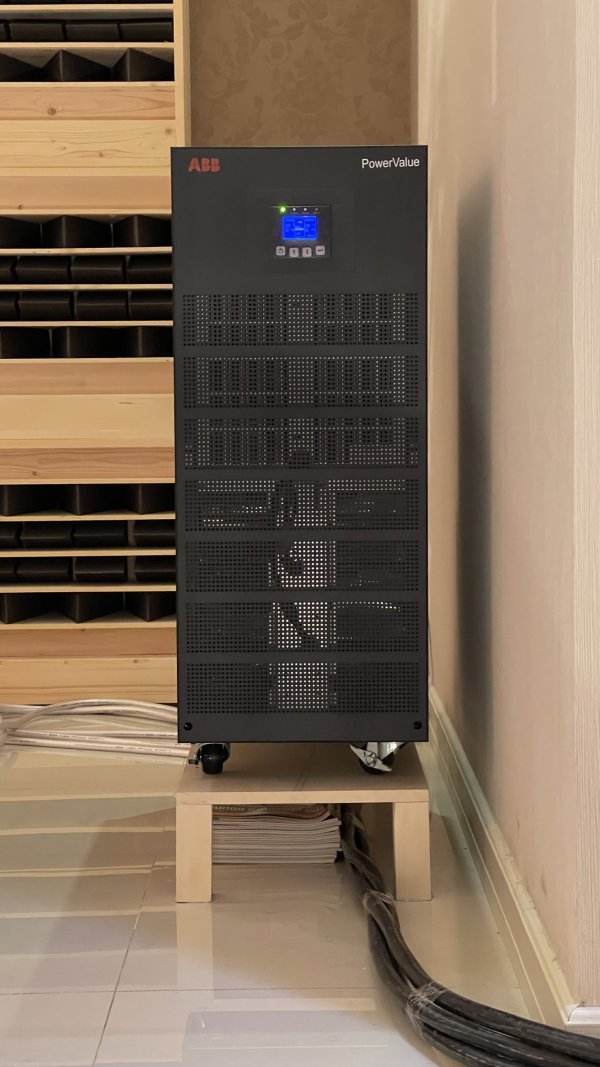
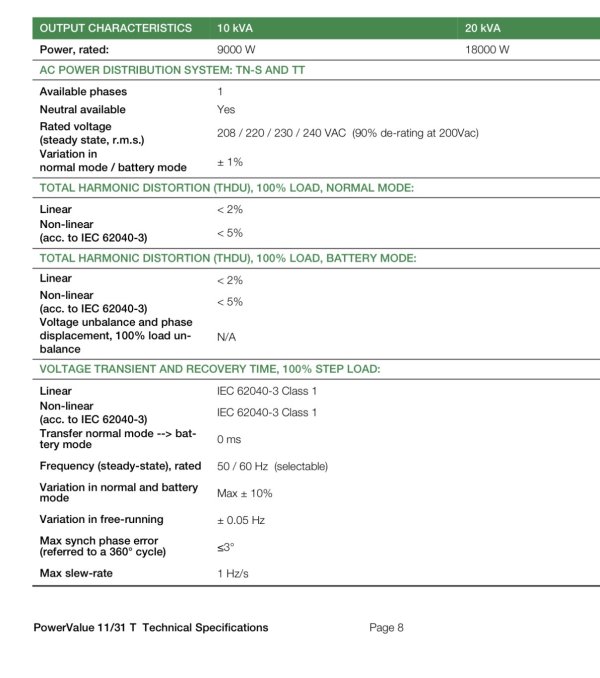
I had some ac distributors, ac filters, UPS, AVR … all of them were not good. ABB switzerland is very good in AC regeneration industry , very high quality parts, very low distortion but the ABB 20KVA never sounded good.

I have spent many times for this problem but did not find the proper solution.

ABB low distortion 20KVA UPS

IMG_1998.jpeg
 
My real point is Eaton makes a very good UPS. And they do switch pretty fast. Not always fast enough, but they are very good.
When you have a UPS, you have routed your branch wires into an enclosure that has contactors and power supplies inside. Your adding a lot of breaks in the power feed. Connections points. And most of these devices have a lot of aluminum lugs. Not copper. Its all noise your injecting.

I personally, if seeking the highest performance would go 1 or 2 routes.
One is to use something like a Torus AVR transformer. If the power sags or surges, the transformer will adjust the taps internally and keep the voltage stable at 120 or 230. Depends on what country your in. If the power drops out, the transformer will shut off. It won't come back on until you tell it to. Or, you can program it to turn back on with a controlled sequence. Like the preamps and servers first, then the amps. It can also be told to wait some amount of time to restart so you don't motorboat the equipment.
The other options is a pure battery/Inverter supply. Your always on the battery so there is 0 relation to the utility power. Utility can do what it wants and your stereo will never know. You need to manage the charger. You will hear it when playing music. You have to turn it off or unplug it when playing. Then turn it back on when done. You can purchase a very expensive box like a Stromtank. You could easily spend $100K. Or you can assemble the parts yourself. Issue is understanding how to do it safely and correctly. It will take hands on work to built up the cabling. And you need an isolation transformer. All the people that are doing battery/Inverter say a Isolation transformer is the most natural sounding filter to follow it. You need to figure that into the cost. Figure $4200 plus shipping of $350 retail price for a RM20. Pretty much the perfect device to follow and Exeltech or Victron inverter.
If you went lager, like a 100A inverter and rack mount storage, you need an electrician with a Solar background that has done battery storage systems in the past. Its a very specific installation and a electrician that does not do if for a living will screw it up.
Thank you very much for your reply!
The UPS (Eaton 9130, 3000VA) will be located in the adjacent technical room, so the noise from it won't bother me.
This UPS will only power the CD player and the Gryphon Diablo 300 integrated amplifier. Will this UPS have enough power?
 
TechnicalPie, you need to look for the maximum requirements for your Gryphon to see if the Eaton can provide more than you need.

I use an Emerson Liebert GXT4 3000VA 2700W, so same power output as yours. I just calculated the maximum current draw of what I was going to run on it, I made sure I had a lot more than I needed.
I also have the power amp on the 16amp socket, everything else sits on the 10amp sockets. If you have a high current socket on your UPS, I recommend you put the amp on it.
I also replaced the noisy fans that came with it with Noctua quiet fans.
 
Thank you very much for your reply!
The UPS (Eaton 9130, 3000VA) will be located in the adjacent technical room, so the noise from it won't bother me.
This UPS will only power the CD player and the Gryphon Diablo 300 integrated amplifier. Will this UPS have enough power?
That's 25 amps of power. Yes it can power a Diablo and a CD player. Try a isolation transformer as a filter. In essence, you are powering your stereo with an inverter. Its switching at 10,000 to 20,000 hertz. And there will be harmonics from that.

I forgot to add, The 9130 is a unit Equitech tells people to use when they have issues with power stability. They use their transformer as a filter to clean up the inverter switching noise.

If your out of the room, PM me and I will give you a parts breakdown to get Abyss batteries, Vcton or Exeltech inverters and how to have it wired. The parts will cost about $7k. That will be a 90AH battery and either 2000, 3000 or 4000 watts power. 4000 watts will be about 9K. And you may want a second battery. Those are around $3000 each.
 
Last edited:
  • Like
Reactions: Atmasphere
Last edited:
The Exeltech inverters produce less than 1% thd. Whether the difference is necessarily audible, I don’t know.

And wouldn’t you want a modern LiFEPO battery over a lead acid design?
Batteries are audible. I have never compared them myself, but people trying them told me LiFEPO sound best. No one has tried a Sodium battery that I know of.
 
Your a store, right? Focus on something you can sell. Is that it?

I think you can do better. Build your own. You know electricians that can lash a battery to an inverter. Use a isolation transformer as a filtrr and listen. It will be extremely stable and better than the utility.
 
Thanks! The Elgar conditioners from the 1970s could do 0.5%, so 1/10th of that? They are also not nearly as large!
Batteries are audible. I have never compared them myself, but people trying them told me LiFEPO sound best. No one has tried a Sodium battery that I know of.
The battery shouldn't be audible. If it is, the inverter is really lousy.

You don't need a battery anyway. Just find yourself an Elgar and have it refurbished. This is a small one, good for about 10 Amps:
Elgar conditioner on ebay

You get all the benefit of a battery powered inverter but no need for a battery. The only problem is Elgar got out of the line conditioner business back in the 70s so one you find nowadays has to be refurbished. Like I said earlier, they made ones that could handle up to 5000VA (and ones bigger than that!) which can handle almost any amplifier made for high end audio. People I know that use the bigger ones usually have them set up by the breaker box and the AC line powering their audio room is output from the conditioner, which runs 24/7.
 
  • Like
Reactions: DasguteOhr
Thanks! The Elgar conditioners from the 1970s could do 0.5%, so 1/10th of that? They are also not nearly as large!

The battery shouldn't be audible. If it is, the inverter is really lousy.

You don't need a battery anyway. Just find yourself an Elgar and have it refurbished. This is a small one, good for about 10 Amps:
Elgar conditioner on ebay

You get all the benefit of a battery powered inverter but no need for a battery. The only problem is Elgar got out of the line conditioner business back in the 70s so one you find nowadays has to be refurbished. Like I said earlier, they made ones that could handle up to 5000VA (and ones bigger than that!) which can handle almost any amplifier made for high end audio. People I know that use the bigger ones usually have them set up by the breaker box and the AC line powering their audio room is output from the conditioner, which runs 24/7.
Thanks, impressive machines..on the bucket list33599918138_005b7a5d90_c.jpg
 
  • Like
Reactions: Atmasphere
Thanks, impressive machines..on the bucket listView attachment 163231
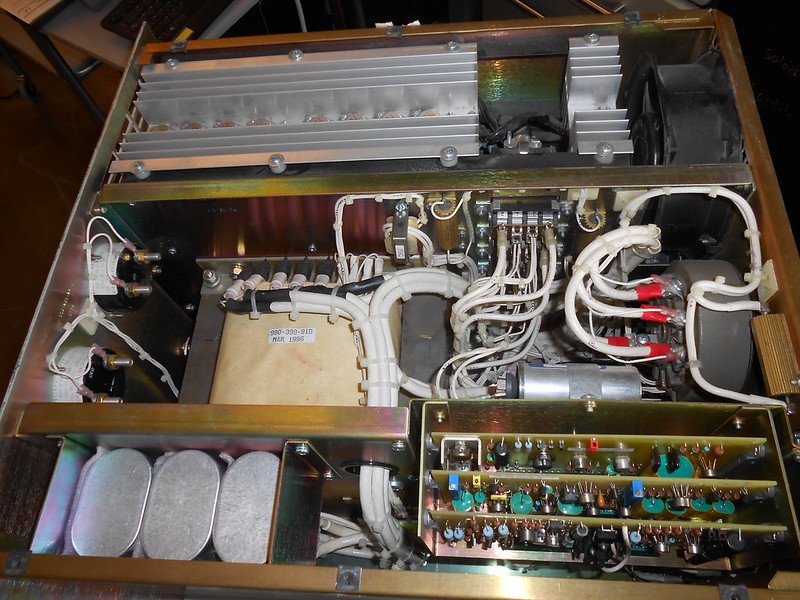
They are! The heatsinks in the rear are for the output transistors of the correction amplifier, which applies its output to the large isolation transformer you see in the center. It is fan cooled and both bucks the output Voltage of the transformer (for line Voltage regulation) and also corrects distortion (I've been wondering recently if a low distortion class D amp might be better suited for this task; that might allow for lower fan noise).

The circuit boards in the foreground are the driver circuit for the amp, also a low distortion oscillator synchronized to the line frequency, and a comparitor circuit. The oscillator output is compared to that of the conditioner itself and a correction signal is generated, which is applied to the correction amplifier. The meters on the left display the line Voltage and current being drawn. The large round object on the right center is a range switch. The output is typically a set of duplex AC outputs. The input is either a set of heavy duty screw terminals or a heavy duty power cord. Some are built to run off of 240V, putting out 117V, and some have 117V input.

I think they made units for overseas operation but I've not seen one. Because of the fan cooling they are noisy, which is why they often see service by the breaker box rather than inside the audio room.

Refurbishing them consists mostly of replacing electrolytic capacitors in its power supply and on the circuit boards. They are a great example of how something can be built to be 'bullet proof', which was required since they were used 24/7 in commercial, hospital and industrial applications where there's no fooling around- the job simply has to be done, and done right. When associated equipment it was powering became less susceptible to AC line troubles, Elgar got out of the business, but they still make AC power sources and the like of extreme quality, although they are not much to look at.
 
  • Like
Reactions: DasguteOhr
They are! The heatsinks in the rear are for the output transistors of the correction amplifier, which applies its output to the large isolation transformer you see in the center. It is fan cooled and both bucks the output Voltage of the transformer (for line Voltage regulation) and also corrects distortion (I've been wondering recently if a low distortion class D amp might be better suited for this task; that might allow for lower fan noise).

The circuit boards in the foreground are the driver circuit for the amp, also a low distortion oscillator synchronized to the line frequency, and a comparitor circuit. The oscillator output is compared to that of the conditioner itself and a correction signal is generated, which is applied to the correction amplifier. The meters on the left display the line Voltage and current being drawn. The large round object on the right center is a range switch. The output is typically a set of duplex AC outputs. The input is either a set of heavy duty screw terminals or a heavy duty power cord. Some are built to run off of 240V, putting out 117V, and some have 117V input.

I think they made units for overseas operation but I've not seen one. Because of the fan cooling they are noisy, which is why they often see service by the breaker box rather than inside the audio room.

Refurbishing them consists mostly of replacing electrolytic capacitors in its power supply and on the circuit boards. They are a great example of how something can be built to be 'bullet proof', which was required since they were used 24/7 in commercial, hospital and industrial applications where there's no fooling around- the job simply has to be done, and done right. When associated equipment it was powering became less susceptible to AC line troubles, Elgar got out of the business, but they still make AC power sources and the like of extreme quality, although they are not much to look at.
If someone were to make something like that today, what do you think it would cost to put it together?
 
If someone were to make something like that today, what do you think it would cost to put it together?
$10-20K?? That alone is why its worth finding these and having them refurbished. I've saw a refurbished unit on eBay for $3500, the one I am thinking of was one of the bigger ones too. So much cheaper than what you'd pay for that new! But you have to keep an eye out. They were easier to find 5 years ago...
 
They are! The heatsinks in the rear are for the output transistors of the correction amplifier, which applies its output to the large isolation transformer you see in the center. It is fan cooled and both bucks the output Voltage of the transformer (for line Voltage regulation) and also corrects distortion (I've been wondering recently if a low distortion class D amp might be better suited for this task; that might allow for lower fan noise).

The circuit boards in the foreground are the driver circuit for the amp, also a low distortion oscillator synchronized to the line frequency, and a comparitor circuit. The oscillator output is compared to that of the conditioner itself and a correction signal is generated, which is applied to the correction amplifier. The meters on the left display the line Voltage and current being drawn. The large round object on the right center is a range switch. The output is typically a set of duplex AC outputs. The input is either a set of heavy duty screw terminals or a heavy duty power cord. Some are built to run off of 240V, putting out 117V, and some have 117V input.

I think they made units for overseas operation but I've not seen one. Because of the fan cooling they are noisy, which is why they often see service by the breaker box rather than inside the audio room.

Refurbishing them consists mostly of replacing electrolytic capacitors in its power supply and on the circuit boards. They are a great example of how something can be built to be 'bullet proof', which was required since they were used 24/7 in commercial, hospital and industrial applications where there's no fooling around- the job simply has to be done, and done right. When associated equipment it was powering became less susceptible to AC line troubles, Elgar got out of the business, but they still make AC power sources and the like of extreme quality, although they are not much to look at.
Thank you Ralph for your detailed description.
I just did some research. The Elgar 6225 is made for 240 volt AC, 3kva continuous load in peak 11kva impressive. I think modern ball bearing Pabst fans will probably make it maybe suitable for living rooms;)
 
  • Like
Reactions: Atmasphere
Thanks! The Elgar conditioners from the 1970s could do 0.5%, so 1/10th of that? They are also not nearly as large!

The battery shouldn't be audible. If it is, the inverter is really lousy.

You don't need a battery anyway. Just find yourself an Elgar and have it refurbished. This is a small one, good for about 10 Amps:
Elgar conditioner on ebay

You get all the benefit of a battery powered inverter but no need for a battery. The only problem is Elgar got out of the line conditioner business back in the 70s so one you find nowadays has to be refurbished. Like I said earlier, they made ones that could handle up to 5000VA (and ones bigger than that!) which can handle almost any amplifier made for high end audio. People I know that use the bigger ones usually have them set up by the breaker box and the AC line powering their audio room is output from the conditioner, which runs 24/7.
What I like about a battery and inverter is they are all current products. It's very repeatable, and you know what you're going to get. The Elgar may be better. Maybe not. Probably depends on setup. As in, how well did you set up the inverter.

The Elgar its a one off and it needs to be bought, then sent to you to be rebuilt. Not a deal breaker by any means.
 
What I like about a battery and inverter is they are all current products. It's very repeatable, and you know what you're going to get. The Elgar may be better. Maybe not. Probably depends on setup. As in, how well did you set up the inverter.

The Elgar its a one off and it needs to be bought, then sent to you to be rebuilt. Not a deal breaker by any means.
I see them as the benchmark. If you can beat one with something else you're doing very, very well!
 

About us

  • What’s Best Forum is THE forum for high end audio, product reviews, advice and sharing experiences on the best of everything else. This is THE place where audiophiles and audio companies discuss vintage, contemporary and new audio products, music servers, music streamers, computer audio, digital-to-analog converters, turntables, phono stages, cartridges, reel-to-reel tape machines, speakers, headphones and tube and solid-state amplification. Founded in 2010 What’s Best Forum invites intelligent and courteous people of all interests and backgrounds to describe and discuss the best of everything. From beginners to life-long hobbyists to industry professionals, we enjoy learning about new things and meeting new people, and participating in spirited debates.

Quick Navigation

User Menu

Steve Williams
Site Founder | Site Owner | Administrator
Ron Resnick
Site Owner | Administrator
Julian (The Fixer)
Website Build | Marketing Managersing