Future progress in reproduced sound

To minimize low-frequency resonances, acousticians (R Bolt specifically) recommend using “ideal” room dimension ratios: 1 (H) × 1.9 × 1.4 or 1 × 1.3 × 1.5 × 2.1.
Additionally, it seems that for better results the room should have a volume of at least 40m³ (1400ft).

Hi Greg, the formula is a bit confusing here give the four numbers. Can you tell me what each one represents and maybe walk through an example?

For example, which is length, width, and height…and what does the fourth term represent?
 
maybe. but to me the biggest change to my room is my own personal progress. consider yourself and your system building considerations 20 years ago compared to today. you have evolved too. so the best part of the room is that it has not limited me to attain my system goals as they have evolved. it turned out that the bones of the room were sufficient to support where i went.

as i recall; the idea of the original design was pretty open ended. meaning that it was expected to evolve. especially that the bass trapping was over spec'd intentionally as it was relatively easy to build them in then remove them to taste, as opposed to try and add them later. in the context of my system and room investment; i've probably spent around $15k or so modifying my room....removing bass traps, solidifying the front walls in place of bass traps, adding the cloth covering, adding the window inserts......a drop in the bucket. when the room was built i was not ready to be able to fine tune it. i just had no idea. it took time to recognize the warts.

but for instance, what if i switched to horns? or panels of some sort? my listening position would change again. i view my listening position change as an evolution in my musical presentation viewpoint as the room allowed me to experiment. at first there was too much reflective hash to sit closer. but all that retained musical energy from all the cabinetry and diffusion and wood speaker end floor became a real asset later once tamed.

you hear feedback that purpose built dedicated rooms can be dead sounding or overdamped. well; it's up to the user to get it right once they live in it. the dedicated room part is that it's a canvas to paint your own picture. so go do it. no one is holding you back. but you do have to be a seeker and not afraid to try things and then also to listen to feedback from others. be open minded to learn.

last year after 8 years since i had finished my room tuning in 2016, I removed some of my cloth treatments to add a bit more air and life. this was me evolving my expectations. so the room is still a live thing that can be what i want it to be.


Great post Mike. I have heard many rooms that meet a theoretical acoustic design but sound dead in real life. Truly too much of a good thing.

As for the journey, that seems to me a particularly satisfying part of the hobby. My three years chasing noise out and refining setup has been tremendously enjoyable and fun. Some of my friends are doing that too and our weekly texts and calls indicate they are making progress. Now when I go to their house, I have a better time.
 
  • Like
Reactions: Mike Lavigne
Hello Lee!

This is a totally fair hypothesis, but it's just not the way I think about things.

Maybe it has to do with divergent objectives of the hobby. I don't subscribe to Jonathan Valin's "accuracy" objective, which is conceptually similar to one of my proposed objectives of "reproduce exactly what is on the master tape or digital file being played."

I think this objective focuses theoretically on hearing what the microphone hears. But that's not how I think. I don't care about hearing what the microphone hears. I care about hearing what somebody sitting fifth row/center in Walt Disney Concert Hall hears. And that is definitely not the location of the microphone.

My objective is either "re-create the sound of an original musical event" or "create a sound that seems live." Neither of these formulations focuses on minimizing noise or maximizing detail or amplifying what the microphone hears.

So minimizing noise to maximize detail is just not how I think about my personal objective of the hobby.

How do you recreate the 5th row sound at Disney if the microphones are not there?

Also, some times they are there. Michael Bishop sometimes placed his mics rows back in Atlanta’s Symphony Hall. I can tell stories about attending his sessions there and having union reps upset at my involvement due to silly union rules. Lol.
 
I think a lot of the challenges that we face come from the recording studios themselves and how they master the music for mass consumption. There is often a very wide gap in sound quality between a very few of what I’d almost call audiophile studios where they care tremendously about the sound of the recording and then the standard commercial release where a significant amount of dynamic compression takes place which robs the music of much of the realism as music is hugely dynamic in real life. I get it though that commercially folks listen on the go today more than ever and mastering for that environment might make sense commercially but I believe is likely the largest issue keeping us from having many more of the very best recordings and making think we are really there.

George
 
  • Like
Reactions: Lee
Thare's a lot implied by that statement. Sounds to me like a good and succinctly phrased goal.
I thought so too. That's why I added it to the other three objectives.

I think it overlaps significantly with "re-create the sound of an original music event," but it does so from a different direction which I think was valuable to add to the objectives matrix.
 
I think the biggest impediment to realism is the size of our listening rooms
So you think the reason 95% of systems sound sh*t is the price of real estate, and not the drivers, crossovers, digital media, incorrect matching of components fueled by desire to buy random stuff to satisfy hobby itch? And all of this would go away and systems would sound great if everyone could afford big proportionate rooms?
 
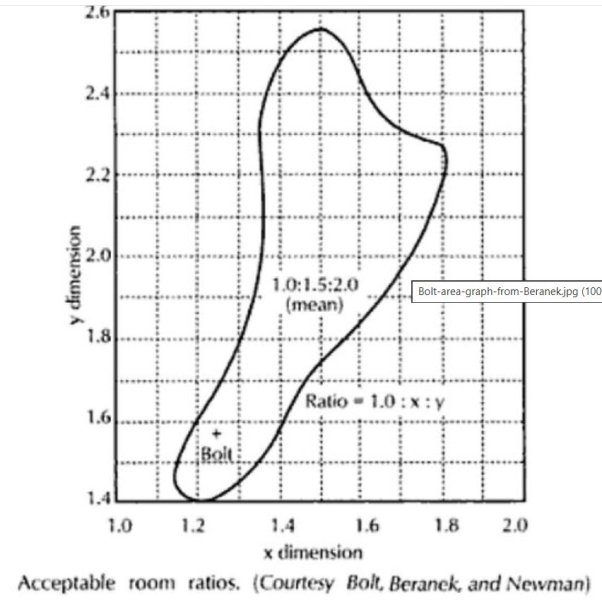
To minimize low-frequency resonances, acousticians (R Bolt specifically) recommend using “ideal” room dimension ratios: 1 (H) × 1.9 × 1.4 or 1 × 1.3 × 1.5 × 2.1.
Additionally, it seems that for better results the room should have a volume of at least 40m³ (1400ft).

The Boltt ratios are considered acceptable dimensions for listening rooms.
They are simple to use but should be verified against the Bonello criteria.

However, these criteria ignore aspects such as boundary impedance, absorption distribution, listener position or source placement and directivity. It is why we can'take them as a path to immediate success.

a1.jpg
 
(...) I think it overlaps significantly with "re-create the sound of an original music event," but it does so from a different direction which I think was valuable to add to the objectives matrix.

I prefer "re-create the experience of an original music event". When you are at a live concert the feeling of presence is created mainly by the singer. Next you want to feel it in your listening room, with a very different sound.
 
How so? I am saying that for me personally reducing noise does not necessarily increase believability for my particular objective.
It sems to me that perceiving the finer details of a recording would contribute to "believability" provided that the rest of the system (for example, the speakers) is able to offer the necessary resolution. In other words, if you start with a system that sounds "credible" and you improve it - all other things remaining the same - to offer more resolution (less noise would imply that you hear low level detail), then I don't see how "believability" would not benefit.
 
It sems to me that perceiving the finer details of a recording would contribute to "believability" provided that the rest of the system (for example, the speakers) is able to offer the necessary resolution. In other words, if you start with a system that sounds "credible" and you improve it - all other things remaining the same - to offer more resolution (less noise would imply that you hear low level detail), then I don't see how "believability" would not benefit.
Thank you for explaining.

Let's start at the first principle: what is your personal high-end objective?
 
Thank you for explaining.

Let's start at the first principle: what is your personal high-end objective?

In terms of « experience », I simply want to be immersed in music. I know exactly what sound I am looking for (I am not very difficult - and am pretty close to reaching my objective). Not sure this will be useful.
 
maybe. but to me the biggest change to my room is my own personal progress. consider yourself and your system building considerations 20 years ago compared to today. you have evolved too. so the best part of the room is that it has not limited me to attain my system goals as they have evolved. it turned out that the bones of the room were sufficient to support where i went.

as far as the original design, the biggest thing was that the room had the size for large music to scale and breathe and happen. which was exactly what my previous small room could not do, for all that it was great at.

as i recall; the idea of the original design was pretty open ended. meaning that it was expected to evolve. especially that the bass trapping was over spec'd intentionally as it was relatively easy to build them in then remove them to taste, as opposed to try and add them later. in the context of my system and room investment; i've probably spent around $15k or so modifying my room....removing bass traps, solidifying the front walls in place of bass traps, adding the cloth covering, adding the window inserts......a drop in the bucket. when the room was built i was not ready to be able to fine tune it. i just had no idea. it took time to recognize the warts.

but for instance, what if i switched to horns? or panels of some sort? my listening position would change again. i view my listening position change as an evolution in my musical presentation viewpoint as the room allowed me to experiment. at first there was too much reflective hash to sit closer. but all that retained musical energy from all the cabinetry and diffusion and wood speaker end floor became a real asset later once tamed.

you hear feedback that purpose built dedicated rooms can be dead sounding or overdamped. well; it's up to the user to get it right once they live in it. the dedicated room part is that it's a canvas to paint your own picture. so go do it. no one is holding you back. but you do have to be a seeker and not afraid to try things and then also to listen to feedback from others. be open minded to learn.

last year after 8 years since i had finished my room tuning in 2016, I removed some of my cloth treatments to add a bit more air and life. this was me evolving my expectations. so the room is still a live thing that can be what i want it to be.

It’s more than your field, listening position. Don’t you think by sitting in the near field, that the direct sound overwhelms most of the reflections of the room or certainly arrive significantly earlier than the reflections so that the room itself has less of an impact? Yours is just the first case I’ve seen where there is a nice dedicated room designed by a professional, and the listener actually sits close to his speakers to diminish the sound of the room. Having not actually been in your room, I’m guessing on the effect of listening in the near field.
 
(...) Let's start at the first principle: what is your personal high-end objective?

Maximum enjoyment of my system. Curiously, I find that top quality and quantity of information and a reasonable degree of accuracy to the media helps me. Surely I add my subjective biases and particular constraints to try reaching my objective.
 
It’s more than your field, listening position. Don’t you think by sitting in the near field, that the direct sound overwhelms most of the reflections of the room or certainly arrive significantly earlier than the reflections so that the room itself has less of an impact? Yours is just the first case I’ve seen where there is a nice dedicated room designed by a professional, and the listener actually sits close to his speakers to diminish the sound of the room. Having not actually been in your room, I’m guessing on the effect of listening in the near field.

Proper near field listening can be an intoxicating experience - I own some mini monitors that sound great in such geometry - the Bowers and Wilkinson Silver Signature SS25 and someone I know well has QUAD ELS 63 in a very small room. Detail and clarity are astonishing, sound is surely less colored. But surely it is not my preferred way of listening. I do not consider you will find it "realistical"
 
In terms of « experience », I simply want to be immersed in music. I know exactly what sound I am looking for (I am not very difficult - and am pretty close to reaching my objective). Not sure this will be useful.
No, this is not useful.

We can be immersed in music in an elevator. We can be immersed in music in a bar playing a PA system.

Are you able to be more specific in terms of what you are hoping to achieve when sitting in front of your stereo system?
 

About us

  • What’s Best Forum is THE forum for high end audio, product reviews, advice and sharing experiences on the best of everything else. This is THE place where audiophiles and audio companies discuss vintage, contemporary and new audio products, music servers, music streamers, computer audio, digital-to-analog converters, turntables, phono stages, cartridges, reel-to-reel tape machines, speakers, headphones and tube and solid-state amplification. Founded in 2010 What’s Best Forum invites intelligent and courteous people of all interests and backgrounds to describe and discuss the best of everything. From beginners to life-long hobbyists to industry professionals, we enjoy learning about new things and meeting new people, and participating in spirited debates.

Quick Navigation

User Menu

Steve Williams
Site Founder | Site Owner | Administrator
Ron Resnick
Site Owner | Administrator
Julian (The Fixer)
Website Build | Marketing Managersing