







Active Crossovers

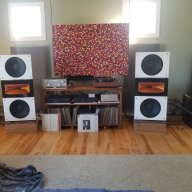
I have the horn and the 10 inch on the stock crossover. That crossover seems to have a capacitor and resistor to the 10 inch. Isn't that cutting the low frequency off?
Ist that your stock crossover, are my assumptions correct?
Are the drivers connected correctly?
20251217_080440.jpg

A phase plug for 10" is difficult and has a greater influence than you think. I would search the internet for wooden buttons that close the central hole (dust cap)20251217_081638.jpg

P.S
Analyzing a crossover without having it in hand and drawing a circuit diagram is very difficult. It can be notchflter, zobel network and different edge steepness in this xover.
 
Last edited:
  • Like
Reactions: Atmasphere
I don't understand???
Isn't there a difference between how low a frequency a driver can reach based upon its size and how its mounted, and the space it in. VS How much energy a amplifier is spending to send power to the driver at all frequency levels.. In other words, even though the driver can not produce sound below 120 hertz in a baffle, the amp might still be giving it as much power as it can to produce a 30 hertz tone. Essentially that ends up being heat and distortion.
Of course the amplifier also reproduces 30hz, but if the speaker has a sound pressure of -20db than at 120hz, that's no longer a load. If you want to free it from bass there are two options: active xover or reducing the size of the coupling capacitor in the tube amp
 
  • Like
Reactions: Atmasphere
Its been a lot of work tryiing to adjust the crossover for it all.
 

Attachments

  • IMG_6642.jpg
    IMG_6642.jpg
    190.9 KB · Views: 17
  • Love
Reactions: MarkusBarkus
Of course the amplifier also reproduces 30hz, but if the speaker has a sound pressure of -20db than at 120hz, that's no longer a load. If you want to free it from bass there are two options: active xover or reducing the size of the coupling capacitor in the tube amp
Or passive crossover after the amp.
 
A phase plug for 10" is difficult and has a greater influence than you think. I would search the internet for wooden buttons that close the central hole (dust cap)View attachment 163215
That is what he actually offered. A plug to keep the wave from rolling into the center hole. He said a bullet nose is more for high frequency.
I can hear a change with the horn out. Its hard to pin down how to describe the change. Lets just say its staying out.
 
I tried using the active crossover to level match the amp for the woofers to the mid and high amplifier. I defeated the active crossover. The active only adjusted the gain. I used the stock passive crossover to adjust the low pass filtration. The sound is definitely more grainy. There is now a notable hash. As active only, and the woofers in series for 16 ohms, the sound is more clear, less hash. Through the passive in parallel mode for 4 ohms, the sound is grainy, but, it has more body and a sense of umph. Not necessarily more dynamic. Just more weight and body that is moving.
I am not sure if this is the 16 ohm vs 4 ohms. Or cabling. The cables change when in series.
 
I tried using the active crossover to level match the amp for the woofers to the mid and high amplifier. I defeated the active crossover. The active only adjusted the gain. I used the stock passive crossover to adjust the low pass filtration. The sound is definitely more grainy. There is now a notable hash. As active only, and the woofers in series for 16 ohms, the sound is more clear, less hash. Through the passive in parallel mode for 4 ohms, the sound is grainy, but, it has more body and a sense of umph. Not necessarily more dynamic. Just more weight and body that is moving.
I am not sure if this is the 16 ohm vs 4 ohms. Or cabling. The cables change when in series.
Sorry, you need a diagram or something because it is practically impossible to understand what it is exactly you are doing.
 
I tried using the active crossover to level match the amp for the woofers to the mid and high amplifier.
Why level match?

As long as you have the flexibility to drive each amplifier separately, why not woofer cook (or tweeter cook) to achieve a custom frequency response perfectly suited to your personal preference?

PS: I am puzzled why a passive filter solution would be grainier than an active filter solution, unless, perhaps, it's due to a significant difference in parts quality?
 
Sorry, you need a diagram or something because it is practically impossible to understand what it is exactly you are doing.
In order to biamp, I had to tame down the A3cr volume. The easy way to do that is to run the signal from my preamp, through the active crossover and into the amp. Everything in the active crossover is in bypass, accept for the gain. The A3cr amp then goes into the stock Biampable crossover by PAP.

In doing this so that I am using the passive crossover with both amps, I was very aware the sound is thicker and more full sounding. But has a grain to it.

When the A3cr is fed from the active crossover and the active crossover is doing the low pass cut off and the amp is direct to the speaker, the sound is more clean. Less grain in the background. But it is 16 ohms and the drivers are in series, not parallel. With the active crossover doing the work, their is a bit more air and sense of ease and less effort. I feel like I can sense there is more power in the system. But its lacking. The Ratchets Inferno just does not have it. The Eagles sounds good. But rock is missing some thrust and punch.
 
Last edited:
Today I realized it was very simple to compare the Blade tube amp running the entire speaker to biamping of the speaker with the Blade and the A3cr. All I had to do was pull the speaker cable from the A3cr and put it into the Blade. Its nice to have both spade style and banana plugs.
What I heard surprised me. The Blade amp bass was just as full and rich as the bass from the A3cr. In addition, the bass from the Blade tube amp is faster, more accurate, more dynamic and has a more natural presentation. Listening to A Charlie Brown Christmas, the stand up is heard more as a stand up bass than generic bass notes.

I have not compared enough to know if there is any difference in ease. As in, does a single 40 watt tube amp feel like its lacking any power compared to a 40 watt tube amp on the top and 130 watts of SS on the woofers. I had to shut it down and go grocery shopping with my wife, and tonight we have a concert to attend.

Happy Solstice. The days are getting Longer!!!!!!!
 
  • Like
Reactions: Atmasphere
Pass labs XVR-1. Only if you can find used. Probably the most flexible analog x-over out there. Almost unlimited number of settings
I enjoyed using an XVR-1 for the first two weeks in December. It is a brilliant design with amazing flexibility!
 
From what I have heard so far, I don't think I can beat my single tube amp with multiple amps. I need to spend more time disaling in the stock crossover since I modified the drivers. Then work on the room and some subs.
 
Why level match?

As long as you have the flexibility to drive each amplifier separately, why not woofer cook (or tweeter cook) to achieve a custom frequency response perfectly suited to your personal preference?

PS: I am puzzled why a passive filter solution would be grainier than an active filter solution, unless, perhaps, it's due to a significant difference in parts quality?
This is a whole topic…

Either one goes for a system that is
1 “anechoic flat”
2 “in room tapered”.

The later has the challenges of quelling the modes either with an analogue signal processing or using DSP.
Or quelling the modes with active or passive absorbers.

Then there is the fact that every other recording engineer has their own take on “what the artist intended”.
So either the system needs to be ridden like a jockey, or a gamer/hacker playing with the digital DSP… or having some tone controls on the preamp to diddle with.

The only thing that makes sense is #1 “Anechoically flat” as then at least the speakers are playing how they should in spite of the room.
If they are not level matched in that sense, then they are made to be intentionally wrong.
 
From what I have heard so far, I don't think I can beat my single tube amp with multiple amps. I need to spend more time disaling in the stock crossover since I modified the drivers. Then work on the room and some subs.
Two blades?
 
From what I have heard so far, I don't think I can beat my single tube amp with multiple amps.
if you don't want to woofer cook then that eliminates one of the two main reasons for using two amplifiers.
 
From what I have heard so far, I don't think I can beat my single tube amp with multiple amps. I need to spend more time disaling in the stock crossover since I modified the drivers. Then work on the room and some subs.
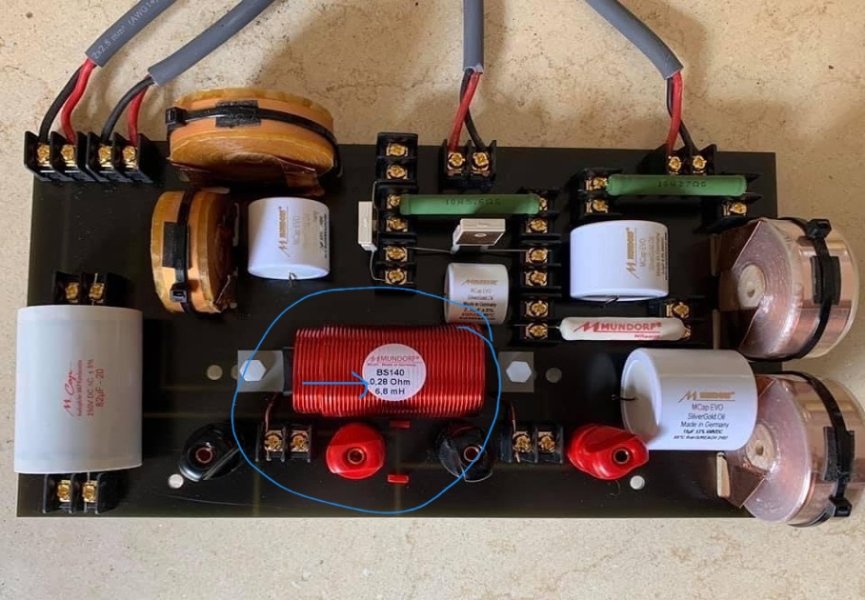
If you want to continue using the PAP Trio with a passive crossover. You can improve the control of the tube amplifier over the woofer. You have to change the DC resistance of the coil in front of the woofer.
If you lower the value, the following happens: the damping factor of the amplifier improves. You gain some efficiency 0.5-1.0dB but it will sound more precise because you reduce the overall qts value. The lower limit frequency fs -3db becomes higher.
If you increase the ohm value, the speaker plays lower fs point is lower but lost controll over the woofer.
Marked blue20251222_133817.jpg

Maybe such coils, but thy are huge&heavy
There are a few adjustment screws to get the ideal approach;)
 
Last edited:
If you want to continue using the PAP Trio with a passive crossover. You can improve the control of the tube amplifier over the woofer. You have to change the DC resistance of the coil in front of the woofer.
If you lower the value, the following happens: the damping factor of the amplifier improves. You gain some efficiency 0.5-1.0dB but it will sound more precise because you reduce the overall qts value. The lower limit frequency fs -3db becomes higher.
If you increase the ohm value, the speaker plays lower fs point is lower but lost controll over the woofer.
Marked blueView attachment 163444

Maybe such coils, but thy are huge&heavy
There are a few adjustment screws to get the ideal approach;)
I have a big air core their now. I think 14awg and fairy close spec to stock. I got it a while back. I forget where and what it is.

@Ron Resnick
What is woofer cook?
 
  • Like
Reactions: morricab
I tried using the active crossover to level match the amp for the woofers to the mid and high amplifier. I defeated the active crossover. The active only adjusted the gain. I used the stock passive crossover to adjust the low pass filtration. The sound is definitely more grainy. There is now a notable hash. As active only, and the woofers in series for 16 ohms, the sound is more clear, less hash. Through the passive in parallel mode for 4 ohms, the sound is grainy, but, it has more body and a sense of umph. Not necessarily more dynamic. Just more weight and body that is moving.
I am not sure if this is the 16 ohm vs 4 ohms. Or cabling. The cables change when in series.
When talking about tube amps the impedance is important.

Your output transformer can lose as much as an octave of low frequency bandwidth by using the 4 Ohm taps instead of higher taps. The 16 Ohm tap (if you have one) is more efficient! So if you can wire the woofers for 16 Ohms you should get better bass. But there are a few moving parts here! My point is that if you can sort a way to use the 16 Ohm tap and get the body and weight (which should be possible since the amp will be lower distortion driving 16 Ohms) you should have the best of both worlds.
I have a big air core their now. I think 14awg and fairy close spec to stock. I got it a while back. I forget where and what it is.

@Ron Resnick
What is woofer cook?
Air coil chokes have a higher DC resistance. Since it blocks highs getting to the woofer, it is also lowering the damping factor the amp can express to the woofer. You might consider a ferrite core device. And of course it will be a different value in a 16 Ohm crossover as opposed to one designed for 4 Ohms!
 

About us

  • What’s Best Forum is THE forum for high end audio, product reviews, advice and sharing experiences on the best of everything else. This is THE place where audiophiles and audio companies discuss vintage, contemporary and new audio products, music servers, music streamers, computer audio, digital-to-analog converters, turntables, phono stages, cartridges, reel-to-reel tape machines, speakers, headphones and tube and solid-state amplification. Founded in 2010 What’s Best Forum invites intelligent and courteous people of all interests and backgrounds to describe and discuss the best of everything. From beginners to life-long hobbyists to industry professionals, we enjoy learning about new things and meeting new people, and participating in spirited debates.

Quick Navigation

User Menu

Steve Williams
Site Founder | Site Owner | Administrator
Ron Resnick
Site Owner | Administrator
Julian (The Fixer)
Website Build | Marketing Managersing