“Physicality” in sound: my novel theory of its basis.

Good explanation for the speakers, but what about the effect from electronics? Surely you have heard some electronics giving more physicality and presence than others? You can emasculate even them most physical of speakers with poor electronics choice.

I'm not sure how far back up the signal chain I have relevant and useful observations, let alone (hopefully plausible) explanations to go along with them.

A disproportionate number of systems that (to my ears, and with eyes closed) created a convincing impression of being in the physical presence of actual musicians used tube amplifiers. Disclaimer - I'm a dealer for an OTL tube amplifier manufacturer (Atma-Sphere), and have been for about twenty-five years.
 
  • Like
Reactions: morricab and tima
The tone is what tells me that an instrument is a violin or a viola. It is not the 3D image in my mind's eye from listening to my system. I certainly agree that the instrument is placed in space relative to other instruments on the same stage, and that is left/right/ front/back, and often the height of the violinist, standing or sitting. The energy and scale is simply too big during a live concert to same definitively that the violin is 23" long. The live experience is just not that precise. Yes, the impression from a good system is of physical instruments and people performing in space.
Yes, of course it’s the tone that tells you the instrument, no one was suggesting otherwise. The reality of you seemingly not being able to get a 3D image from your system is another matter and, IMO, something your system does not do optimally because it is reproducing recordings and not channeling the Berlin Philharmonic directly into your room from a mid-hall seating position.
A good reproduction of a closely miked violin will have the tone, detail, dynamics AND dimension/physicality of the recorded instrument.
 
  • Like
Reactions: Rexp
Hello Vinicius,

Thank you for this excellent post! I love this kind of think piece!

I have often said that I believe that horn speakers doing a wonderful and convincing job of producing brass instruments, for example, because horns move air in a way that is consonant with the way those instruments themselves move air.

How do you explain the sonic physicality of the MBL 101E Mk. II and X-Treme loudspeakers?

Specious as usual. For our readers not conversant with the English language, the word does not refer to the 3d space Ron is not getting
 
  • Like
Reactions: tima
How is a human voice, which you use as your reference, fundamentally different from a horn? You have narrow constriction in the... throat that progressively opens to the ...mouth. Funny how horns use the same terminology...
Not speaking for @Ron Resnick - but for myself… it was somewhere between conception and shortly after birth where we are exposed to the human voice.
We do not use horns as a form of communication except for the heralding of the angels, whereas the voice is used ubiquitously.
It should be one of the more/most well understood sounds that we train ourselves to listen to.
 
'Specious' -- I like that word.

I wonder what speakers make sound consonant with the way a piano makes sound? Or an oboe?

Yeah need a whole suite of speakers in different sizes and shapes to recreate each instrument
 
Not speaking for @Ron Resnick - but for myself… it was somewhere between conception and shortly after birth where we are exposed to the human voice.
We do not use horns as a form of communication except for the heralding of the angels, whereas the voice is used ubiquitously.
It should be one of the more/most well understood sounds that we train ourselves to listen to.
My point is that the human voice is largely an organic horn. How else do trained opera singers project their voices across large halls without amplification? An Opera singers project can hit 130dB…show me an instrument that isn’t a horn that gets that loud.
 
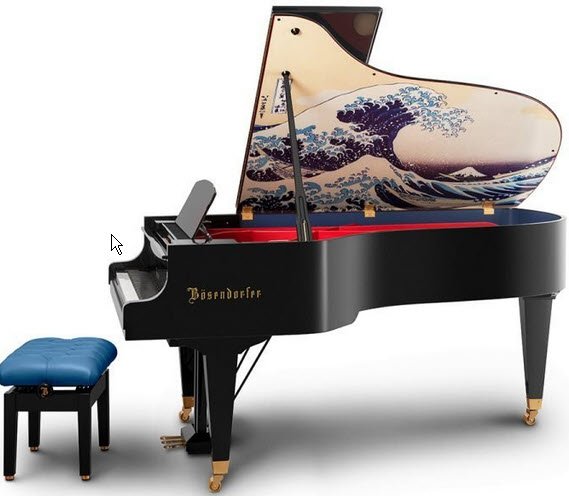
View attachment 163132
Bösendorfer Great Wave off Kanagawa Grand Piano

130dB is the pain threshold -- not advised.
First of all, where do you find the specs for how loud this piano play? I found this:
  • Fortissimo (FF): Can reach 100 dB or more in a small space, which is loud enough to risk hearing damage after about 15 minutes.
They will hit 130dB...at the strings but no one listens with their head inside the piano. A trumpet can hit 150dB at the bell, but no one sensibly does that either...at least on purpose. The real world levels for the piano are not the same as for an operatic voice...we both know this...especially when you compare the physical size differences...it takes a HUGE piano to produce sound levels even close to a compact voice. Kind of like a horn loaded woofer replacing a whole wall of conventional direct radiating woofers.

Second, the level achieved by the human voice was not really the point, the point is that it is essentially an organic horn and this is why it can have such high dynamic range.

Third, it is therefore wrong to assume that horn speakers would only be performing most accurately with horn instruments and not with voice, given that a voice is essentially a horn loaded organic instrument.
 
A good reproduction of a closely miked violin will have the tone, detail, dynamics AND dimension/physicality of the recorded instrument.

Brad, could you clarify something about this statement? When you write “dimension/physicality” like this, are you suggesting that dimension and physicality are somehow interchangeable or equivalent sonic attributes? I think of them as distinct characteristics.

My system does in fact convey a sense of dimension, though I prefer to think of it as relative scale. Various recordings do present different sized impressions. I can clearly distinguish for instance the relative scale of say Peter Schrier singing Winterreise in front of a piano and someone singing in the middle of the choir in Cantato Domino. Or a timpani in the back of a stage versus Jim Keltner’s solo drum kit large and up close in Sheffield’s famous track, or the violin smaller and to the left of the cello in Brahm’s concerto. And that sonic information from the recordings presented by my system does encourage images in my imagination formed from memories of live experiences. So it does all come together into something believable and convincing, because of both the relative scale and also the sense of physicality from mass and impact presented in the front of the listening room. For me, it just does not seem as literal an image as what some others seem to describe experiencing from some systems.

I think there are components and set up techniques that can accentuate this imaging effect in hifi. Some prefer this kind of presentation, and that is fine. As Fransisco writes, there are also engineering techniques in the recordings that can enhance this effect, all in an attempt to recreate the visual sense from the live concert in the listening room, if I understand correctly. My point is that this differs from what I actually hear in the concert hall. These different perceptions and goals are what make this hobby so fascinating and they explain in part why there are so many different types of systems and system presentations.

 
Brad, could you clarify something about this statement? When you write “dimension/physicality” like this, are you suggesting that dimension and physicality are somehow interchangeable or equivalent sonic attributes? I think of them as distinct characteristics.

My system does in fact convey a sense of dimension, though I prefer to think of it as relative scale. Various recordings do present different sized impressions. I can clearly distinguish for instance the relative scale of say Peter Schrier singing Winterreise in front of a piano and someone singing in the middle of the choir in Cantato Domino. Or a timpani in the back of a stage versus Jim Keltner’s solo drum kit large and up close in Sheffield’s famous track, or the violin smaller and to the left of the cello in Brahm’s concerto. And that sonic information from the recordings presented by my system does encourage images in my imagination formed from memories of live experiences. So it does all come together into something believable and convincing, because of both the relative scale and also the sense of physicality from mass and impact presented in the front of the listening room. For me, it just does not seem as literal an image as what some others seem to describe experiencing from some systems.

I think there are components and set up techniques that can accentuate this imaging effect in hifi. Some prefer this kind of presentation, and that is fine. As Fransisco writes, there are also engineering techniques in the recordings that can enhance this effect, all in an attempt to recreate the visual sense from the live concert in the listening room, if I understand correctly. My point is that this differs from what I actually hear in the concert hall. These different perceptions and goals are what make this hobby so fascinating and they explain in part why there are so many different types of systems and system presentations.

Hi Peter,
No, I don't consider physicality and dimensionality interchangeable but they are related. I have heard systems do very good dimensionality but many sound rather ethereal rather than solid and physical. I have also heard systems that sound very physical and solid but they don't resolve space that well. So, no, to me they are not interchangeable and very few systems I have heard get both things together but when they do it sounds more realistic.

It might differ from what you hear in a music hall but that is because it is not recorded as if you are in a concert hall. So, if your system is making something that is recorded wrongly to have a live hall sound, then that is also not really right. However, if you want that with everything then that's also fine.

To get what you have in a concert hall even remotely at home, the recording has to be made in a way to facilitate that or it will just not really give you that perception.
 

About us

  • What’s Best Forum is THE forum for high end audio, product reviews, advice and sharing experiences on the best of everything else. This is THE place where audiophiles and audio companies discuss vintage, contemporary and new audio products, music servers, music streamers, computer audio, digital-to-analog converters, turntables, phono stages, cartridges, reel-to-reel tape machines, speakers, headphones and tube and solid-state amplification. Founded in 2010 What’s Best Forum invites intelligent and courteous people of all interests and backgrounds to describe and discuss the best of everything. From beginners to life-long hobbyists to industry professionals, we enjoy learning about new things and meeting new people, and participating in spirited debates.

Quick Navigation

User Menu

Steve Williams
Site Founder | Site Owner | Administrator
Ron Resnick
Site Owner | Administrator
Julian (The Fixer)
Website Build | Marketing Managersing