


I thought it should have been obvious to micro why industry amp manufacturers tie up with different speakers and vice versa, but he seems to be twisting it for gaining foothold in forum debate with Peter.I don't think that is an endorsement. If you look at what Vladimir used in his big system rooms at CES and other venues, the ancillaries tend to be very expensive and generally thought of as representing quality -- at least in the press -- regardless of critique otherwise. For a while he did show with Wilson speakers, sometimes his own pair of Wilson Audio Maxx3. Toward the end of his CES shows he used the Kharma Enigma Veyron EV2, the Kharma Exquisite Midi Grand and the Verity Audio Lohengrin II S. He did frequently show with the TechDAS AF 1 and sometimes with an EMT 927.
Think of them more as expensive props that fill out a system for the photographs. Posibly on loan.













“Physicality” in sound: my novel theory of its basis.
- Thread starter Vinicius297
- Start date
You are using an out of date browser. It may not display this or other websites correctly.
You should upgrade or use an alternative browser.
You should upgrade or use an alternative browser.
I don't think that is an endorsement. If you look at what Vladimir used in his big system rooms at CES and other venues, the ancillaries tend to be very expensive and generally thought of as representing quality -- at least in the press -- regardless of critique otherwise. For a while he did show with Wilson speakers, sometimes his own pair of Wilson Audio Maxx3. Toward the end of his CES shows he used the Kharma Enigma Veyron EV2, the Kharma Exquisite Midi Grand and the Verity Audio Lohengrin II S. He did frequently show with the TechDAS AF 1 and sometimes with an EMT 927.
Think of them more as expensive props that fill out a system for the photographs. Posibly on loan.
Well, considering Wilson we have testimony of Vladimir Lamm about Dave Wilson and Wilson Audio speakers, and in an italian review available since long in the Lamm site, the reviewer, Giulio Salvioni, specifically refers to Vladimir Lamm Wilson XLF's in his listening room, as well as to his imposing turntable, a prototype that Vladimir built him self.
Curious that, in general, audio manufacturer interviews to european audio magazines have more information that those to the US magazines ...
I don't think that is an endorsement. If you look at what Vladimir used in his big system rooms at CES and other venues, the ancillaries tend to be very expensive and generally thought of as representing quality -- at least in the press -- regardless of critique otherwise. (...)
I was addressing a current picture publicized by Lamm Industries, not show associations. No need to diverge - and surely speculation is free in WBF. I would prefer comments based on facts.
3d representation and physicality are not mutually exclusive... I am not sure why you keep presenting it that way...Agreed. If that information was captured during the recording process and put on the medium, it’s a matter of extracting the information and presenting it in the room through the system. I don’t think it’s just a speaker thing. It depends on the whole system, and I agree with you that it starts at the source being able to extract the information that’s on the recording, and then not having the system corrupt that information as it presents it to the listener in the room.
To me, it all comes down to the the degree of clarity in the presentation and the amount of energy that gets launched into the room. This is what I take away from live music.
The other night I went to listen to a piano violin and cello trio, playing Mendelsohn and solo piano playing Beethoven and Rachmaninoff. The energy from 20 feet away was unbelievable. I felt it through my body. The sound was huge and clear with beautiful rich tone. And it was incredibly immediate. It was not palpable in the sense of a holographic three-dimensional image that is so often described in these discussions. There was simply localization of the three instruments playing near each other in space. I want my system to present that experience, not 3-D images presented against a black background, nor flat and two dimensional. And I don’t want systems to create a precise virtual representation of musicians on a stage because that is not what I experienced the other night. What I did experience was the physicality of live music performed in front of me and sound filling the space around me. When a recording captures that essence and the system can present it, we are getting closer to the natural sound of live music. The best systems, regardless of price or type, can do this.
I do not think it is as simple as speaker typology. It is about very carefully selected gear set up in a particular way in a room. For some, this is the target and why we speak in terms of the listening experience rather than just the sound.
I disagree. I have experienced some gear that brings physicality to basically every system it is inserted into and some that never brings it regardless of what other gear they are paired with.IMO physical presence results from frequency balance, distortions purposely added to the signal, speaker dispersion and surely room characteristics.
Merging these four characteristics needs expertise, or sometime luck. It is not associated with a particular type of gear, but a system property that unfortunately also includes the recording. Optimizing the system just for physical presence with just a couple of favorite recordings risks jeopardizing others. It is an extremely individual characteristic - I have seen experienced people having extreme opinions on it in the same system.
I think you mean a syncophant.Oh, and I did indeed have a long and fascinating discussion with Grok (XAi). In fact, it urged me to join this Forum and post my theory. If you aren’t using Grok or something similar, you’re missing out on a sounding-board better than any human you know.
How is a human voice, which you use as your reference, fundamentally different from a horn? You have narrow constriction in the... throat that progressively opens to the ...mouth. Funny how horns use the same terminology...Hello Vinicius,
Thank you for this excellent post! I love this kind of think piece!
I have often said that I believe that horn speakers doing a wonderful and convincing job of producing brass instruments, for example, because horns move air in a way that is consonant with the way those instruments themselves move air.
How do you explain the sonic physicality of the MBL 101E Mk. II and X-Treme loudspeakers?
Good explanation for the speakers, but what about the effect from electronics? Surely you have heard some electronics giving more physicality and presence than others? You can emasculate even them most physical of speakers with poor electronics choice.I agree with the correlation you have observed. But I think there might be a different causation than the one you have proposed.
At the risk of oversimplifying, I believe three conditions must be met in order for the perception of "physicality" to occur:
1. The direct sound should sound like the direct sound of real instruments, or close enough.
2. The reflections should sound like the reflections of real instruments, or close enough.
3. There should be a sufficient time gap in between the direct sound and the strong onset of reflections so that the ear/brain system can process them separately. If the reflections arrive too soon, the ear/brain system cannot separate them sufficiently and we do not get the sense of "physicality" that you describe. According to my understanding of psychoacoustician David Griesinger, about ten milliseconds (the time it takes for sound to travel about 11 feet) is sufficient.
Horns often do a better job with the sound quality of the reflection field than most speakers, and their relatively narrow radiation patterns can result in an unusually long time delay before the strong onset of reflections. But it is possible to meet the above three criteria with conventional systems, with dipoles, and with omnis... imo it's just easier (and less demanding of room size and/or room treatment) with horns.
You might find David Griesinger to be a valuable source of insight. David specializes in concert hall acoustics and psychoacoustics, and imo the general principles he decribes are applicable to home audio, even though our reflection path lengths are much shorter. Here is a lecture in which he talks about "proximity" in the context of concert halls, and I think he's referring to what we would call "physicality" or "palpability" or "presence" in the context of home audio.
The link is cued up to where he does a demonstration using a sound clip that has been processed to include only the direct sound; then the direct sound plus the first reflection; then the direct sound and late reflections but excluding the first reflection; and finally all at once. Headphones or earbuds recommended:
Imo the third one ("all but no first reflection") @ 14:20 is what sounds best, combining both proximity and envelopment. While the reflection path lengths are shorter for home audio, imo the general principles are applicable, and these clips illustrate the desirability of having that time gap between the direct sound and the strong onset of reflections.
David also talks about the importance of preserving the phase alignment of the harmonics above 1 kHz or so, and this is a more complicated topic in a home audio context but again it is an area where horn systems often do pretty well.
I disagree. I have experienced some gear that brings physicality to basically every system it is inserted into and some that never brings it regardless of what other gear they are paired with.
Ok, please tell us about exact models that bring such physicality to every system and those who kill it.
(...) It is an extremely individual characteristic - I have seen experienced people having extreme opinions on it in the same system.
Nice you disagree - I was expecting disagreement on this subject!

3d representation and physicality are not mutually exclusive... I am not sure why you keep presenting it that way...
Brad, I have heard 3D representation and physicality from audio systems presented in enhanced holographic, outlined or etched, palpable images. I have not heard that same effect from live music. What I have heard from live music is physicality in the form of energy rapidly expanding from the locations of instruments on a stage in front of me. Images, if one can even think of it as such, are ill defined. Image of what exactly? I don't see the musician when hearing her play her violin on a recording. I hear the sound of the violin at a certain scale and location relative to other instruments, and I hear them in the space, within the ambiance of the hall. Our eyes provide those images for us when we listen to live music, not our ears, and not the sound. Clearly defined images from an audio system seem artificial to me, something man made, an enhanced sense of reality.
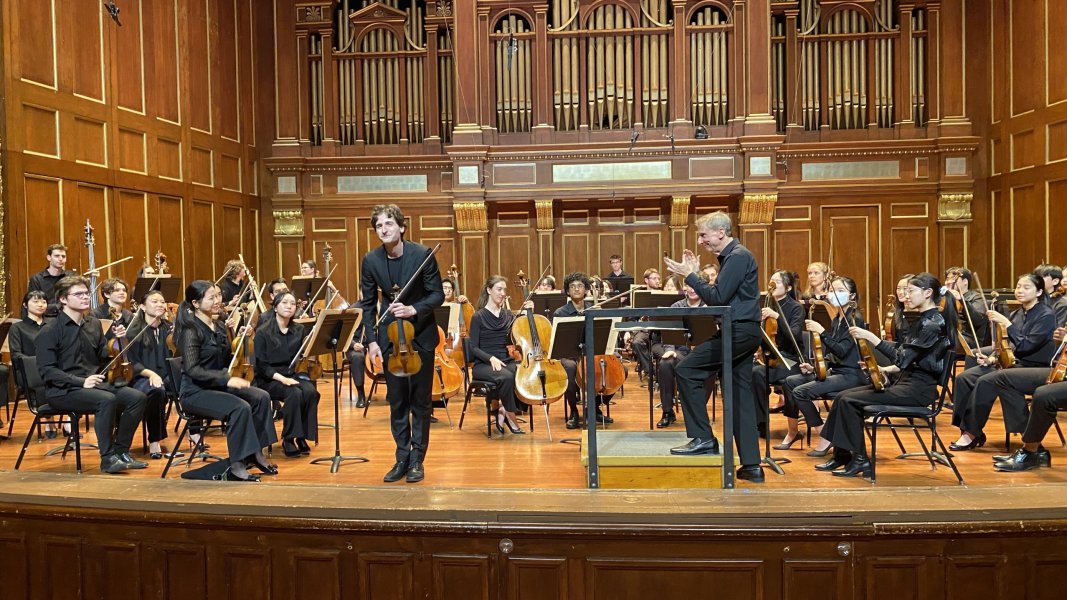
Here is a photograph of Joshua Brown bowing after a brilliant performance of Beethoven's Violin Concerto last week at the New England Conservatory's Jordan Hall. Al M. and I attended the concert sitting in the fifth row center. Al and I actually discussed the subject of physicality and imaging on our drive home after the concert. I heard Brown's violin in front and in the center of the other strings. I heard the cellos behind him. The few wind instruments were behind the strings, and the timpani was behind the woodwinds. There were no real images. It was easy to locate the instruments relative to each other and within the stage based on sound and reflections. I could also perceive the sense of scale, but again, there were no 3D, holographic, palpable images of musicians arranged up on a stage as depicted in the photograph. There was intense physicality though, and relative location and scale in space. Some audio systems present this information very differently than the way I experience it in the actual hall.
Good explanation for the speakers, but what about the effect from electronics? Surely you have heard some electronics giving more physicality and presence than others? You can emasculate even them most physical of speakers with poor electronics choice.
DDK refers to this as "mass". It is clearly more evident from some cartridges (Neumann DST versus vdH Colibri) and turntables (Micro Seiki SX 8000 II versus Technics SP10 II) than from others. Physicality is not just a speaker thing. It is about the whole system carefully chosen and set up well in a given room.
Of course you don't 'see' the musician... They are not what's making the sound! The violin though will have dimensionality and physicality if reproduced correctly... This will be perceived in 3 dimensions as the sense of the instruments volume and even dir3ction it's facing can sometimes be determined.Brad, I have heard 3D representation and physicality from audio systems presented in enhanced holographic, outlined or etched, palpable images. I have not heard that same effect from live music. What I have heard from live music is physicality in the form of energy rapidly expanding from the locations of instruments on a stage in front of me. Images, if one can even think of it as such, are ill defined. Image of what exactly? I don't see the musician when hearing her play her violin on a recording. I hear the sound of the violin at a certain scale and location relative to other instruments, and I hear them in the space, within the ambiance of the hall. Our eyes provide those images for us when we listen to live music, not our ears, and not the sound. Clearly defined images from an audio system seem artificial to me, something man made, an enhanced sense of reality.
Here is a photograph of Joshua Brown bowing after a brilliant performance of Beethoven's Violin Concerto last week at the New England Conservatory's Jordan Hall. Al M. and I attended the concert sitting in the fifth row center. Al and I actually discussed the subject of physicality and imaging on our drive home after the concert. I heard Brown's violin in front and in the center of the other strings. I heard the cellos behind him. The few wind instruments were behind the strings, and the timpani was behind the woodwinds. There were no real images. It was easy to locate the instruments relative to each other and within the stage based on sound and reflections. I could also perceive the sense of scale, but again, there were no 3D, holographic, palpable images of musicians arranged up on a stage as depicted in the photograph. There was intense physicality though, and relative location and scale in space. Some audio systems present this information very differently than the way I experience it in the actual hall.
View attachment 163113
It really depends where you sit in hall as to how much individual instruments you can hear and their dimensionality.... If you sit as close as ,many recordings are miked then you will perceived sound much as it is heard on really good recordings. Imo, it is wrong for a system to always have 'mid-hall' perspective.Brad, I have heard 3D representation and physicality from audio systems presented in enhanced holographic, outlined or etched, palpable images. I have not heard that same effect from live music. What I have heard from live music is physicality in the form of energy rapidly expanding from the locations of instruments on a stage in front of me. Images, if one can even think of it as such, are ill defined. Image of what exactly? I don't see the musician when hearing her play her violin on a recording. I hear the sound of the violin at a certain scale and location relative to other instruments, and I hear them in the space, within the ambiance of the hall. Our eyes provide those images for us when we listen to live music, not our ears, and not the sound. Clearly defined images from an audio system seem artificial to me, something man made, an enhanced sense of reality.
Here is a photograph of Joshua Brown bowing after a brilliant performance of Beethoven's Violin Concerto last week at the New England Conservatory's Jordan Hall. Al M. and I attended the concert sitting in the fifth row center. Al and I actually discussed the subject of physicality and imaging on our drive home after the concert. I heard Brown's violin in front and in the center of the other strings. I heard the cellos behind him. The few wind instruments were behind the strings, and the timpani was behind the woodwinds. There were no real images. It was easy to locate the instruments relative to each other and within the stage based on sound and reflections. I could also perceive the sense of scale, but again, there were no 3D, holographic, palpable images of musicians arranged up on a stage as depicted in the photograph. There was intense physicality though, and relative location and scale in space. Some audio systems present this information very differently than the way I experience it in the actual hall.
View attachment 163113
Of course you don't 'see' the musician... They are not what's making the sound! The violin though will have dimensionality and physicality if reproduced correctly... This will be perceived in 3 dimensions as the sense of the instruments volume and even dir3ction it's facing can sometimes be determined.
It really depends where you sit in hall as to how much individual instruments you can hear and their dimensionality.... If you sit as close as ,many recordings are miked then you will perceived sound much as it is heard on really good recordings. Imo, it is wrong for a system to always have 'mid-hall' perspective.
The tone is what tells me that an instrument is a violin or a viola. It is not the 3D image in my mind's eye from listening to my system. I certainly agree that the instrument is placed in space relative to other instruments on the same stage, and that is left/right/ front/back, and often the height of the violinist, standing or sitting. The energy and scale is simply too big during a live concert to same definitively that the violin is 23" long. The live experience is just not that precise. Yes, the impression from a good system is of physical instruments and people performing in space.
(...) There were no real images. It was easy to locate the instruments relative to each other and within the stage based on sound and reflections. I could also perceive the sense of scale, but again, there were no 3D, holographic, palpable images of musicians arranged up on a stage as depicted in the photograph. (...)
View attachment 163113
Were you blindfolded during the concert? How did your brain manage to separate the audio visual experience from the sound experience?
Do you aim to evoke past real experiences in your system or just blindfolded experiences?
Quoting one of the objectives of Decca engineers:
- Capturing Realism: The goal was to recreate the drama and atmosphere of a live performance in a way that compensated for the lack of visual elements, using early stereo technology effectively.
Were you blindfolded during the concert? How did your brain manage to separate the audio visual experience from the sound experience?
Do you aim to evoke past real experiences in your system or just blindfolded experiences?
Quoting one of the objectives of Decca engineers:
Keywords used to get it : Full Frequency Range Recording" (FFRR) and "Decca Panoramic Sound" standards.
- Capturing Realism: The goal was to recreate the drama and atmosphere of a live performance in a way that compensated for the lack of visual elements, using early stereo technology effectively.
Since I listened to a stereo system at home and I am not watching a TV concert, I closed my eyes at times during the concert to focus on the actual sound divorced from the visual. My descriptions above are based on what I heard not on what I saw. I don’t see the Orchestra in my living room.
Can you give us a clear verbal description of the images you somehow sense when listening to a recording of a violin concerto on your audio system?
Since I listened to a stereo system at home and I am not watching a TV concert, I closed my eyes at times during the concert to focus on the actual sound divorced from the visual.
Ok, IMO a non natural experience. I see your "natural" reference aims to create the facsimile of the sound scene. For me it is an artificial objective.
My descriptions above are based on what I heard not on what I saw. I don’t see the Orchestra in my living room.
Ok, I aim to feel like I was seeing it.
Can you give us a clear verbal description of the images you somehow sense when listening to a recording of a violin concerto on your audio system?
Surely the images I sense in my system are strongly influenced by my audio visual memories. The orchestral sections, the layering of the orchestra, the size of instruments. After I see a life performance of Savall, my listening room scene changes. Fortunately I keep the eyes open all the time.
Even seeing an youtube video changes how you perceive space and layering in our listening.
Ok, IMO a non natural experience. I see your "natural" reference aims to create the facsimile of the sound scene. For me it is an artificial objective.
Ok, I aim to feel like I was seeing it.
Surely the images I sense in my system are strongly influenced by my audio visual memories. The orchestral sections, the layering of the orchestra, the size of instruments. After I see a life performance of Savall, my listening room scene changes. Fortunately I keep the eyes open all the time.
Even seeing an youtube video changes how you perceive space and layering in our listening.
Yes, of course, I have memories of images from live concerts too, and they inform the virtual experience at home. I am not disputing any of that. What I’m trying to do is actually describe what I hear. That is why I asked you to describe the images you sense when listening to your system. It is curious to me that those who often feel most strongly about the importance of images created by an audio system do not actually describe what those images are. When pressed, they say those images are based on memory, and they are actually vague. I agree with that. Rarely do I ever see a description of a 3-D holographic outlined piano or violin against a black background. I often read people saying their systems produce 3-D and holographic and palpable images but nothing specifically about what they are describing. I actually wonder if people really think they experience that at home or just trying to argue or describe some hi-fi effect to promote some new component or cable?
Last edited:

I was addressing a current picture publicized by Lamm Industries, not show associations. No need to diverge - and surely speculation is free in WBF. I would prefer comments based on facts.
You asked for an explanation for a picture you saw. I have access to information not on the Internet and unavailable to you. You did not understand my response. You are fortunate you got one.
Yes, the impression from a good system is of physical instruments and people performing in space.
Only because you associate to your own concert hall experience or from movies or pictures of performers and instruments. Reality informs the reproduction listening experience. Remove that from the stereo room and what is left is ... not a part of what was recorded.

Similar threads

- Replies
- 20
- Views
- 1K
- Replies
- 39
- Views
- 6K

 | Steve Williams Site Founder | Site Owner | Administrator |  | Ron Resnick Site Owner | Administrator |  | Julian (The Fixer) Website Build | Marketing Managersing |