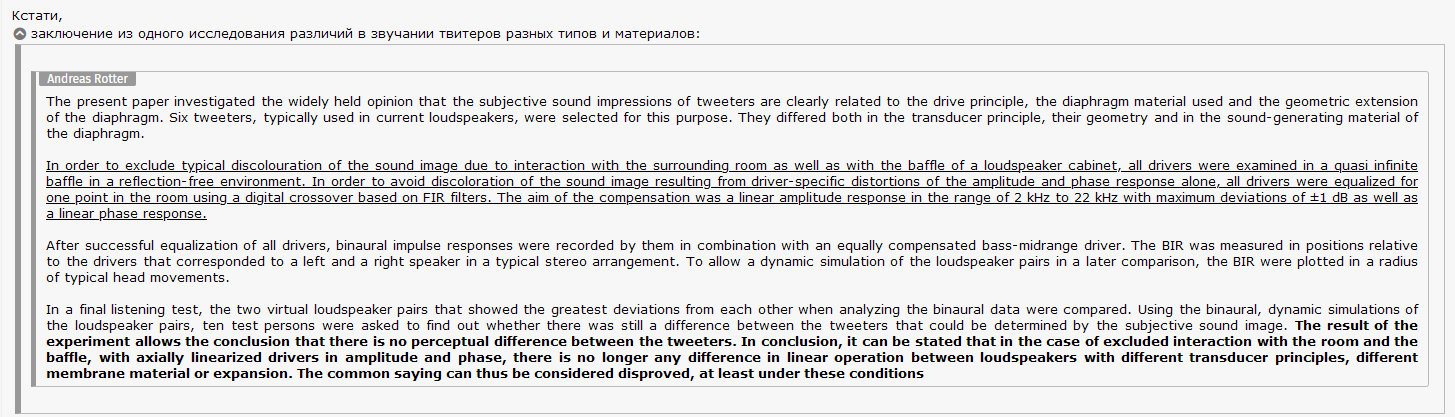
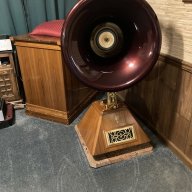
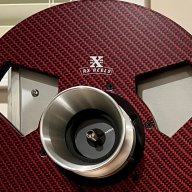
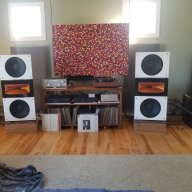
Some speakers use exotic drivers and some use "simple" drivers
The exotic ones don't always sound better
But I must admit Beryllium tweeters sound the best to me.
So I'm not so sure how much impact the driver material itself has on the sound quality .
What are your thoughts on the subject ?
Because You Need To Know The Truth About Pistonic Driver Cones … Bringing paper cones to a super-speaker today is like bringing a horse and buggy to a Formula One race. Materials...
There is an audible benefit of using the same materials for all drivers (except subs). My two favorite speakers do this - the Vandersteen Model 7 and the classic Zellatons
Some speakers use exotic drivers and some use "simple" drivers
The exotic ones don't always sound better
But I must admit Beryllium tweeters sound the best to me.
So I'm not so sure how much impact the driver material itself has on the sound quality .
What are your thoughts on the subject ?
I would say it all matters ( in the case of a cone: cone material, surround, spider, magnet type and size, voice coil design etc. ) but that doesn't mean that different designers wont have different preferences as they tackle all the compromises towards their goals.
Because You Need To Know The Truth About Pistonic Driver Cones … Bringing paper cones to a super-speaker today is like bringing a horse and buggy to a Formula One race. Materials...
There is an audible benefit of using the same materials for all drivers (except subs). My two favorite speakers do this - the Vandersteen Model 7 and the classic Zellatons
The midrange of my DIY horn speakers is an AER BD3 in an Oris 150 horn. The AER driver has a paper cone. I might deluding myself, but I find the SQ it produces to be very good, fast, coherent, tuneful, with great transients, etc. I have tremendous respect for Mr. Vandersteen, but I feel that in this particular case he is painting with too broad a brush when he condemns all paper cone drivers.
With Dynamic drivers treated paper is still the best for midrange ...
Vandersteen is way off IMO as many of these wonder material drivers are so bad when operated out of bandwidth , that magic wonder xovers are needed making for clean and clear but very Hifi sounding products ..!
With Dynamic drivers treated paper is still the best for midrange ...
Vandersteen is way off IMO as many of these wonder material drivers are so bad when operated out of bandwidth , that magic wonder xovers are needed making for clean and clear but very Hifi sounding products ..!
Any driver materials that absorbs moisture or changes in temp has inherent issues
so while I can’t say I have a fav in a given type materials I think over all cross overs used has a big effect as well.
I have no idea if I like paper or composites. I have never heard a speaker with either material to swap back and forth. To hear one or the other in a different box with different crossover, different amp, different toom. Pretty hard to draw any real conclusions.
I do have PAP trio 10 and 15. The 10 woofers/midrange are a composit. I like the 15 a whole lot more. But there is a large size difference.
I’m audio many look to new age materials in the hope to attract buyers on new tech merit
be it better or not. alum woofers as an example some say they ring I’ve never measured
but stiffness and lightness does have merit
they all need to move air right but air is very variable
In density so what is best ?
to me room first then speakers but it can be done opposite either way the amp must drive them well to given loudness. This makes me feel materials used has a large effect on room size and seating