

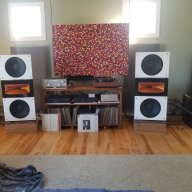
Sounds like I need one to measure against.I see them as the benchmark. If you can beat one with something else you're doing very, very well!





Sounds like I need one to measure against.I see them as the benchmark. If you can beat one with something else you're doing very, very well!
Sounds like I need one to measure against.
Stability of the AC line Voltage and distortion of the AC waveform while under load.What would you exactly measure?
As well as harmonic noise, max current delivery. I would love to get a spectrograph and look at the fundimental as well as harmonics from the inverter. They seem to be about $2500 for a basic one.Stability of the AC line Voltage and distortion of the AC waveform while under load.
'Harmonic noise' is the distortion I mentioned. 'Max current delivery' is how well the unit holds up and is able to maintain the output Voltage while under load.As well as harmonic noise, max current delivery.
As well as harmonic noise, max current delivery. I would love to get a spectrograph and look at the fundimental as well as harmonics from the inverter. They seem to be about $2500 for a basic one.
Measurements also include listening. Taking it to other locations and comparing to other power supplies at other homes. I have 2 reviewers, and 3 other serious audiophile local, with quality systems to listen at. Problem is, most people would rather spend $50,000 for a Stromtank. If they have the $15,000 to get one built up, they have the big money.
And for the most part, if you have a big system, I still really like using utility power properly. Maybe a few point source filters. Or a large wall mount. Amir is an anomaly with the issues he is having. But come on. Hes in Iran. Who knows whats gping on with electrical infrastructure there. My perception is, the biggest danger to audiophiles is the current climate of electrify everything. The electrical grids are straining and Brown outs are all to often. A Brown out or drop in voltage to say 90 volts or less is the real danger for a stereo.
Remind me how to get a one for not a lot?I have told you how to get a top one almost for free ...
IMO absolutely irrelevant, unless done in very strict and controlled conditions, that need a lot of time and serious work. I would not expect reviewers and local friends to be good partners for such job. In order to be considered a measurement listening needs independent valid statistics.
I do not know but Kevin uses lead acid batteryThe Exeltech inverters produce less than 1% thd. Whether the difference is necessarily audible, I don’t know.
And wouldn’t you want a modern LiFEPO battery over a lead acid design?
As far as I can tell from a search, the living voice battery supply goes back all the way to 2004! Battery technology has come a long way since then.I do not know but Kevin uses lead acid battery
The interior shots show a lot of chokes, so I imagine the cap is used as part of a filter. Being a passive unit, I would not call it a 'conditioner' since I have a pretty strict definition of that term (that most of 'high end audio' seems to not use). The 90A thing is mysterious to me: how would you measure that and what exactly does it mean? I was not able to tell from their website.Ralph, I have a question about Audioquest niagara 5000, they use capacitor for increasing transient current to load (they claim 90A), Do you know about the schematic circuit of these capacitors?
To test ampacity, arn't you using something as simple as a Sure Test that injects some current into the line and calculates the ability of the circuit to pass current. A #10 branch wire usually reads over 500 Amps. A Torus RM20 about 270 Amps.The interior shots show a lot of chokes, so I imagine the cap is used as part of a filter. Being a passive unit, I would not call it a 'conditioner' since I have a pretty strict definition of that term (that most of 'high end audio' seems to not use). The 90A thing is mysterious to me: how would you measure that and what exactly does it mean? I was not able to tell from their website.
A filter might be a choke in series with the line to knock out higher frequencies. It can also be a choke and capacitor in series, placed in parallel to the signal path. Such a thing used on AC power would have to be robust! They may well not be able to block frequencies in the megahertz range and above, but honestly if that's a problem in your equipment, the equipment itself is at fault, not the AC power! Any audio circuit using tubes or transistor should have a thing called a 'stopping resistor' at the input of each amplifying device (tube or transistor) to prevent oscillation but also intrusion of radio frequencies into the circuit.What do you consider a filter Ralph? Don't caps and chokes smooth the waveform on the load side? Isnt that filtering? Don't they also blick noise in the mega and gigahertz range?
No. We're talking about a conditioner here, not the AC line itself. What you want to see is the output of the conditioner not show any Voltage drop as the current load is increased to its upper spec limit.To test ampacity, arn't you using something as simple as a Sure Test that injects some current into the line and calculates the ability of the circuit to pass current

Arn't those power strip like $15k. Do they have an MOV in it too?.In most homes the passive Furutech NCF distributors are the best sosolutior.
Arn't those power strip like $15k. Do they have an MOV in it too?.
Why would a power strip with a NCF duplex be a filter? That would be the same as saying, a ncf duplex in your wall is a filter. I do use a Furutech NCF Rhodium to my amps. I do like how it interacts with the metals on my power cords (gold). I have looked into stripping my RM20 of Hubbel and replacing them with Furutech. Voids warranty. And Torus might get angry with me. I don't want to damage that relationship. Too bad Furutech can't get a UL or CE certification. If they did, they could be used in other equipment.
IMO there are far too many gloried power strips with a slight amount of HF filtering in them masquerading as AC line conditioners.Arn't those power strip like $15k. Do they have an MOV in it too?.
Why would a power strip with a NCF duplex be a filter? That would be the same as saying, a ncf duplex in your wall is a filter. I do use a Furutech NCF Rhodium to my amps. I do like how it interacts with the metals on my power cords (gold). I have looked into stripping my RM20 of Hubbel and replacing them with Furutech. Voids warranty. And Torus might get angry with me. I don't want to damage that relationship. Too bad Furutech can't get a UL or CE certification. If they did, they could be used in other equipment.

 | Steve Williams Site Founder | Site Owner | Administrator |  | Ron Resnick Site Owner | Administrator |  | Julian (The Fixer) Website Build | Marketing Managersing |

