The vivaldi is already very quite on its power side, so very little to be gained obviously from splitting it into separate boxes.
The big gain I guess is on cross talk, and the mono dac's will certainly help that, and be in it's design,much quieter.
the Wadax dac chassis is complete dual mono with the digital control unit in between. needs 8 footers. then they have dual 45 pound outboard power supplies. the Wadax Ref server has a 90 pound outboard power supply.
until you A/B how power supplies and Akasa DC cables transform Wadax it's hard to imagine how it can boost performance. Wadax seemed quiet as tomb. but there is more to power supplies than just the perceived absence of noise. micro-dynamics, weight and ease all come from better power supplies.
and digital performance clearly gets transformed a great deal by advances in this area.
look at how much work Emile has done on the Taiko Olympus battery power supplies.
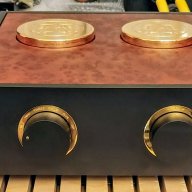
It’s an interesting aesthetic. The variation of the face plate designs is curious. Why just three rather than all four? A fourth small box with the major crease arched from top left to bottom right and minor crease starting in lower left corner seems missing. That would complete the four variations on the theme.
The top and bottom box face plates are the same variation, just different proportions.
The biggest issue with Vivaldi is the cable scheme connecting all the boxes. With customer supplied cables one could never get a fixed measure of its sonics.
With dCS supplied cabling between the Varese boxes(if I understand correctly), we now have a fixed data point to work with. Time will tell....
the Wadax dac chassis is complete dual mono with the digital control unit in between. needs 8 footers. then they have dual 45 pound outboard power supplies. the Wadax Ref server has a 90 pound outboard power supply.
until you A/B how power supplies and Akasa DC cables transform Wadax it's hard to imagine how it can boost performance. Wadax seemed quiet as tomb. but there is more to power supplies than just the perceived absence of noise. micro-dynamics, weight and ease all come from better power supplies.
and digital performance clearly gets transformed a great deal by advances in this area.
look at how much work Emile has done on the Taiko Olympus battery power supplies.
from my experiences over the last year there is no such thing as quiet enough. The reason I say this is becasue you don't know what you don't know is possible. The change is power supply cables, the change in how the units are connected to electricity, the cables that are used to connect to electricity , the power conditioner and power distributor used to connect it all together and then grounding the whole thing each take "quietness" to new unexperienced before places which deliver MORE.
What is More? More is an audio destination that is constantly evolving. I don't know what the dCS will do and what its capabilities will be so bring it on and maybe we can all learn someting more. It does look like it will require a lot of cables...
In past discussions with dCS, they told me the goal is not to just surpass the Vivaldi sonics but to be the industry benchmark for digital sources.
I am most curious to learn about the price (although likely above my pay grade) and how they evolved the Ring DAC technology.
I also wonder if the new Ring technology (or elements thereof) will later trickle down into either software for my Rossini Apex or a Rossini replacement (new board or entirely new product).
In past discussions with dCS, they told me the goal is not to just surpass the Vivaldi sonics but to be the industry benchmark for digital sources.
I am most curious to learn about the price (although likely above my pay grade) and how they evolved the Ring DAC technology.
I also wonder if the new Ring technology (or elements thereof) will later trickle down into either software for my Rossini Apex or a Rossini replacement (new board or entirely new product).
I am curious about trickle down too. I suspect it maybe awhile before they release anything for Vivaldi or Rossini. I am sure the price on the Verese will scare a few Vivaldi owners away...but they maybe willing to invest more in their Vivaldi platforms...ditto Rossini owners...
Alan Sircon at HI-FI + reports the cost figures are:
Varèse comprises a £20,000 User Interface, a £32,000 Master Clock and two Mono DACs (£90,000 per pair), all driven by a £75,000 Core unit (£217,000 for 5 boxes or close to $276,000 USD).
The article is here:
US Pricing and the ACTUS cables are included. The VARÈSE CD/SACD player will be available early 2025 which will need the I/O module. (I/O Module supports Rossini & Vivaldi Transport owners as well).
Best to all,
Bob
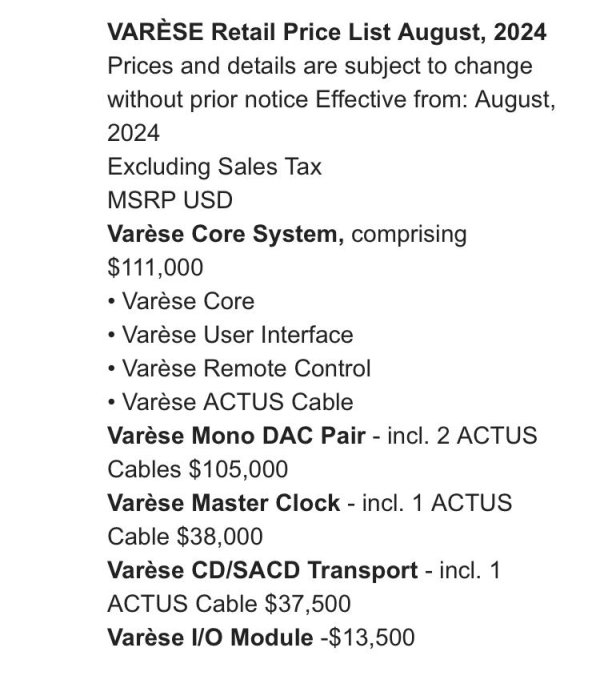
VARÈSE Retail Price List August, 2024
Prices and details are subject to change without prior notice Effective from: August, 2024
Excluding Sales Tax
MSRP USD Varèse Core System, comprising $111,000
• Varèse Core
• Varèse User Interface
• Varèse Remote Control
• Varèse ACTUS Cable Varèse Mono DAC Pair - incl. 2 ACTUS Cables $105,000 Varèse Master Clock - incl. 1 ACTUS Cable $38,000 Varèse CD/SACD Transport - incl. 1 ACTUS Cable $37,500 Varèse I/O Module -$13,500
i'm sure MSB (Sentinel) and Taiko (Olympus) and others with their new products, feel the same. how could you make any 'statement' product and not have that as the goal?
it's the bleeding edge of digital.....not a fixed place. and Wadax won't necessarily stand still either (fyi; i have zero info in that regard). Game On.
This is the right direction for DCS. The competition for their current offerings is crowded. Not better necessarily but it becomes a value decision. This elite tier is better for them.
I like many will watch and enjoy what I have. I’m wholly in the single box disc playback group and we are few.