

My dedicated audio room build - QuadDiffusor's Big Dig
- Thread starter QuadDiffuser
- Start date
You are using an out of date browser. It may not display this or other websites correctly.
You should upgrade or use an alternative browser.
You should upgrade or use an alternative browser.

This must be, without doubt, the craziest and most amazing build ever!
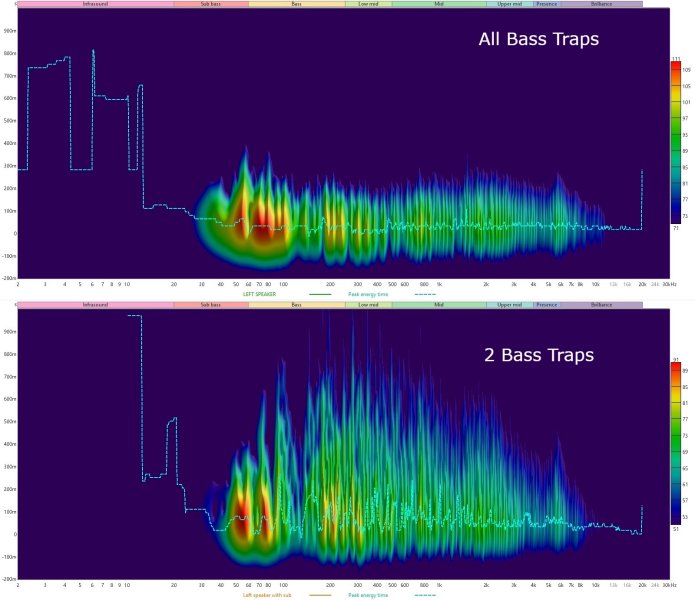
REW graphs of before/after (with/without) the "passive" VPR metal bass traps.
Note that measurement conditions are very different between the "after" (top graph) and the "before" (bottom graph).
The latest measurements are expected to improve substantially after 77 pcs. of QRDs are installed, the acoustic door fitted, and the PSI Audio AVAA active bass cancellation units (6 pcs.) are strategically placed in high bass pressure zones
TOP ("after")
1) peak bass amplitude reaches crazy loud levels of 111 dB - LOTS of acoustic energy is pumped out into the room to test its "limits", using the massive subwoofer and the omni-directional loudspeaker
2) 55 pieces of VPRs had been installed (2 different thicknesses of 1.5mm and 3.0mm, in 5 different sizes)
3) peak decay overshoot at 50-60Hz reaches 400ms
4) next highest decay overshoot at 80Hz reaches under 400ms
5) robust bass seen at sub-30Hz frequencies
6) decay peaks of the mid and high frequencies are all under 300ms
BOTTOM ("before")
1) peak bass amplitude is merely 91 dB
2) only 2 pieces of prototype VPRs were installed in the entire room; essentially the room "only" had a 4-layer gypsum wall system targeting 35Hz (room length nodes) and 50Hz (room width nodes)
3) overshoot at 50-60Hz were between 400-800ms
4) 80Hz overshoot reaches 650ms
5) effectively no sub-40Hz bass energy seen
6) decay peaks of the mid and high frequencies are as high as 1,000ms and are mostly above 700ms
Note that measurement conditions are very different between the "after" (top graph) and the "before" (bottom graph).
The latest measurements are expected to improve substantially after 77 pcs. of QRDs are installed, the acoustic door fitted, and the PSI Audio AVAA active bass cancellation units (6 pcs.) are strategically placed in high bass pressure zones
TOP ("after")
1) peak bass amplitude reaches crazy loud levels of 111 dB - LOTS of acoustic energy is pumped out into the room to test its "limits", using the massive subwoofer and the omni-directional loudspeaker
2) 55 pieces of VPRs had been installed (2 different thicknesses of 1.5mm and 3.0mm, in 5 different sizes)
3) peak decay overshoot at 50-60Hz reaches 400ms
4) next highest decay overshoot at 80Hz reaches under 400ms
5) robust bass seen at sub-30Hz frequencies
6) decay peaks of the mid and high frequencies are all under 300ms
BOTTOM ("before")
1) peak bass amplitude is merely 91 dB
2) only 2 pieces of prototype VPRs were installed in the entire room; essentially the room "only" had a 4-layer gypsum wall system targeting 35Hz (room length nodes) and 50Hz (room width nodes)
3) overshoot at 50-60Hz were between 400-800ms
4) 80Hz overshoot reaches 650ms
5) effectively no sub-40Hz bass energy seen
6) decay peaks of the mid and high frequencies are as high as 1,000ms and are mostly above 700ms
Last edited:

(...) 6) decay peaks of the mid and high frequencies are all under 300ms (...)
Great graphs - but aren't you afraid of he mid and high frequencies being overdamped after you add the RPG QRD panels? They are partially absorbers.
At what frequencies are the PSI Audio AVAA aiming at?
Microstrip,
Of course, as acoustic energy enters the wells of the P17 and P23 QRDs it becomes slightly attenuated. The relevant question is what happens afterwards, and how QRDs improve or subtract from the enjoyment of music psychoacoustically compared to untreated rooms in which domestic upholstery and furniture are typical fixtures (or unfortunately, too commonly seen - "dedicated" listening rooms whose wall surfaces are mostly tiled with textured ceramic, or merely wallpapered plaster board).
Would you rather have multiple sources of hard mirror-like high amplitude "billiard ball collision" reflections creating secondary indirect signals which confuse the ear/brain's localization of the primary music signal? "Audiophile" decorative wall panels whose narrow bandwidth do absolutely nothing in the bass but instead deliver colored frequency-selective (and directionally selective) notch-filters which suck out deep chasms of mid and high frequencies to unbalance the perceived acoustical space?
I'd much rather bathe in the cloud of wonderfully broadband (frequency-agnostic), diffusive but neutral and "live" sounding QRDs which deliver the illusion of physical listening room boundaries being expanded into the distance, helping the listener distinguish primary musical signals more distinctly from deleterious secondary reflections.
BTW, mine are not "RPG" panels, but custom made QRDs which are deeper, denser, and larger than most anything which are commercially available, delivering lower cavity attenuation (via marine grade plywood having twice the density of typical commercial plywood), wider dispersion (via narrower wells), and wider bandwidth (via deeper wells, ie. the P23).
The PSI Audio AVAAs will automatically sense the highest pressure and adjust dynamically, effective across a wide bandwidth of 15-150Hz. I'll have two AVAA C214s mounted in the rear-wall ceiling corners, as well as four C20s placed around the room.

 www.psiaudio.swiss
Of course, as acoustic energy enters the wells of the P17 and P23 QRDs it becomes slightly attenuated. The relevant question is what happens afterwards, and how QRDs improve or subtract from the enjoyment of music psychoacoustically compared to untreated rooms in which domestic upholstery and furniture are typical fixtures (or unfortunately, too commonly seen - "dedicated" listening rooms whose wall surfaces are mostly tiled with textured ceramic, or merely wallpapered plaster board).
Would you rather have multiple sources of hard mirror-like high amplitude "billiard ball collision" reflections creating secondary indirect signals which confuse the ear/brain's localization of the primary music signal? "Audiophile" decorative wall panels whose narrow bandwidth do absolutely nothing in the bass but instead deliver colored frequency-selective (and directionally selective) notch-filters which suck out deep chasms of mid and high frequencies to unbalance the perceived acoustical space?
I'd much rather bathe in the cloud of wonderfully broadband (frequency-agnostic), diffusive but neutral and "live" sounding QRDs which deliver the illusion of physical listening room boundaries being expanded into the distance, helping the listener distinguish primary musical signals more distinctly from deleterious secondary reflections.
BTW, mine are not "RPG" panels, but custom made QRDs which are deeper, denser, and larger than most anything which are commercially available, delivering lower cavity attenuation (via marine grade plywood having twice the density of typical commercial plywood), wider dispersion (via narrower wells), and wider bandwidth (via deeper wells, ie. the P23).
The PSI Audio AVAAs will automatically sense the highest pressure and adjust dynamically, effective across a wide bandwidth of 15-150Hz. I'll have two AVAA C214s mounted in the rear-wall ceiling corners, as well as four C20s placed around the room.
AVAA Technology
AVAA technology is the way to actively absorb room modes and get clear bass. AVAA C20 and AVAA C214 are the products.
www.psiaudio.swiss
Last edited:
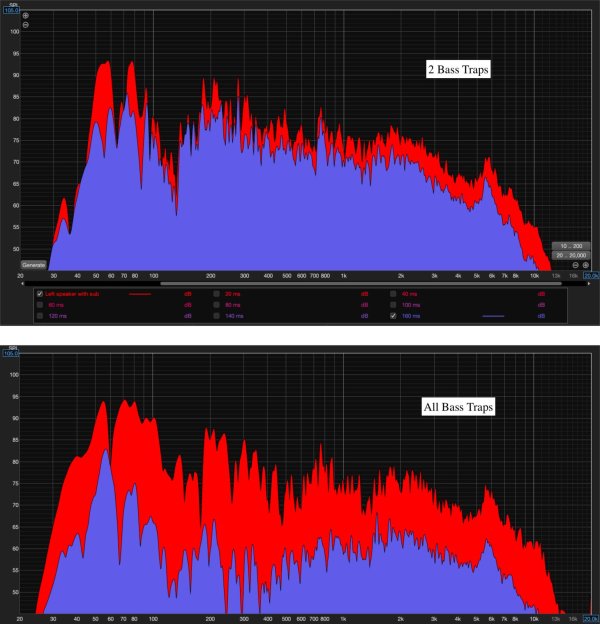
Another representation of the REW data, made easier to understand by normalizing peak amplitudes in the bass.
They're not exactly an apples-to-apples comparison, but it's evident the metal bass traps help dampen mid to higher frequencies, too.
I suspect that the 55Hz peak is the subwoofer’s port resonance frequency because it’s so prominent and does not correspond to the primary room node frequencies.
They're not exactly an apples-to-apples comparison, but it's evident the metal bass traps help dampen mid to higher frequencies, too.
I suspect that the 55Hz peak is the subwoofer’s port resonance frequency because it’s so prominent and does not correspond to the primary room node frequencies.
Last edited:
(...) The PSI Audio AVAAs will automatically sense the highest pressure and adjust dynamically, effective across a wide bandwidth of 15-150Hz. I'll have two AVAA C214s mounted in the rear-wall ceiling corners, as well as four C20s placed around the room.
AVAA Technology
AVAA technology is the way to actively absorb room modes and get clear bass. AVAA C20 and AVAA C214 are the products.
Do you know if the AVAA's can cancel dips due negative interference by bass reflection in the front wall?
Microstrip,
The AVAAs will only help flatten out the amplitude of high pressure waves through its electro-mechanical circuitry, mitigating the effects of an otherwise run-away bass energy running amok in the room.
Nothing I know of will fill in the hard-baked Black Hole room node cancellation dips, but strategically placing subs inside the abyss of the half-wave or quarter-wave will help fill out the hole. My Ultra.nine loudspeakers' powered subwoofers will be placed at this quarter room length "null-position" distance for this reason.
The AVAAs will only help flatten out the amplitude of high pressure waves through its electro-mechanical circuitry, mitigating the effects of an otherwise run-away bass energy running amok in the room.
Nothing I know of will fill in the hard-baked Black Hole room node cancellation dips, but strategically placing subs inside the abyss of the half-wave or quarter-wave will help fill out the hole. My Ultra.nine loudspeakers' powered subwoofers will be placed at this quarter room length "null-position" distance for this reason.
Last edited:
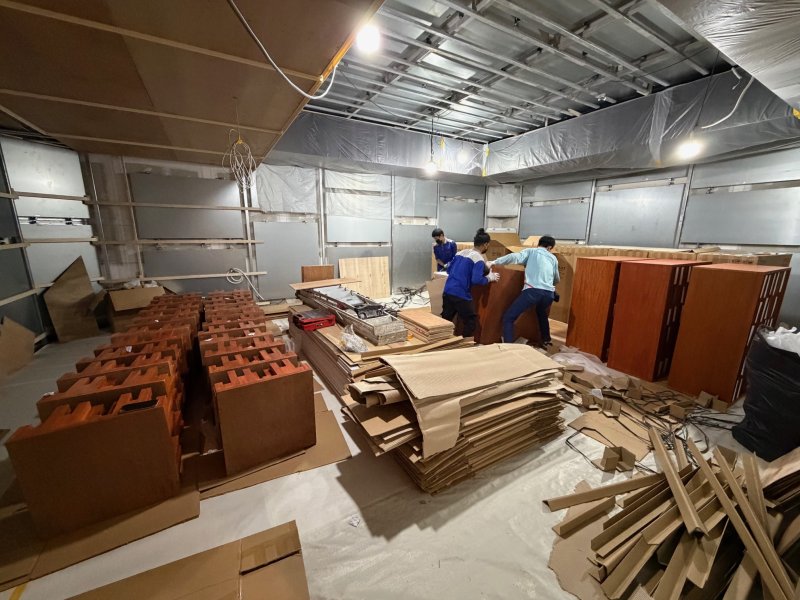
The QRDs are being unboxed for two weeks of off-gassing VOCs, and acclimatizing the wood to the basement's cooler and drier microclimate.
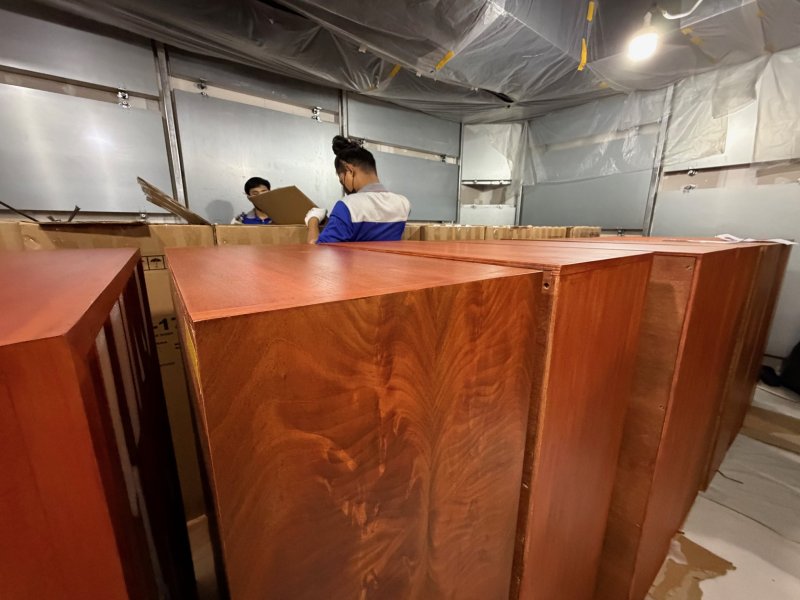
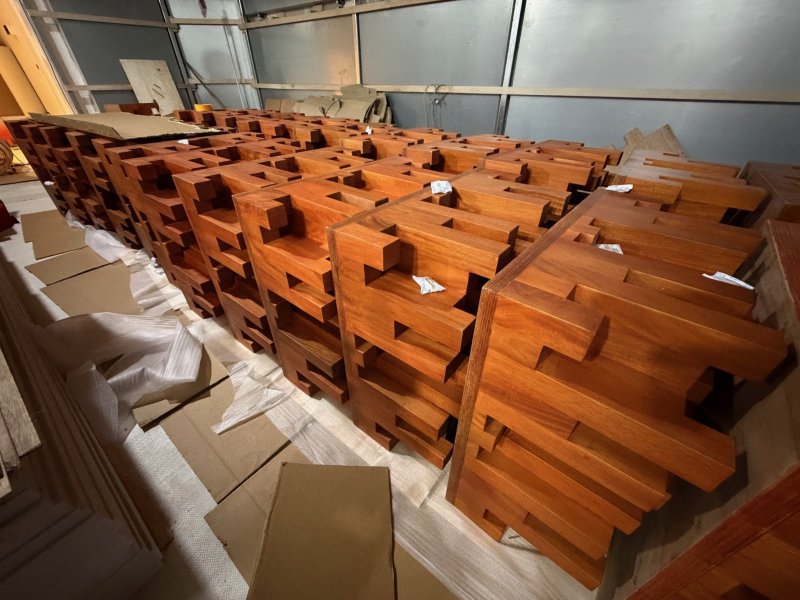
Last edited:
...so easy to overlook the localization/normalization of wood products to stabilize them. You are covering all the bases QD. Bravo, sir.
Is there a term beyond 'next level'?
Because this is it!
Because this is it!
...this is it! So very interesting to follow the thinking and level of detail. I suppose we may find people could disagree on an idea or execution, that's normal IMO. But here we see how thoughtful is the planning and consideration of the variables leading to the decisions.
It's a genuine pleasure to be able to audit the process, thanks to QD's posts and pics. Surely, one of my favorite threads with a coffee!
It's a genuine pleasure to be able to audit the process, thanks to QD's posts and pics. Surely, one of my favorite threads with a coffee!

I’m following this thread from the beginning and considering it as a “case study” in audiophile history indeed. Every detail explained and documented. Images, thoughts, explications. Passion, dedication, economic investment, deep knowledge… you name it!
Congrats! This is a benchmark (and a dream for many of us).
Congrats! This is a benchmark (and a dream for many of us).
I agree. This is absolutely incredible. Its like watching a symphony hall being built...in a home!

Perhaps, Mike is among one of many inspirations for this thread?Is Mike Lavigne following this thread?...

I suspect that the 55Hz peak is the subwoofer’s port resonance frequency because it’s so prominent and does not correspond to the primary room node frequencies.
Do you accept criticism of your project?
The visualization of the room looks wonderful, but despite in-depth study of the theory, expensive materials and products, something going wrong.
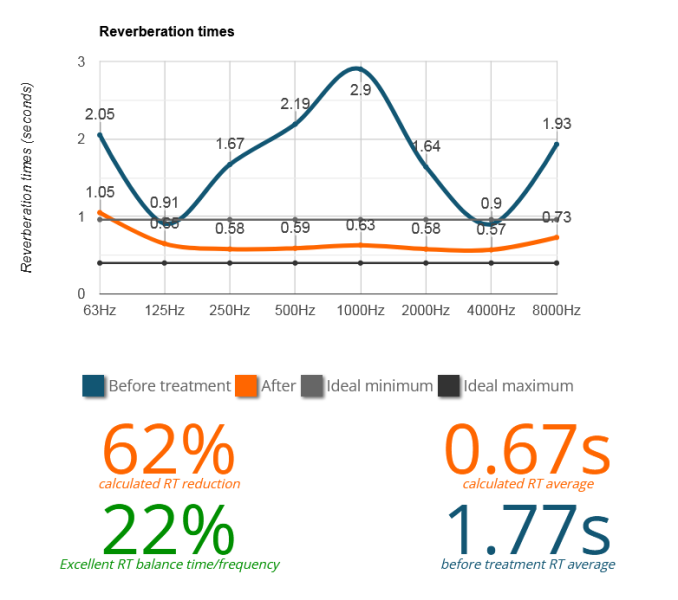
55Hz on your graph looks like one of the main resonance where your bass traps does not work. Take a look on your NTI measurements in empty room and then your REW measurements with bass traps and without. It looks that the bass traps are working of a wrong frequency and do not eliminate main problem.
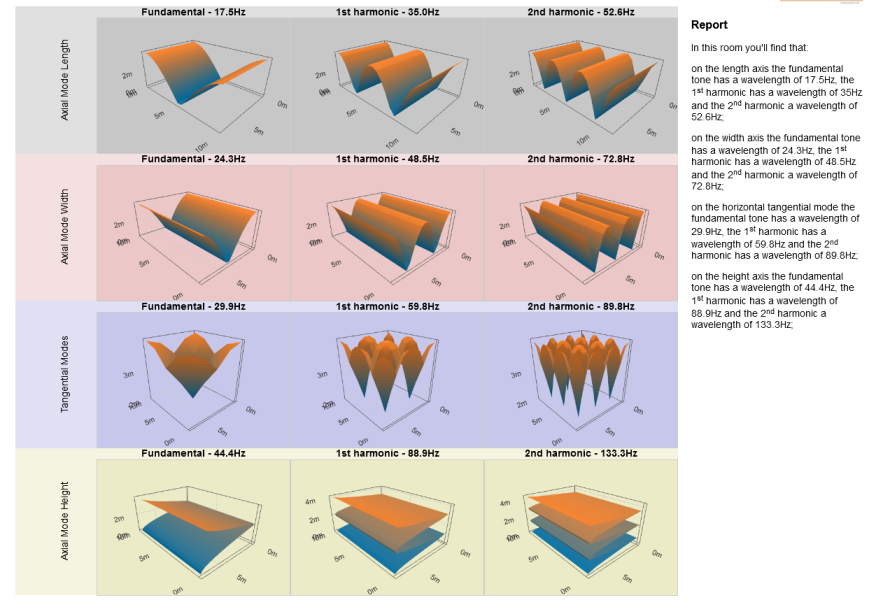
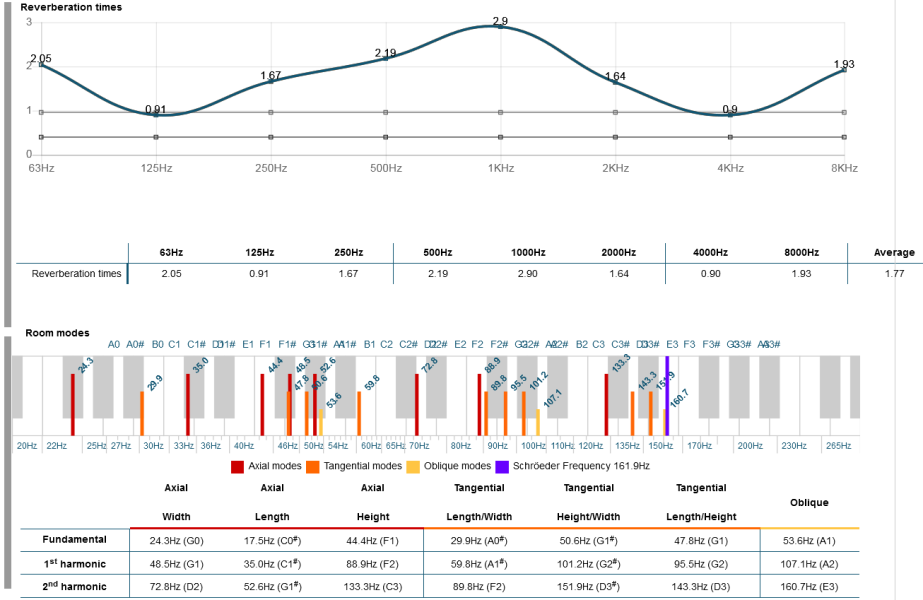
Brief simulation of rectangular room with your size L=9,79 W=7,07 H=3,86m with concrete floor and 9.5mm plasterboard on walls and ceiling gives me the results you can see in attachments.
As you see there, with that size room rings on 1st, 2nd and 3rd harmonics around 44, 48, 52Hz what are multiplied and causing main problem you see on your measurements. You need to do more comprehensive research on this problem.
While your room have almost perfect W/L/H ratio, why you have not changes geometry from "square" to inclined/trapezoid wall, ceiling?
Changing shape from rectangular to more complex shape will cost less then hundreds of panels and give you much headroom to play.
Attachments
Maxim,
Of course - criticism (or its euphemism, "advice") is always welcome!
Fundamentally, what you modeled is no different from calculations done in mid-2023 (see links below), regarding room nodes. Recent REW measurements were done without any doors installed, leaving a gaping hole to the outside room, which could have contributed to the erratic room node response. The JBL subwoofer's vented bass port is likely tuned to around 50-55Hz, which could have be the source of the outsized source and resonance peak.
My room dimensions are closer to those below (9.71mL x 7.10mW x 4.2mH), so the inputs into your program needs to be tweaked.
Regarding asymmetric surfaces, due to the sloping carport between the road and house, the ceiling is actually at its highest at the R corner, but slopes down 400mm towards the far L corner, creating one large non-parallel surface relative to the flat floor. Also, the dampened plasterboard system is definitely not a simple single-layer 9.5mm one. Under the VPR's steel plate surface, there are five more layers underneath before reaching the base layer of reinforced concrete. The swimming pool projection also reduces the ceiling height at the back wall's ceiling, introducing room nodes at slightly higher frequencies compared to the rest of the listening room. See the two links below:
 www.whatsbestforum.com
www.whatsbestforum.com
I've never claimed to be building "perfect" listening room, just that I'm trying to optimize what's possible with a large room in the basement whose bass room nodes will be extremely challenging to tame, give how bass pressure will mostly be "trapped" with nowhere to go. Many may be surprised hear me say this, but even a smallish 3dB reduction (halving) of room node energy by the VPRs would be a welcome result, and anything more would be a bonus.
You've likely missed my post back in Nov 2023 (see link below), but the VPRs were calculated and tuned (via metal plate thickness, mass, and size) to address the predicted bass problems. In all likelihood, there will be no need to tear out the VPR panels, as they will not be harmful in any way acoustically.
www.whatsbestforum.com
Once the 5,000kgs of QRDs are installed as the final 7th layer, a number of positive outcomes are expected:
1) absorption of the 150 - 500Hz frequencies will diminish, via suppression of the exposed perimeters of the VPR metal bass traps
2) diffusion of the 185 - 3.4kHz frequencies will rise, via the P23 QRDs on the front wall
3) diffusion of the 225 - 3.4kHz frequencies will rise, via the P17 QRDs on the two side walls
4) diffusion of the 300 - 3.4kHz frequencies will rise, via the P13 Skyline 2D diffusers on the ceiling
Overall, these measures will rebalance the room’s spectral and time‑decay characteristics while creating the highly desirable psychoacoustic effect of making the boundary walls seem farther away - an illusion that effectively doubles the perceived room volume.
As I typically listen to music at low volumes below 80dB (but will still be articulate and expressive, thanks to the sub 20dB ambient noise of the room), I will leverage certain psychoacoustical phenomena such as insensitivity of low frequencies, and masking/precedence effects to reduce the audibility of bass anomalies. I also expect PS Audio's AVAA active bass cancellation units and Von Schwikert Audio's room node cancellation subwoofers to help "flatten" room node peaks.
Of course - criticism (or its euphemism, "advice") is always welcome!
Fundamentally, what you modeled is no different from calculations done in mid-2023 (see links below), regarding room nodes. Recent REW measurements were done without any doors installed, leaving a gaping hole to the outside room, which could have contributed to the erratic room node response. The JBL subwoofer's vented bass port is likely tuned to around 50-55Hz, which could have be the source of the outsized source and resonance peak.
My room dimensions are closer to those below (9.71mL x 7.10mW x 4.2mH), so the inputs into your program needs to be tweaked.
Regarding asymmetric surfaces, due to the sloping carport between the road and house, the ceiling is actually at its highest at the R corner, but slopes down 400mm towards the far L corner, creating one large non-parallel surface relative to the flat floor. Also, the dampened plasterboard system is definitely not a simple single-layer 9.5mm one. Under the VPR's steel plate surface, there are five more layers underneath before reaching the base layer of reinforced concrete. The swimming pool projection also reduces the ceiling height at the back wall's ceiling, introducing room nodes at slightly higher frequencies compared to the rest of the listening room. See the two links below:
My dedicated audio room build - QuadDiffusor's Big Dig
The Linkwitz LX521.4 system was outstanding - no - astonishing! The digital source was in plain-old CD resolution, streamed via an integrated streamer/DAC with no fancy ancillary cables or other equipment. I can expect that with a statement streamer like the Aurender N30 or Taiko Extreme with...
www.whatsbestforum.com
My dedicated audio room build - QuadDiffusor's Big Dig
The Linkwitz LX521.4 system was outstanding - no - astonishing! The digital source was in plain-old CD resolution, streamed via an integrated streamer/DAC with no fancy ancillary cables or other equipment. I can expect that with a statement streamer like the Aurender N30 or Taiko Extreme with...
www.whatsbestforum.com
I've never claimed to be building "perfect" listening room, just that I'm trying to optimize what's possible with a large room in the basement whose bass room nodes will be extremely challenging to tame, give how bass pressure will mostly be "trapped" with nowhere to go. Many may be surprised hear me say this, but even a smallish 3dB reduction (halving) of room node energy by the VPRs would be a welcome result, and anything more would be a bonus.
You've likely missed my post back in Nov 2023 (see link below), but the VPRs were calculated and tuned (via metal plate thickness, mass, and size) to address the predicted bass problems. In all likelihood, there will be no need to tear out the VPR panels, as they will not be harmful in any way acoustically.
My dedicated audio room build - QuadDiffusor's Big Dig
...cool stuff @QuadDiffuser Did you find a good source for the pellets? I dove into this a few years back and ran into a dead-end for a source. And shipping was brutal.
www.whatsbestforum.com
Once the 5,000kgs of QRDs are installed as the final 7th layer, a number of positive outcomes are expected:
1) absorption of the 150 - 500Hz frequencies will diminish, via suppression of the exposed perimeters of the VPR metal bass traps
2) diffusion of the 185 - 3.4kHz frequencies will rise, via the P23 QRDs on the front wall
3) diffusion of the 225 - 3.4kHz frequencies will rise, via the P17 QRDs on the two side walls
4) diffusion of the 300 - 3.4kHz frequencies will rise, via the P13 Skyline 2D diffusers on the ceiling
Overall, these measures will rebalance the room’s spectral and time‑decay characteristics while creating the highly desirable psychoacoustic effect of making the boundary walls seem farther away - an illusion that effectively doubles the perceived room volume.
As I typically listen to music at low volumes below 80dB (but will still be articulate and expressive, thanks to the sub 20dB ambient noise of the room), I will leverage certain psychoacoustical phenomena such as insensitivity of low frequencies, and masking/precedence effects to reduce the audibility of bass anomalies. I also expect PS Audio's AVAA active bass cancellation units and Von Schwikert Audio's room node cancellation subwoofers to help "flatten" room node peaks.
Last edited:
Sizes: not a significant changes, all LF modes are still about same.Of course! Criticism (euphemism = "advice") is always welcome!
BTW, my room dimensions are closer to those below (9.71mL x 7.10mW x 4.2mH), so the inputs into your program needs to be tweaked. Due to the sloping carport between the road and house, the ceiling is actually at its highest under the far R corner, but slopes down 400mm towards the far L corner, creating one large non-parallel surface, departing from the perfect rectangular room. Also, the dampened plasterboard system is definitely not a simple single-layer 9.5mm one. Counting the VPR's steel plate surface, there are six layers before the base reinforced concrete layer.
Wall covering with more thick plasterboard will slightly change LF and midrange absorption.
Indeed simulation and measurements will not show anything reasonable for double layer. Here you are fine with more thick layers/wall weight.
Why I wrote here is that I see your before/after REW graphs with damn big amount of VPRs that does not eliminate main problem.
They absorb a lot of energy in 150-1500Hz, while leave a big and untouched bump on a region where you have main problem - quite low frequencies around 50Hz which you can eliminate only with a tuned bass-traps.
Damped 150-1500Hz: that is important area where you could have natural decay if sidewalls will be inclined and floor plane will be non-rectangular.
Interior items like chairs, sofas, humans, carpets, furniture do absorption in that area, and once your finish your room it will make additional abortion in this area, and you will get real problem that room will be overdamped in a specific frequencies.
Means you need to add a lot of diffusion with a different amounts on a different frequencies, and it is not a simple task and it will not sound natural. Looks that now you create a problem which you do not see now, but definetly will see on next steps, and remove initial error will be almost impossible.
What I see on your graphs say me that you need to replace ALL your VPR absorbers with the ones what will work on a problematic frequencies.
Do not kill me if I say that you need to change geometry of walls, accept the losses for building walls and specially produced but unmatching panels and start everything from the beginning
 It would be really disappointing if, with such healthy budget and your very detailed approach to every nuance, your room will not be the best of the best.
Similar threads

- Replies
- 39
- Views
- 4K
- Replies
- 4
- Views
- 863

- Replies
- 0
- Views
- 875

- Replies
- 7
- Views
- 1K
- Replies
- 30
- Views
- 1K

 | Steve Williams Site Founder | Site Owner | Administrator |  | Ron Resnick Site Owner | Administrator |  | Julian (The Fixer) Website Build | Marketing Managersing |