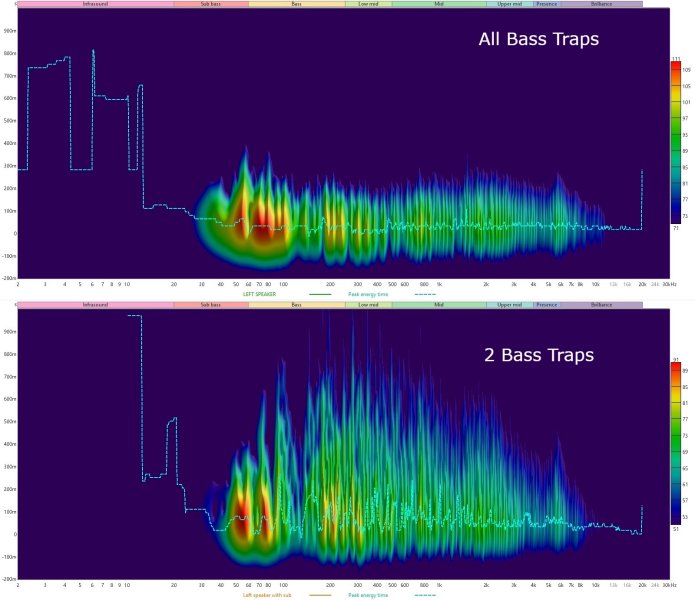
REW graphs of before/after (with/without) the "passive" VPR metal bass traps.
Note that measurement conditions are very different between the "after" (top graph) and the "before" (bottom graph).
The latest measurements are expected to improve substantially after 77 pcs. of QRDs are installed, the acoustic door fitted, and the PSI Audio AVAA active bass cancellation units (6 pcs.) are strategically placed in high bass pressure zones
TOP ("after")
1) peak bass amplitude reaches crazy loud levels of 111 dB - LOTS of acoustic energy is pumped out into the room to test its "limits", using the massive subwoofer and the omni-directional loudspeaker
2) 55 pieces of VPRs had been installed (2 different thicknesses of 1.5mm and 3.0mm, in 5 different sizes)
3) peak decay overshoot at 50-60Hz reaches 400ms
4) next highest decay overshoot at 80Hz reaches under 400ms
5) robust bass seen at sub-30Hz frequencies
6) decay peaks of the mid and high frequencies are all under 300ms
BOTTOM ("before")
1) peak bass amplitude is merely 91 dB
2) only 2 pieces of prototype VPRs were installed in the entire room; essentially the room "only" had a 4-layer gypsum wall system targeting 35Hz (room length nodes) and 50Hz (room width nodes)
3) overshoot at 50-60Hz were between 400-800ms
4) 80Hz overshoot reaches 650ms
5) effectively no sub-40Hz bass energy seen
6) decay peaks of the mid and high frequencies are as high as 1,000ms and are mostly above 700ms