Orchestral Music System Videos - Symphonic or Tone Poems, etc.

Wow - that's cool! I like it and your system sounds great. First time I've heard an orchestral version of this venerable music. You can easily hear the smoothness of the free-bowing technique Stowkowski brings to an orchestra.

I don't listen to much organ music but that is how I know this work. Michael Murray.


Thank you! My first exposure to this piece was actually from the Disney movie Fantasia, and it was also conducted by Stokowski.

This is actually my first time listening to Michael Murray playing this piece, and it is powerful! Thank you for sharing.
 
  • Like
Reactions: tima
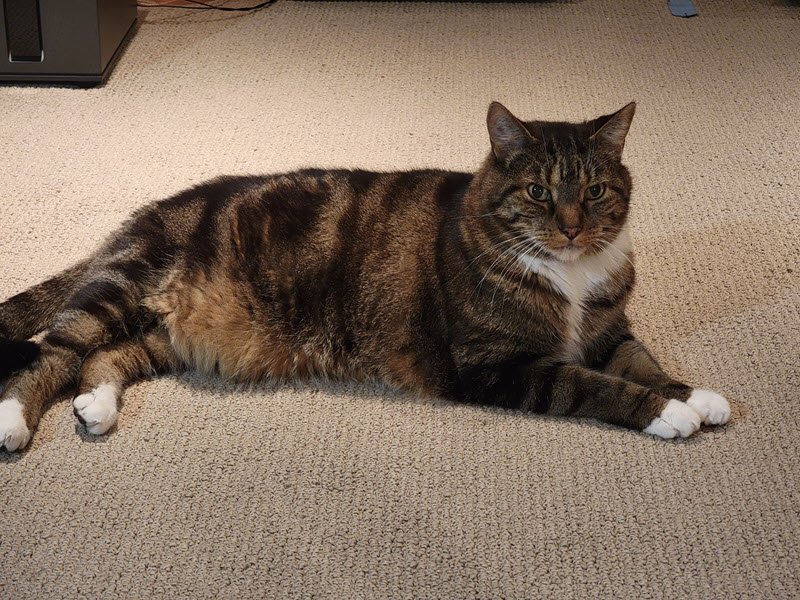
Audio Cat Finzi loves him some Wagner

20251203_053358-s.jpg

A medieval fairy tale opera where curiosity ends in disaster and an inquiring mind will lead you astray. Lohengrin is a knight of the Holy Grail who is sent in a boat pulled by swans to rescue a maiden in distress. He marries her and demands absolute faith from her - a very Protestant idea from the Lutheren Wagner -- never to ask him for his identity. She forgets her promise on their wedding night. He leaves her, never to return, the marriage unfulfilled..

The Prelude to Act 1 depicts the Holy Grail as it descends to Earth in the care of an Angelic host. Wagner takes his strings higher and higher topping out at A7 - 3520Hz, the highest practical note of a violin within human audible range . This is WunderMusik.

High A7.jpg


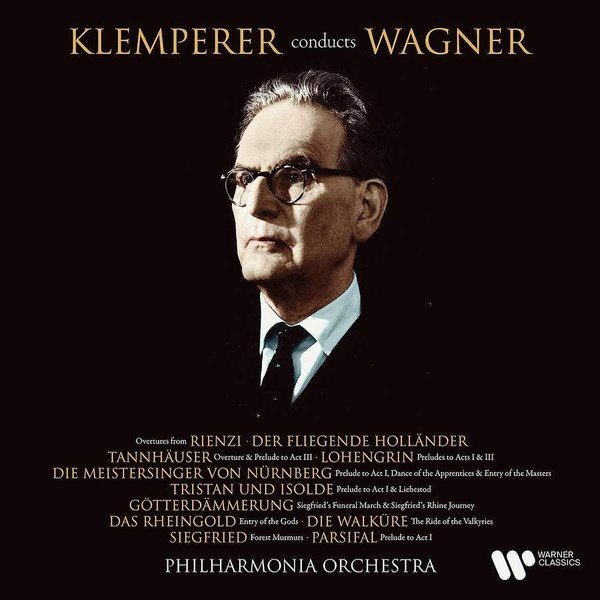
Wagner Klemperer Warner Classics 5419757987 .jpg
Warner Classics 5419757097 LP Box Set
 
Wonderful! Is that RCA LSC-2471. Rhapsodies? If you have it, please record Enescu’s Roumanian Rhapsody No. 1 -- music for tumblers, jugglers, sword dancers and plate spinners, and it will give both your stereo system and your ears a real workout.
Yes I have RCA LSC-2471 in vinyl and also love Enescu’s Roumanian Rhapsody No.1. The one I posted is streaming via Qobuz though.
 
  • Like
Reactions: tima
Although I did not plan for it, this year I've played more 20th C. music than in the past and learned a lot. Here's more...

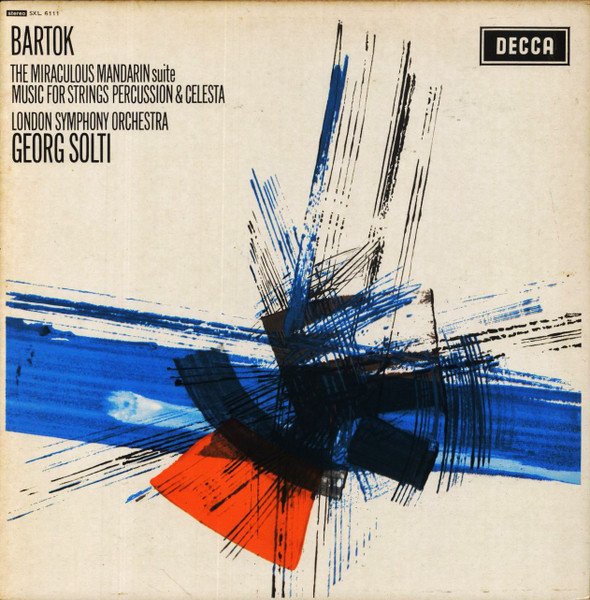
@PeterA told me about a recent concert he went to hearing violinist Joshua Brown. Nice to be in an area where that sort of event just happens. Also on his program was a performance of ... uh oh ... Bartók's Music for Strings Percussion & Celesta. I don't know this music but I looked in my stacks and there it was. George Solti and the London Symphony b/w Bartók's The Miraculous Mandarin.

Bartok Music for Strings Percusion & Celesta Solti LSO Decca SXL 6111.jpg
Decca SXL 6111 - recorded in 1963 and released in 1964.

Of course it's different. Changing rhythms and time signatures are hallmarks of B's style along with unresolving memes that go nowhere while celebrating sound but not so much melody and completion. It's Bartók and in its own way it is kinda cool, kinda beatnik and very percussive. Percussion instruments are his thing. The Celesta (also known as a bell-piano) is a percussion instrument with a keyboard and hammers that strike metal plates, not strings. Its tone can be rich, even golden.and often subdued. None of that is the Bartók way.

The home video recordings below are for the two interior movements out of a total of four.

Here is the Allegro

And the Adagio

 
Although I did not plan for it, this year I've played more 20th C. music than in the past and learned a lot. Here's more...

@PeterA told me about a recent concert he went to hearing violinist Joshua Brown. Nice to be in an area where that sort of event just happens. Also on his program was a performance of ... uh oh ... Bartók's Music for Strings Percussion & Celesta. I don't know this music but I looked in my stacks and there it was. George Solti and the London Symphony b/w Bartók's The Miraculous Mandarin.

View attachment 163137
Decca SXL 6111 - recorded in 1963 and released in 1964.

Of course it's different. Changing rhythms and time signatures are hallmarks of B's style along with unresolving memes that go nowhere while celebrating sound but not so much melody and completion. It's Bartók and in its own way it is kinda cool, kinda beatnik and very percussive. Percussion instruments are his thing. The Celesta (also known as a bell-piano) is a percussion instrument with a keyboard and hammers that strike metal plates, not strings. Its tone can be rich, even golden.and often subdued. None of that is the Bartók way.

The home video recordings below are for the two interior movements out of a total of four.

Here is the Allegro

And the Adagio

Thank you Tim. These videos bring back nice memories. The New England Conservatory main orchestra played the entire composition that evening. I appreciate your posts that discuss music. There is always something to learn.
 
Thanks Tim, It is good to step back away from the core sonic perspectives in our hifi focus and throw ourselves into wider observation and appreciation of the engendered musical realm… system videos are a great platform for that. Funny how focussing on one aspect of being an audiophile and drawn to our defaulting to analysing sound can serve in ways to also distance and disconnect ourselves from the more holistic appreciation and awareness with the very core of the music as content itself.

But (understandably) this is an audio forum so sound is the core appreciation activity here. But it’s always a great bonus to be drawn back to discussing deeper aspects of the music itself. Especially with classical music and looking to form and reason in composition.

Bartók is a great topic because it can be quite uncomfortable music for many I feel and less accessible to get in to what is central to its development and in its spirit and context… Bartok certainly for many isn’t a simple connection or its drivers and structure easily interpreted.

There’s a lot of obscure intellectual foundation built into it that takes a deal of formal musical composition education to identify and interpret looking at what’s going on beyond its angularity of its modernist folk influences in faster movements and then there’s often that eerie sparse quality containsd in many of the slower movements referred to as his night music. I’m a bit aware playing it only occasionally over the years but not at all expert in Bartok so the exposure here again is a nice return in listening.

I admire his skill but as said don’t often play Bartok and so it’s nice to be brought back into contact with it via a video… and while not my favourite among 20th century music it is important which is I figure why it’s sitting obviously in the repertoire. I’d add that your system is well suited to it here… and as always the music system videos can broaden us beyond the simple why am I a believer or not usual controversy and the background you provide is much appreciated… nice work.
 
Last edited:
  • Like
Reactions: tima and PeterA
Funny how focussing on one aspect of being an audiophile and drawn to our defaulting to analysing sound can serve in ways to also distance and disconnect ourselves from the more holistic appreciation and awareness with the very core of the music as content itself.

Thanks for your write-up, Graham -- I enjoyed reading it.

I believe it is worthwhile to provide a at least an island of relevance to why some of us are in this hobby. I cannot deny going on the 'audiophile journey' of trying different components over time in the search for satisfying reproduction but that has always been for me the means not the end.

Despite maybe 20 years of rock n roll, I have a somewhat strong bias coming out of my younger days of playing music that classical music is simply the most interesting music to appreciate. It is far more challenging to my mind to understand and far more satisfying to my soul to hear. Now that I have a system that meets my needs I am on another journey to explore much of what it has to offer -- and across the centuries there is plenty. I make these videos to share my discoveries with others -- to say 'hey look what I found'.

Bartók is one of those. It started when I was doing record reviews at TAB and assigned two albums with his Piano Concertos* to write about. That did not create an on-going interest in the composer but I did learn about his music and his life. And yes, it can take you out of the Western comfort zone. I had largely stopped at the end of the late Romantic period -- early 20th Century. At some point my curiosity pushed me further - maybe is was Shostakovich or Mahler or Copland or the British pastoralists of the '30 and 40's. Two World Wars had a pretty profound effect on composition. Now I'm willing to try anything up to 1950 or so. Modern music is not part of my regular diet -- it's more like going to see an art exhibit that comes to town for a few weeks. It is interesting and I try to understand it.

For what it's worth, in this 3rd Piano Concert which he wrote while he was dying, there is the Adagio religioso where one might find Bartók returning to a more romantic approach from whence he started as a composer.

*Béla Bartók: Concerto for Piano and Orchestra No. 1, Rhapsody for Piano and Orchestra, Op. 1 Béla Bartók: Concertos for Piano and Orchestra Nos. 2 and 3
 
Thanks for your write-up, Graham -- I enjoyed reading it.

I believe it is worthwhile to provide a at least an island of relevance to why some of us are in this hobby. I cannot deny going on the 'audiophile journey' of trying different components over time in the search for satisfying reproduction but that has always been for me the means not the end.

Despite maybe 20 years of rock n roll, I have a somewhat strong bias coming out of my younger days of playing music that classical music is simply the most interesting music to appreciate. It is far more challenging to my mind to understand and far more satisfying to my soul to hear. Now that I have a system that meets my needs I am on another journey to explore much of what it has to offer -- and across the centuries there is plenty. I make these videos to share my discoveries with others -- to say 'hey look what I found'.

Bartók is one of those. It started when I was doing record reviews at TAB and assigned two albums with his Piano Concertos* to write about. That did not create an on-going interest in the composer but I did learn about his music and his life. And yes, it can take you out of the Western comfort zone. I had largely stopped at the end of the late Romantic period -- early 20th Century. At some point my curiosity pushed me further - maybe is was Shostakovich or Mahler or Copland or the British pastoralists of the '30 and 40's. Two World Wars had a pretty profound effect on composition. Now I'm willing to try anything up to 1950 or so. Modern music is not part of my regular diet -- it's more like going to see an art exhibit that comes to town for a few weeks. It is interesting and I try to understand it.

For what it's worth, in this 3rd Piano Concert which he wrote while he was dying, there is the Adagio religioso where one might find Bartók returning to a more romantic approach from whence he started as a composer.

*Béla Bartók: Concerto for Piano and Orchestra No. 1, Rhapsody for Piano and Orchestra, Op. 1 Béla Bartók: Concertos for Piano and Orchestra Nos. 2 and 3
I am a long time fan of the music of Bartók. I was fortunate to have friends in college that introduced me to his music. Also got introduced to Bartók through studying piano.

I have collected numerous LPs of Bartók's music on the Hungaroton label. While not always the best recording or pressing they have wonderful performances and artists that capture the musical language of the composer.

Some of my favorite pieces are the string quartets - they are milestones in the twentieth century literature. The Violin Concert #2, Viola Concerto, Rhapsody #1, Concerto for Orchestra also get frequent play. The violin sonatas are particularly appealing, at least to me and of course all the piano music - (Microcosmos and concertos).

There is a wonderful book on Bartók's piano music by Barbara Nissman: Bartók and The Piano

Great topic!
 
Last edited:
  • Like
Reactions: MarkusBarkus
Thanks for your write-up, Graham -- I enjoyed reading it.

I believe it is worthwhile to provide a at least an island of relevance to why some of us are in this hobby. I cannot deny going on the 'audiophile journey' of trying different components over time in the search for satisfying reproduction but that has always been for me the means not the end.

Despite maybe 20 years of rock n roll, I have a somewhat strong bias coming out of my younger days of playing music that classical music is simply the most interesting music to appreciate. It is far more challenging to my mind to understand and far more satisfying to my soul to hear. Now that I have a system that meets my needs I am on another journey to explore much of what it has to offer -- and across the centuries there is plenty. I make these videos to share my discoveries with others -- to say 'hey look what I found'.

Bartók is one of those. It started when I was doing record reviews at TAB and assigned two albums with his Piano Concertos* to write about. That did not create an on-going interest in the composer but I did learn about his music and his life. And yes, it can take you out of the Western comfort zone. I had largely stopped at the end of the late Romantic period -- early 20th Century. At some point my curiosity pushed me further - maybe is was Shostakovich or Mahler or Copland or the British pastoralists of the '30 and 40's. Two World Wars had a pretty profound effect on composition. Now I'm willing to try anything up to 1950 or so. Modern music is not part of my regular diet -- it's more like going to see an art exhibit that comes to town for a few weeks. It is interesting and I try to understand it.

For what it's worth, in this 3rd Piano Concert which he wrote while he was dying, there is the Adagio religioso where one might find Bartók returning to a more romantic approach from whence he started as a composer.

*Béla Bartók: Concerto for Piano and Orchestra No. 1, Rhapsody for Piano and Orchestra, Op. 1 Béla Bartók: Concertos for Piano and Orchestra Nos. 2 and 3
Thanks Tim, will put Bartok 3rd piano concerto in to play on my next listen… I’m not familiar with it and within all the various kinds of classical great piano music is probably my favourite so very much looking forward to it. Much appreciated.
 

About us

  • What’s Best Forum is THE forum for high end audio, product reviews, advice and sharing experiences on the best of everything else. This is THE place where audiophiles and audio companies discuss vintage, contemporary and new audio products, music servers, music streamers, computer audio, digital-to-analog converters, turntables, phono stages, cartridges, reel-to-reel tape machines, speakers, headphones and tube and solid-state amplification. Founded in 2010 What’s Best Forum invites intelligent and courteous people of all interests and backgrounds to describe and discuss the best of everything. From beginners to life-long hobbyists to industry professionals, we enjoy learning about new things and meeting new people, and participating in spirited debates.

Quick Navigation

User Menu

Steve Williams
Site Founder | Site Owner | Administrator
Ron Resnick
Site Owner | Administrator
Julian (The Fixer)
Website Build | Marketing Managersing