

Seeking recommendations for the best type and manufacturer of diffuser for the front wall where the rear of the speaker is approximately 12”-18” from the wall. Thanks!
Diffuser for Front Wall
- Thread starter Walnut Horns
- Start date
You are using an out of date browser. It may not display this or other websites correctly.
You should upgrade or use an alternative browser.
You should upgrade or use an alternative browser.

1. That’s quite close to the wall.
2. Book cases are great diffusers. Any diffuser requires some depth. You don’t have much depth available.
3. Pictures of the present configuration could help others to make useful suggestions.
2. Book cases are great diffusers. Any diffuser requires some depth. You don’t have much depth available.
3. Pictures of the present configuration could help others to make useful suggestions.
What are the dimensions of your room and how is the equipment placed within it? Do you have a budget in mind?Seeking recommendations for the best type and manufacturer of diffuser for the front wall where the rear of the speaker is approximately 12”-18” from the wall. Thanks!
I just moved my system from the short to the long wall after much experimentation. It just sounds better this way. My room is 33’ long. Where the speakers are located, the room is 16’ wide, being 18’ at its widest and 12’ at its narrowest.
I’m still experimenting with speaker distance from front wall, but my understanding is that diffusion works well here.
You must excuse how messy the room is as moving the system, records and cabinets was a huge undertaking.
Thanks for your help.
Evan
I’m still experimenting with speaker distance from front wall, but my understanding is that diffusion works well here.
You must excuse how messy the room is as moving the system, records and cabinets was a huge undertaking.
Thanks for your help.
Evan
Attachments
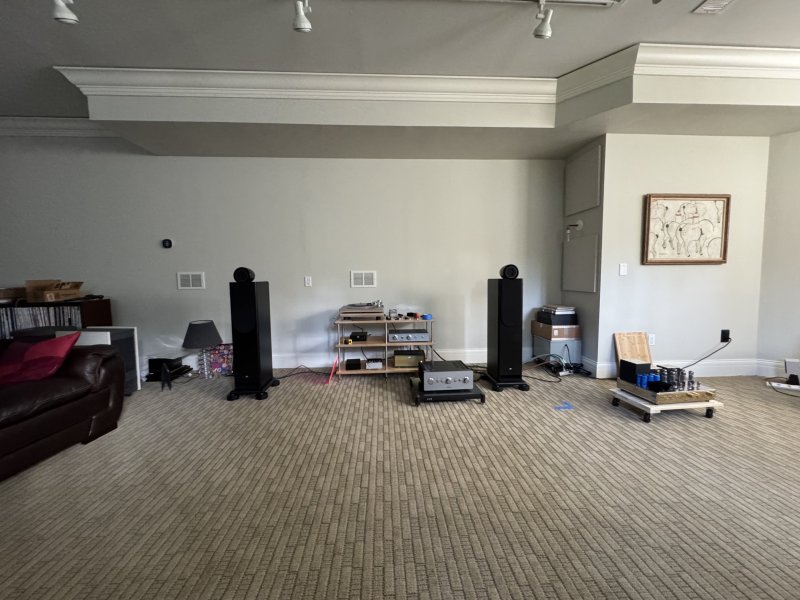
...hey Evan, a local friend has his speakers on the long wall, and ASC half-rounds seem to work pretty well there. He has a similar distance behind the speakers.
We experimented with the exact placement, left/right behind the speakers. I believe the devices he has have a reflective element beneath the fabric covering.
Not sure how much more you can do, given the space available behind the speakers. Good Luck, sir.
We experimented with the exact placement, left/right behind the speakers. I believe the devices he has have a reflective element beneath the fabric covering.
Not sure how much more you can do, given the space available behind the speakers. Good Luck, sir.

I have GIK quadratic diffusers as well as diffuser/absorbers. They will consult with you for free to help you design a room treatment solution.
GIK Acoustics
GIK Acoustics
...I like GIK and have their stuff too. Respectfully, I would say that the OP's distance is too close for a quad product back there.

WH, before diffusion on the rear wall, I would order up some ASC tube traps for that right side corner wall pocket as bass pressure will almost certainly build up there causing asymetry between left and right channels. Once that is dealt with rear wall diffusion will be an easy affair and a nice wide and deep sounstage will be yoursI just moved my system from the short to the long wall after much experimentation. It just sounds better this way. My room is 33’ long. Where the speakers are located, the room is 16’ wide, being 18’ at its widest and 12’ at its narrowest.
I’m still experimenting with speaker distance from front wall, but my understanding is that diffusion works well here.
You must excuse how messy the room is as moving the system, records and cabinets was a huge undertaking.
Thanks for your help.
Evan

GIK makes a nice assortment of products at reasonable prices. Good luck!
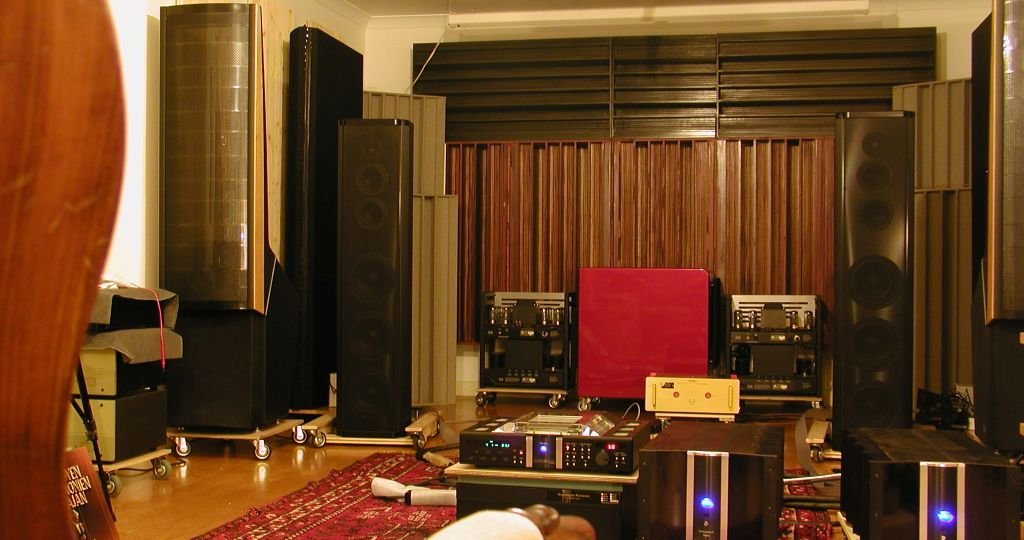
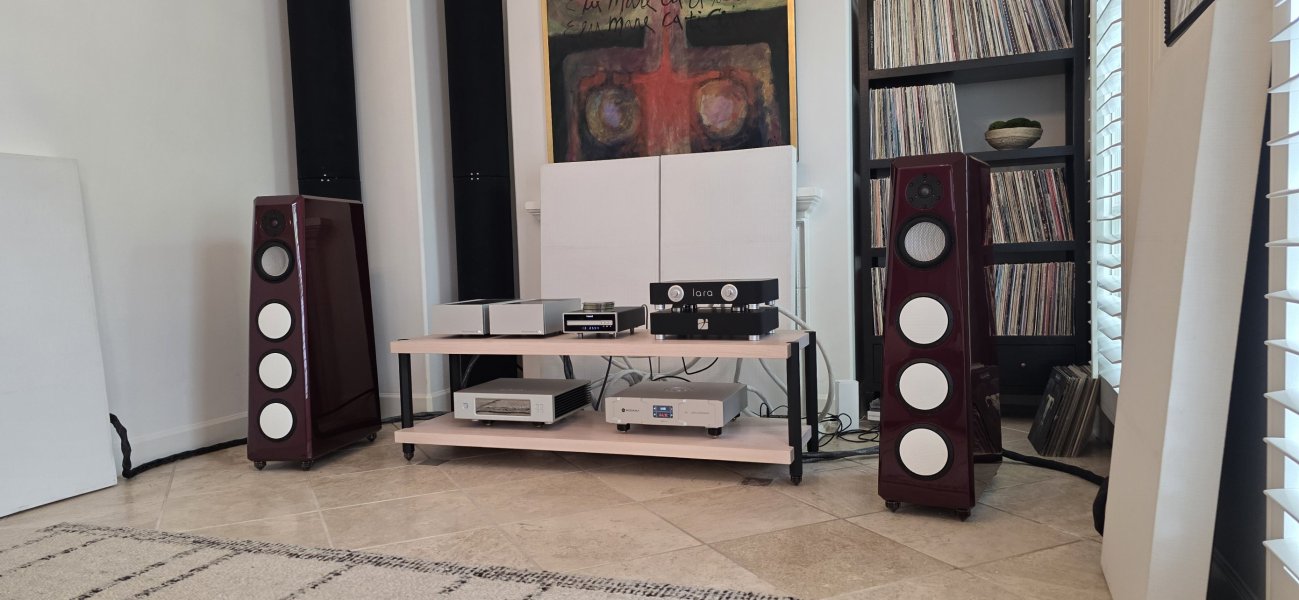
We started with the speakers on the long dimension of the room (see photo below of this orientation). Our room (it is a multi-purpose room not a dedicated listening room) has multiple hallways and a large stairwell joining it so acoustically, it is a difficult room to deal with. The dimensions are roughly 21.5' wide x 28' long x 10.5' high.I just moved my system from the short to the long wall after much experimentation. It just sounds better this way. My room is 33’ long. Where the speakers are located, the room is 16’ wide, being 18’ at its widest and 12’ at its narrowest.
I’m still experimenting with speaker distance from front wall, but my understanding is that diffusion works well here.
You must excuse how messy the room is as moving the system, records and cabinets was a huge undertaking.
Thanks for your help.
Evan
The primary room treatment is a RD Acoustics Hybrid diffuser in combination with strategically placed ACS Tube Traps, Vicoustics DC3 diffusers on the ceiling and 2 x PSI Audio AVAA C20 active bass absorbers. We also use Hunter Douglas Duette Honeycomb Vertiglide Vertical Blinds to treat an ~18 foot span of sliding glass doors on the north facing wall. The measured RT60 of the room is ~ 0.45, down from 1.2 for the untreated room.
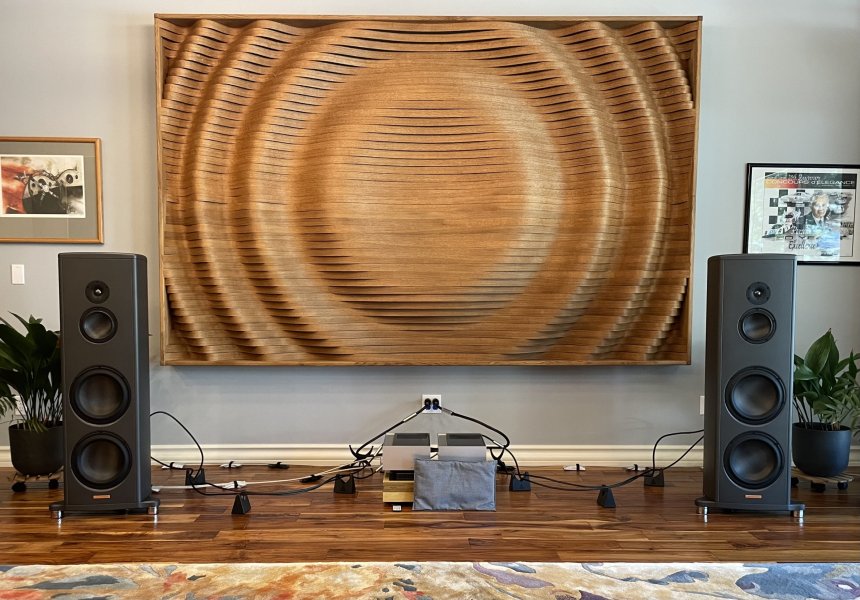
In this asymmetric "long wall" orientation, the soundstage was exceptionally wide but there are two (2) bass modes in the corners on the right side of this photo that could not be adequately tamed in this orientation.
We subsequently reoriented the speakers to make the 21.5' "short wall" the front wall with the sliding glass doors behind the speakers. In this orientation, the bass modes were treated more effectively by symmetrically stacking 2 x 13"x3' Tube traps on top of a PSI C20 active bass absorber in each corner of the (now) front wall. This also allowed us to better voice the bass by placing the speakers further into the room now that we had more space to work with in front of the listening position.
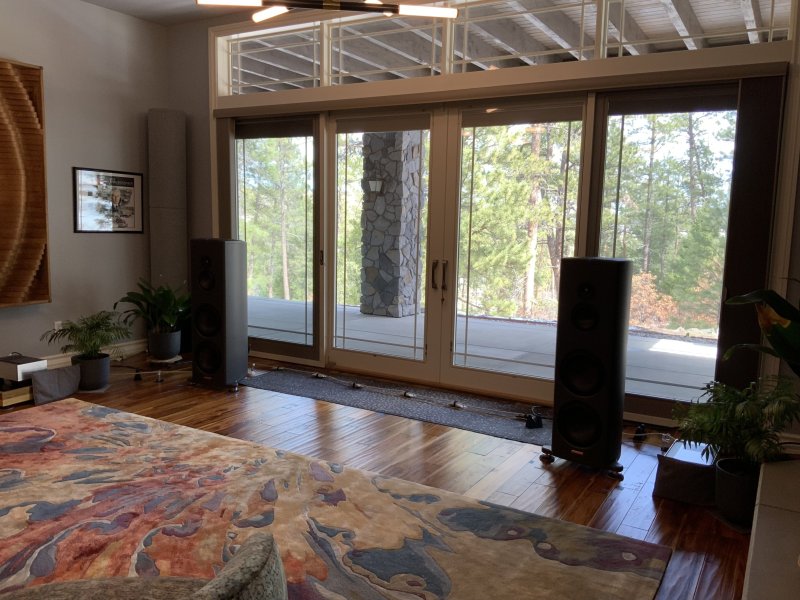
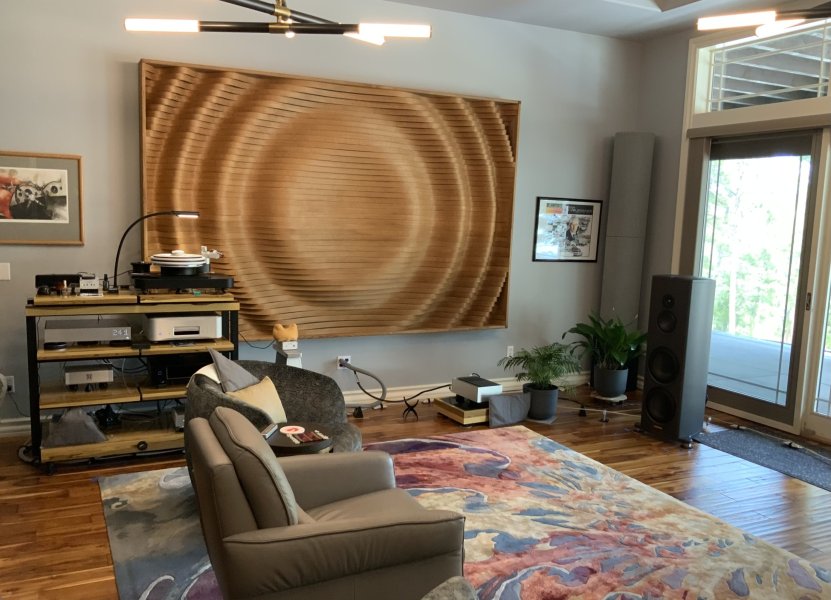
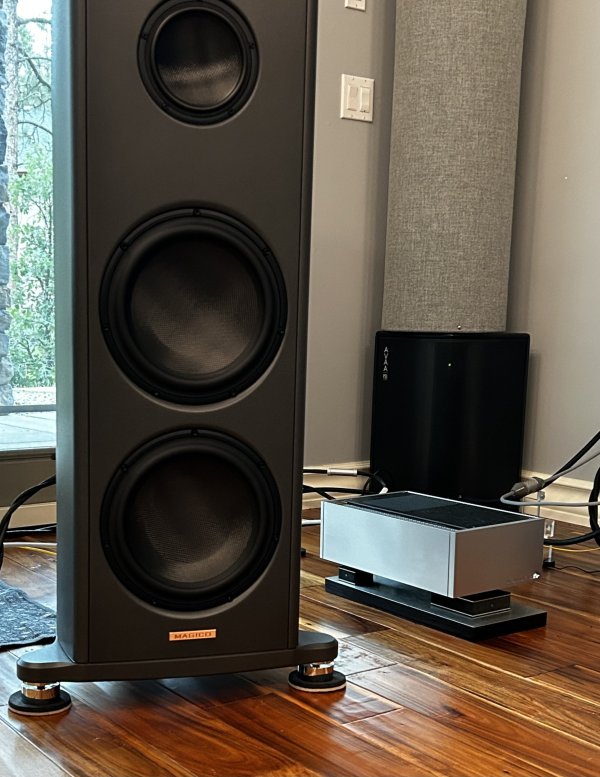
The speakers now vanish into the space and rather than listening to the equipment, I spend my time listening to the music. If the recording contains it, there is a continuous-ness to the music that provides a "you are there" immersive quality that is enormously satisfying.
For me the lesson learned was to place the speakers where the major bass modes are symmetric relative to the speakers.
In this room, with the speakers on the long dimension, both major bass modes were on the right side of the room. No amount of room treatment or physical manipulation of the speaker or listening position could prevent me from hearing that discontinuity. Every room has its own unique sonic signature so I vowed to work with the room, being particularly mindful of the room's bass response, and choose the speaker location (and therefore the listening position) carefully. For me optimising the bass response of the speakers in the room is the first step, and foundational prerequisite, to obtain what we seek in sound quality and the therapy music provides.
Advice is worth what you pay for it and this is free. Take your time. If you alter something, live with the change for a while before you decide if it is a step in the right direction.
Last edited:

I suggest you check SMT too. Here’s more info on these very effective and WAF friendly diffusers.
 www.whatsbestforum.com
My (SMT) room
Well, it’s time to introduce a part of my path to better sound. I hope you find it interesting. We used to live in a beautiful apartment in a late ninety century house that had more than 80 cm thick brick walls, 3.6m high ceilings, floating wooden floor and ceiling with ancient rock and dry...
www.whatsbestforum.com
The minimum distance between diffusor and speakers for acceptable diffusion depends on the bandwidth of the diffusor, usually related to its depth. Typical minimum distance is between 4 and 6 feet (1.2-1.8m).
Otherwise the panel will work mainly as a partial absorber - reflector, probably not a bad thing, as most panels sold as diffusors are just that. In these days any panel that is not an absorber becomes a diffusor.
IMO in the referred conditions absorptive or hybrid panels (absorption and reflective) are a better solution.
Otherwise the panel will work mainly as a partial absorber - reflector, probably not a bad thing, as most panels sold as diffusors are just that. In these days any panel that is not an absorber becomes a diffusor.
IMO in the referred conditions absorptive or hybrid panels (absorption and reflective) are a better solution.
I suggest you check SMT too. Here’s more info on these very effective and WAF friendly diffusers.
My (SMT) room
Well, it’s time to introduce a part of my path to better sound. I hope you find it interesting. We used to live in a beautiful apartment in a late ninety century house that had more than 80 cm thick brick walls, 3.6m high ceilings, floating wooden floor and ceiling with ancient rock and dry...
You have plenty of space behind the speakers - these excellent diffusors have space to to spread sound. As I had in my previous room, almost twenty years ago ... Diffusors were RPG diffractals.

WH, before diffusion on the rear wall, I would order up some ASC tube traps for that right side corner wall pocket as bass pressure will almost certainly build up there causing asymetry between left and right channels. Once that is dealt with rear wall diffusion will be an easy affair and a nice wide and deep sounstage will be yours
GIK makes a nice assortment of products at reasonable prices. Good luck!
Fully agree. First bass traps, then it will be easy to fix the rest
hi Evan,I just moved my system from the short to the long wall after much experimentation. It just sounds better this way. My room is 33’ long. Where the speakers are located, the room is 16’ wide, being 18’ at its widest and 12’ at its narrowest.
I’m still experimenting with speaker distance from front wall, but my understanding is that diffusion works well here.
You must excuse how messy the room is as moving the system, records and cabinets was a huge undertaking.
Thanks for your help.
Evan
looking at your picture, my opinion from just a quick observation is that you have two issues.
1--agree you need some mild diffusion at ear height on that wall between your speakers. there are many choices and maybe best to experiment with degrees of diffusion. in my case i had a fairly large (8 foot tall 4 feet wide RPG Skyline) in that center section which worked well for a few years. but my wall was 8-feet behind my front speaker baffles. so that is quite significant. later as i did more room tuning, i found that my center RPG Skyline was too strong after cleaning up other reflective issues, and was creating confusion in my center image so i removed it and replaced it with simple cloth covering which was the right balance going forward. that cut down on the harshness but allowed for a fantastic center image.
so don't fall in love with any treatments and when you go down the road remove them from time to time to make sure they are still a net gain.
agree that considering the closeness of the wall to the speakers and listening position some absorption might be needed. easy to try.
and hopefully you can cover that air vent if necessary. or just work around it.
2--that lower soffit/drop ceiling above your speakers will cause distortion from sound reflecting from the upper wall to that ceiling and back to your ears. so something is likely required to eliminate reflections in that seam area. it's close to the speakers so will have strong reflections. maybe flat cloth on that ceiling and that upper wall. easy to experiment with cloth and push pins and play around. so easy to try while spending zero money. flat cloth up against the wall in places will cut reflective glare but not change tonality or weight or rob overall energy. but too much and the air and space can be reduced.
and......you cannot really judge any front wall diffuser performance good or bad unless you first address that soffit/wall reflective issue.....as they are in close proximity.
Last edited:
Hi everyone,
I appreciate your contributions to this thread. I will first address the right corner with bass traps. Do I need to go floor to ceiling with these?
Mike’s suggestion regarding the potential reflections from the soffit are noted and I will experiment with inexpensive materials to determine if it makes an improvement.
As I’m still not sure how far from the rear wall the speakers will be, I will install the appropriate type of diffusion and/or absorption once finalized.
Lastly, I’m considering an ASC Matrix Panel for behind the listening position as it’s only a couple of feet from the wall. Does anyone have experience with this product?
Best,
Evan
I appreciate your contributions to this thread. I will first address the right corner with bass traps. Do I need to go floor to ceiling with these?
Mike’s suggestion regarding the potential reflections from the soffit are noted and I will experiment with inexpensive materials to determine if it makes an improvement.
As I’m still not sure how far from the rear wall the speakers will be, I will install the appropriate type of diffusion and/or absorption once finalized.
Lastly, I’m considering an ASC Matrix Panel for behind the listening position as it’s only a couple of feet from the wall. Does anyone have experience with this product?
Best,
Evan
Evan, I have excellent experience, both at audio shows and at my home, stacking ACS bass traps in the room corners. Ceiling heights can preclude that, so as an offset, I might suggest using the larger diameter models. At shows, we typically use 16" diameter models.Hi everyone,
I appreciate your contributions to this thread. I will first address the right corner with bass traps. Do I need to go floor to ceiling with these?
Mike’s suggestion regarding the potential reflections from the soffit are noted and I will experiment with inexpensive materials to determine if it makes an improvement.
As I’m still not sure how far from the rear wall the speakers will be, I will install the appropriate type of diffusion and/or absorption once finalized.
Lastly, I’m considering an ASC Matrix Panel for behind the listening position as it’s only a couple of feet from the wall. Does anyone have experience with this product?
Best,
Evan

Great post but doesn’t really relate to OP’s question on front diffusion, especially since you no longer have any.We started with the speakers on the long dimension of the room (see photo below of this orientation). Our room (it is a multi-purpose room not a dedicated listening room) has multiple hallways and a large stairwell joining it so acoustically, it is a difficult room to deal with. The dimensions are roughly 21.5' wide x 28' long x 10.5' high.
The primary room treatment is a RD Acoustics Hybrid diffuser in combination with strategically placed ACS Tube Traps, Vicoustics DC3 diffusers on the ceiling and 2 x PSI Audio AVAA C20 active bass absorbers. We also use Hunter Douglas Duette Honeycomb Vertiglide Vertical Blinds to treat an ~18 foot span of sliding glass doors on the north facing wall. The measured RT60 of the room is ~ 0.45, down from 1.2 for the untreated room.
View attachment 157117
In this asymmetric "long wall" orientation, the soundstage was exceptionally wide but there are two (2) bass modes in the corners on the right side of this photo that could not be adequately tamed in this orientation.
We subsequently reoriented the speakers to make the 21.5' "short wall" the front wall with the sliding glass doors behind the speakers. In this orientation, the bass modes were treated more effectively by symmetrically stacking 2 x 13"x3' Tube traps on top of a PSI C20 active bass absorber in each corner of the (now) front wall. This also allowed us to better voice the bass by placing the speakers further into the room now that we had more space to work with in front of the listening position.
View attachment 157119
View attachment 157118
View attachment 157120
The speakers now vanish into the space and rather than listening to the equipment, I spend my time listening to the music. If the recording contains it, there is a continuous-ness to the music that provides a "you are there" immersive quality that is enormously satisfying.
For me the lesson learned was to place the speakers where the major bass modes are symmetric relative to the speakers.
In this room, with the speakers on the long dimension, both major bass modes were on the right side of the room. No amount of room treatment or physical manipulation of the speaker or listening position could prevent me from hearing that discontinuity. Every room has its own unique sonic signature so I vowed to work with the room, being particularly mindful of the room's bass response, and choose the speaker location (and therefore the listening position) carefully. For me optimising the bass response of the speakers in the room is the first step, and foundational prerequisite, to obtain what we seek in sound quality and the therapy music provides.
Advice is worth what you pay for it and this is free. Take your time. If you alter something, live with the change for a while before you decide if it is a step in the right direction.
The starting point should be symmetry so that right side corner needs to be addressed. I’d pull the speakers out more and shift both to the left if possible. As for front diffusers, the Vicoustics DC-3s are relatively cheap and easy to install. If they don’t work, you can easily sell them or use them elsewhere. What I found when I installed 6 DC3s on my front wall between my speakers I found a level of clarity that had alluded me before. A friend ended up installing his at the first reflection point so there’s no single right way to implement diffusion. The front wall tends to be an easy place to put diffusers though.Seeking recommendations for the best type and manufacturer of diffuser for the front wall where the rear of the speaker is approximately 12”-18” from the wall. Thanks!
Similar threads
- Replies
- 51
- Views
- 3K
- Replies
- 17
- Views
- 834

- Replies
- 47
- Views
- 5K

 | Steve Williams Site Founder | Site Owner | Administrator |  | Ron Resnick Site Owner | Administrator |  | Julian (The Fixer) Website Build | Marketing Managersing |