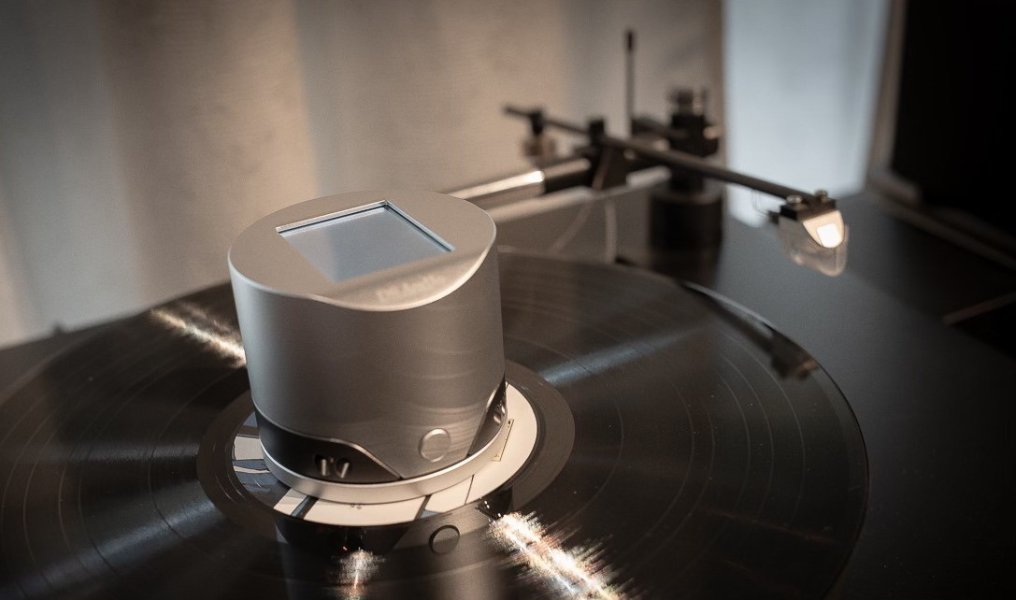
DS Audio ES-001 Eccentricity Detection Stabilizer

I considered it in 2023 and in the end decided that if my records are flat (I use the German API flattener), then other things are more important, such as eccentricity.
Vacuum hold-down isn’t primarily about flattening records during playback. That can be a side benefit, but the real purpose is to ensure uniform, tight coupling between the record and the platter mat across the entire record surface—not just around the label area, which is the only region clamps can actually press down.
 
  • Like
Reactions: thekong
Seems like all modern ultra high-end (except for SAT, but their TT is not great for what they charge) have chosen to skip vacuum hold down.
Either they don’t have the technology to implement proper vacuum hold-down, or they’re simply choosing to skim people with fancy marketing and a basic clamp. At least they should accept this fact and add a washer and screw down clamp as the second best thing.

Many reviewers even say: Vacuum tables wow you at first with control and silence. Non-vacuum tables win you over long-term with musicality and emotional engagement.
I haven’t come across such claims, but IMO if you’re going to generalize that “many reviewers” say it, you’ll need to show more than two examples. Even then, their method is flawed. Simply disengaging the vacuum hold-down is not a valid test. A proper comparison would require removing all the vacuum hold-down elements (rubber lips, etc.) from the platter and then listening with a different mat. None of them do that.

And what exactly is wrong with control and silence? If someone prefers the artificial vibrations caused by a floating or loosely coupled record, that’s their choice—but those artifacts are not what’s cut into the grooves.

 
I’ve heard the table with all Nagra (there best stuff) and not my cup of tea. The dohmann in the same set up preformed at a higher level. Dohmann is going to come out with vacuum for their table. Once you have vacuum you don’t go back.
 
Either they don’t have the technology to implement proper vacuum hold-down, or they’re simply choosing to skim people with fancy marketing and a basic clamp. At least they should accept this fact and add a washer and screw down clamp as the second best thing.


I haven’t come across such claims, but IMO if you’re going to generalize that “many reviewers” say it, you’ll need to show more than two examples. Even then, their method is flawed. Simply disengaging the vacuum hold-down is not a valid test. A proper comparison would require removing all the vacuum hold-down elements (rubber lips, etc.) from the platter and then listening with a different mat. None of them do that.

And what exactly is wrong with control and silence? If someone prefers the artificial vibrations caused by a floating or loosely coupled record, that’s their choice—but those artifacts are not what’s cut into the grooves.


They most likely have an LP 12 in their reference system … only jesting LP 12 devotee's ;)
 
  • Like
Reactions: mtemur
Either they don’t have the technology to implement proper vacuum hold-down, or they’re simply choosing to skim people with fancy marketing and a basic clamp. At least they should accept this fact and add a washer and screw down clamp as the second best thing.


I haven’t come across such claims, but IMO if you’re going to generalize that “many reviewers” say it, you’ll need to show more than two examples. Even then, their method is flawed. Simply disengaging the vacuum hold-down is not a valid test. A proper comparison would require removing all the vacuum hold-down elements (rubber lips, etc.) from the platter and then listening with a different mat. None of them do that.

And what exactly is wrong with control and silence? If someone prefers the artificial vibrations caused by a floating or loosely coupled record, that’s their choice—but those artifacts are not what’s cut into the grooves.

Right on the mark. You need to address your system if vacuum makes it sound sterile.
 
  • Like
Reactions: Argonaut
So please explain something. The DS cuts a new, bigger, more centered hole.
How does one re-position the record when one flips it to play Side B?
Why does the LP need "another" centre hole cut when playing the "already" centered record at a later date?
Would it not be possible for a DS type device to "close up" the original centre hole thus providing a totally secure "new" hole to locate the spindle?
Instead, to continuously cut new holes bigger and bigger than the original seems problematic in use.
 
Huh? DS cuts no hole. You maybe cut a hole one time, not all records need to be expanded.
 
So please explain something. The DS cuts a new, bigger, more centered hole.
How does one re-position the record when one flips it to play Side B?
Why does the LP need "another" centre hole cut when playing the "already" centered record at a later date?
Would it not be possible for a DS type device to "close up" the original centre hole thus providing a totally secure "new" hole to locate the spindle?
Instead, to continuously cut new holes bigger and bigger than the original seems problematic in use.

Here comes my question, would an off-centered hole be off-centered by the same amount and same direction on both sides of a record, ie. if I could drill a centered hole on one side, would the record still be centered when I flip it to the other side?

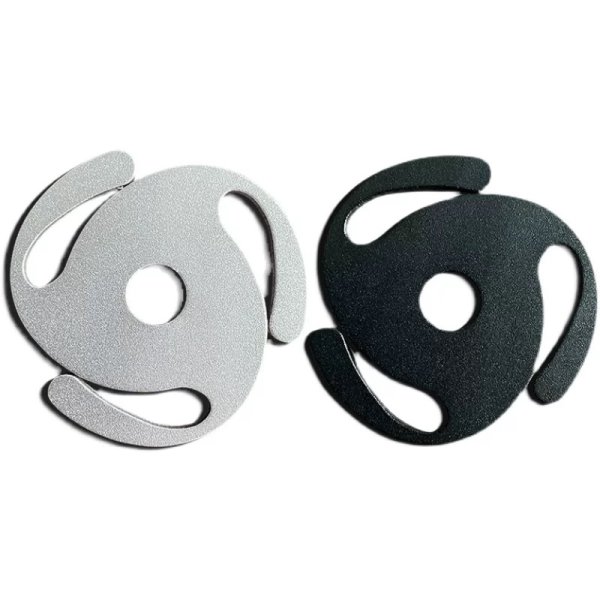
If the answer is positive, then I would think someone could design a small adaptor, much like those adaptors for 7” records, but with the hole position adjustable and then locked down! Then a much larger hole can be cut on the record to fit in the adaptor! This way, you don’t need to readjust the record before every play!

Something like these, but with adjustable hole:
 

Attachments

  • IMG_4376.jpeg
    IMG_4376.jpeg
    110 KB · Views: 1
Huh? DS cuts no hole. You maybe cut a hole one time, not all records need to be expanded.
Sorry, I thought it was the main device that did the reaming.
 
  • Wow
Reactions: Lagonda
Here comes my question, would an off-centered hole be off-centered by the same amount and same direction on both sides of a record, ie. if I could drill a centered hole on one side, would the record still be centered when I flip it to the other side?
The majority of records I've measured over the past few days have different offsets on both sides and require different corrections.
 
  • Like
Reactions: mtemur and thekong
Sorry, I thought it was the main device that did the reaming.
Lagonda, if you asked anyone not involved in this hobby what a device performing the function would do at the lofty pricetag of the DS, they'd expect *at the very least* for it to measure eccentricity, punch a hole & fill the space between the bigger hole and the spindle.
To do the job comprehensively.
 
  • Haha
Reactions: djsina2
Only the consumers get reamed by all devices
I'm a bit worried these comments are straying into 18+ adult material, and will need age verification.
 
  • Haha
Reactions: Lagonda
I'm a bit worried these comments are straying into 18+ adult material, and will need age verification.
No one on an audio forum is below 50 these days.
 
No one on an audio forum is below 50 these days.
This isn't their old dad's Playboy.
At this rate, WBF will fall foul of our Online Safety Act.
 
  • Like
Reactions: rDin
Personally, I think that the ES-001 is suitable for centering TEST RECORDS. Excellent. Otherwise, destroying LP records .....crazy and unacceptable!!


Holbo mk2 + ds.jpg
 
Last edited:
Lagonda, if you asked anyone not involved in this hobby what a device performing the function would do at the lofty pricetag of the DS, they'd expect *at the very least* for it to measure eccentricity, punch a hole & fill the space between the bigger hole and the spindle.
To do the job comprehensively.
No Mark you have to do the "reaming" yourself !:eek:
 
Otherwise, destroying LP records
Some new records actually need reaming if the hole is smaller than the spindle. And some records are pressed with holes wider than spindles. Are they destroyed? Of course not. It's true that reaming a record will forever change it, but we're only talking small amounts and as most of us have lived very happily for decades with off centred records, it's not really changing much most would even notice. Plus you can drop the record on the platter with the new hole centred around the spindle and it will play exactly as it did previously.
 
  • Like
Reactions: mtemur and gds7368
One ream and you're done for good?
This is not something that has to be done every listen?
And removing the DS (my TT is not designed to be used with a heavy weight) doesn't disturb the new correct alignment.
My spindle must be a tad wider than most, very little wiggle room when the LP is on the platter.
 
One ream and you're done for good?
This is not something that has to be done every listen?
And removing the DS (my TT is not designed to be used with a heavy weight) doesn't disturb the new correct alignment.
My spindle must be a tad wider than most, very little wiggle room when the LP is on the platter.
You’re really stuck on this reamimg. Why would you need to do it more than once? Sorry, I can’t understand what you’re thinking. Maybe watch a video on YouTube to get a better understanding of the process.
 

About us

  • What’s Best Forum is THE forum for high end audio, product reviews, advice and sharing experiences on the best of everything else. This is THE place where audiophiles and audio companies discuss vintage, contemporary and new audio products, music servers, music streamers, computer audio, digital-to-analog converters, turntables, phono stages, cartridges, reel-to-reel tape machines, speakers, headphones and tube and solid-state amplification. Founded in 2010 What’s Best Forum invites intelligent and courteous people of all interests and backgrounds to describe and discuss the best of everything. From beginners to life-long hobbyists to industry professionals, we enjoy learning about new things and meeting new people, and participating in spirited debates.

Quick Navigation

User Menu

Steve Williams
Site Founder | Site Owner | Administrator
Ron Resnick
Site Owner | Administrator
Julian (The Fixer)
Website Build | Marketing Managersing