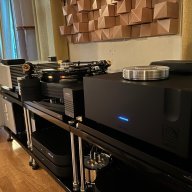
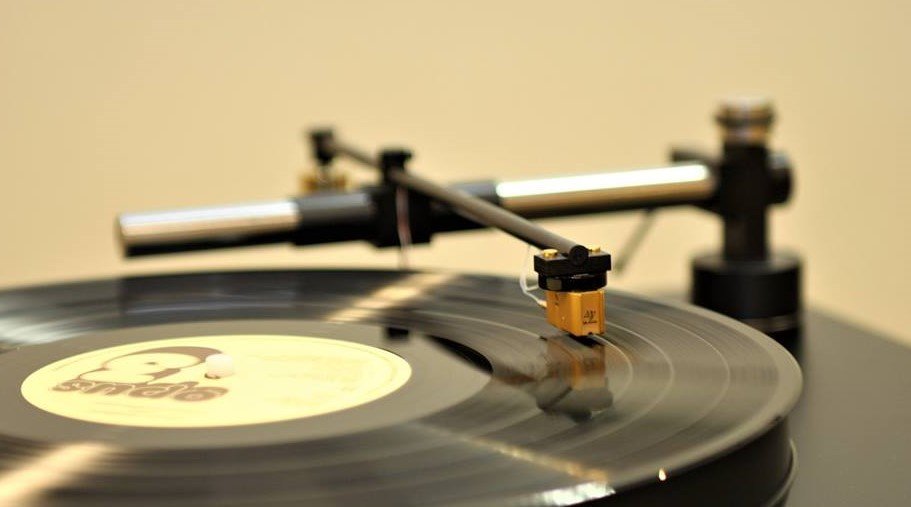
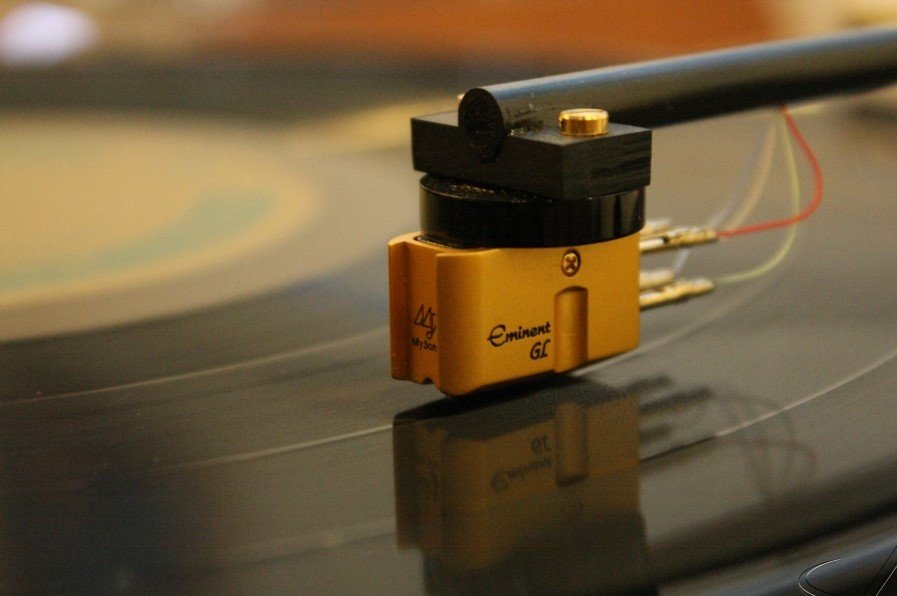
My personal journey to MY SONIC LAB

Gentlemen, may I ask for your advice regarding tonearm cables suitable for MYSL cartridges in this new thread?
 
I tried a new Furutech Project V1 Phono cable (DIN) and was just blown away by the sonic improvements. The clarity and weight along with detail to die for.

(Dealer disclaimer)
 
  • Like
Reactions: engadin and Johan K
I tried a new Furutech Project V1 Phono cable (DIN) and was just blown away by the sonic improvements. The clarity and weight along with detail to die for.

(Dealer disclaimer)
Congratulations @SOS , sounds cool !

/ Jk
 
Another dumb question:
Cartridge screws for MY Sonic Lab are 2.6mm?
 
Well, yes, most are 2.5mm, some are 2.6mm.
Are you sure MYSL are 2.5mm?
 
I can also confirm they are standard 2.5 mm

MY S A.jpgMy Sonic Lab P S.jpg
 
Last edited:
Last edited:
  • Love
Reactions: Johan K
Hmmm.
All Techdas and Yamamoto Titanium screws I found are 2.6mm.
I will look for Grade 5 6Al-4V M2.5 Titanium screws.
Recommendations?
 
  • Like
Reactions: Johan K and engadin
Danke sehr!
 
Last edited:
  • Like
Reactions: DasguteOhr
Hmmm.
All Techdas and Yamamoto Titanium screws I found are 2.6mm.
I will look for Grade 5 6Al-4V M2.5 Titanium screws.
Recommendations?
They conform to Japanese standard for screw pitch. They don’t screw into metric nuts. I couldn’t install Techdas titanium screws to Benz cartridges but no problems with Kondo IO-M.
 
  • Like
Reactions: Johan K

My Personal Journey with My Sonic Lab: Four Years with the Signature Gold and Two Weeks with the Signature Platinum​


Before sharing my experiences with the My Sonic Lab Signature Gold and Signature Platinum, I want to extend a sincere thank-you to @shakti for starting this terrific thread, “My personal journey to MY SONIC LAB.” His insights and enthusiasm were a big part of what encouraged me to pursue MSL in the first place, and this thread has become one of the most informative and inspiring discussions on My Sonic Lab cartridges.

I also want to thank @PeterA, who sold me my first MSL cartridge — the Signature Gold — back in 2021. Peter was an absolutely outstanding seller: honest, communicative, transparent, and genuinely kind throughout the entire process. That experience set the tone for everything that followed in my MSL journey.

And finally, a heartfelt thank-you to all the members who have contributed to this thread over the years. Your collective expertise, listening impressions, system configurations, and thoughtful observations have made this a truly valuable resource. What follows is my contribution to that ongoing conversation.
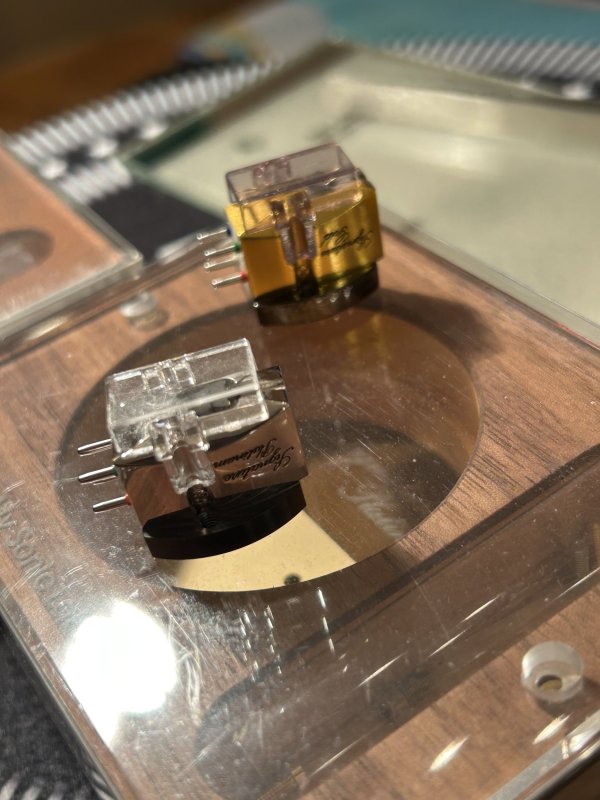
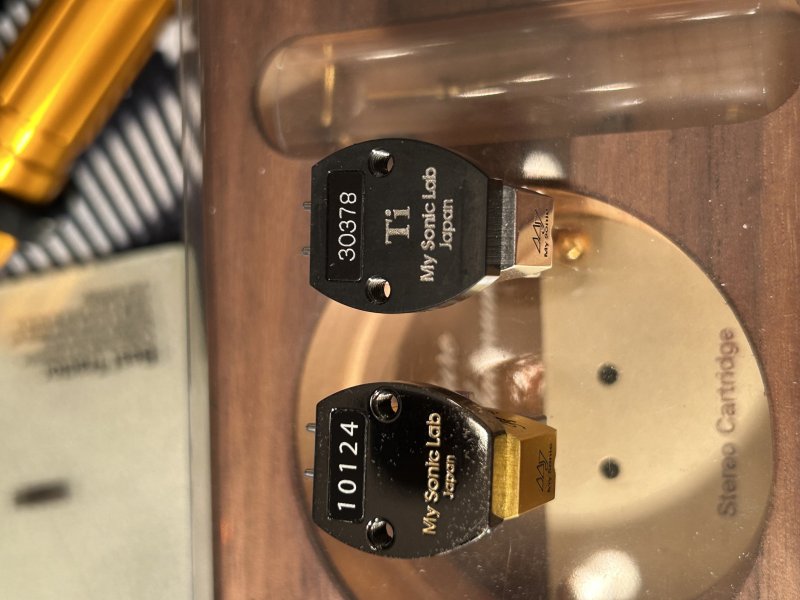
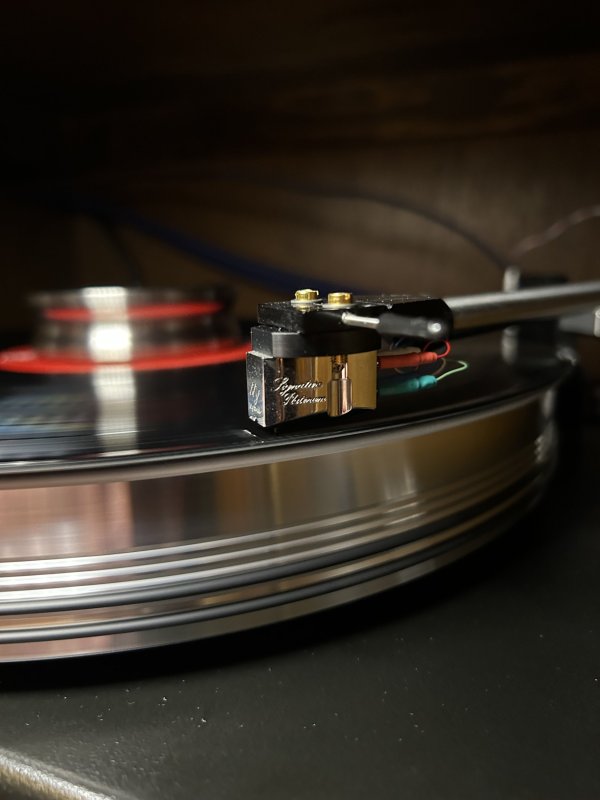
IMG_4542.jpgIMG_4538.jpg

Four Years with the MSL Signature Gold​


I lived with the My Sonic Lab Signature Gold for nearly four years, putting roughly 1,700–2,000 hours on it, and it was one of the most musically satisfying components I’ve ever owned. The Gold always had this ability to pull me into the music with a presentation that was both high in energy and yet warm, dimensional, and beautifully fluid. It never sounded etched or analytical — just natural, engaging, and extremely easy to listen to for long sessions.

Throughout that time, I paired the Gold with a Music First Audio SUT, and the synergy was remarkable. With the cartridge’s 1.4Ω DCR and the SUT’s 1.3Ω primary coil impedance, the electrical matching was nearly perfect. Most discussion around MC/SUT pairing focuses on voltage gain and loading, but the often-overlooked X-factor is the relationship between the cartridge’s internal impedance and the SUT’s primary coil impedance. This single ratio affects bandwidth, transient behavior, noise floor, and energy transfer — and the Japanese have respected this principle for decades.

This perfect electrical match is fed directly into my Decware ZP3, a phono stage that plays a significant role in the system’s overall transparency and musical immediacy. The ZP3 uses a split passive RIAA network with no negative feedback, and its tube-rectified, tube-regulated power supply with DC heaters contributes greatly to its purity and liquidity.

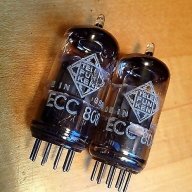
I also personally modified my ZP3 circuit to allow the use of 12AT7 and E80CC tubes in the V1 gain position. These tubes handle a 10mV input signal extremely well — with the 20× gain of the Music First SUT — and they maintain composure, headroom, and harmonic integrity. This modification gave the ZP3 a more robust dynamic envelope and a cleaner presentation with high-output SUT-fed signals, pairing remarkably well with both the Signature Gold and Signature Platinum.

The first time I heard the Gold through the Music First SUT at 20× (resulting in ~10mV into the modified ZP3), the sound was explosive and startlingly alive. The sense of dynamic energy reminded me of the scene in the original Ghostbusters film when the proton streams cross — a controlled surge of power opening another dimension. It also carried the same feeling as the Ma Liang and the Magic Paintbrush: like each stroke of the stylus was painting vivid musical images into existence.

That was the Signature Gold for me: emotional, textured, powerful, and deeply musical.

The Ogura Stylus Difference: PH (Gold) vs PA (Platinum)​


A major — but often underappreciated — reason I believe the Signature Gold and Signature Platinum have different sonic personalities comes from their different Ogura Vital stylus geometries and how they are mounted.

Signature Gold
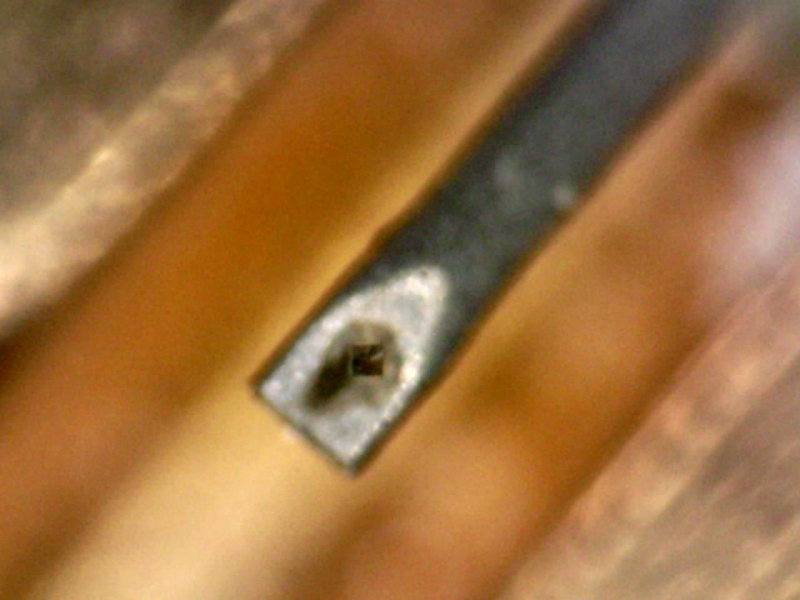
  • Uses an Ogura Vital PH stylus (~35 × 8 µm) - if anyone with more stylus knowledge disagrees, please correct me if the Signature Gold uses a different Ogura stylus.
  • Long vertical contact area
  • Wider minor radius
  • Mounted in an intentional angled orientation (~45°)
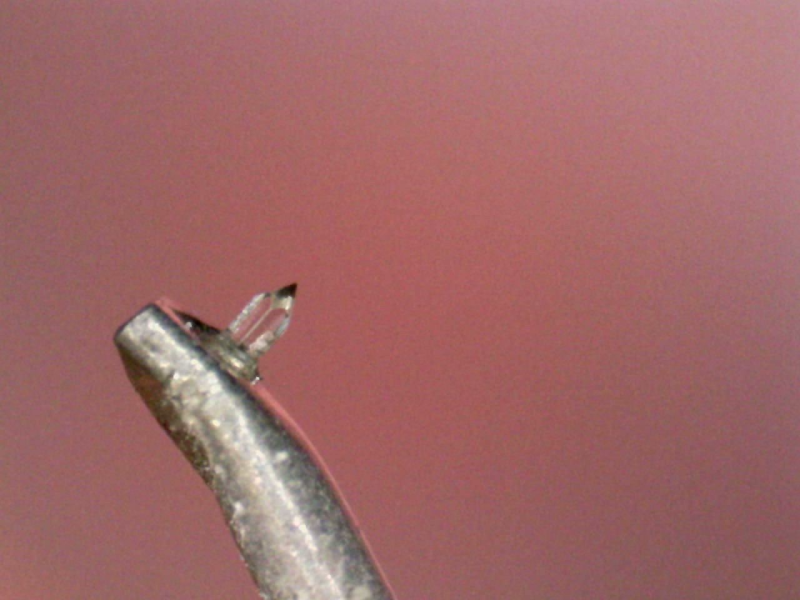
20251203_213232924.png

20251203_163824600.png
This stylus shape emphasizes:
  • warm tonal density
  • smooth, forgiving high frequencies
  • atmospheric layering
  • a weightier, more saturated presentation

Signature Platinum

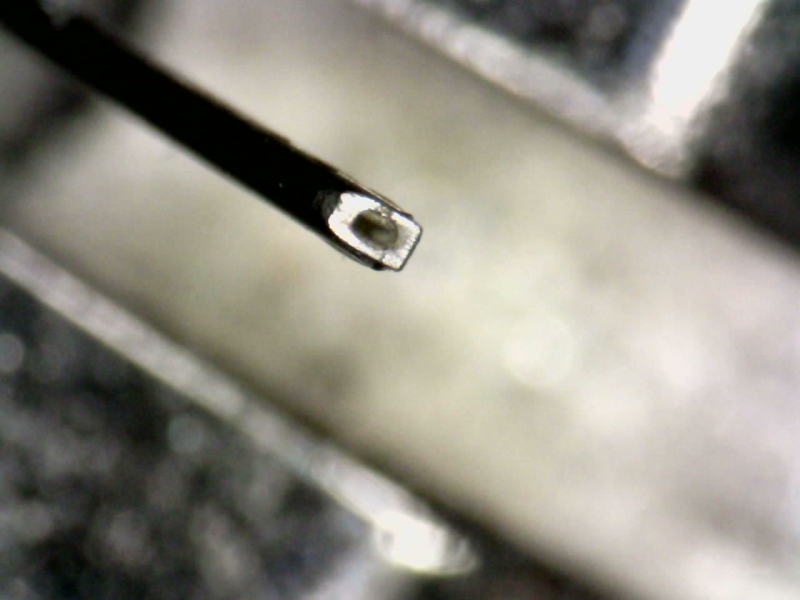
  • Uses an Ogura Vital PA stylus (30 × 3 µm)
  • Extremely fine minor radius
  • Short, highly precise contact line
  • Mounted perfectly straight, perpendicular to the groove
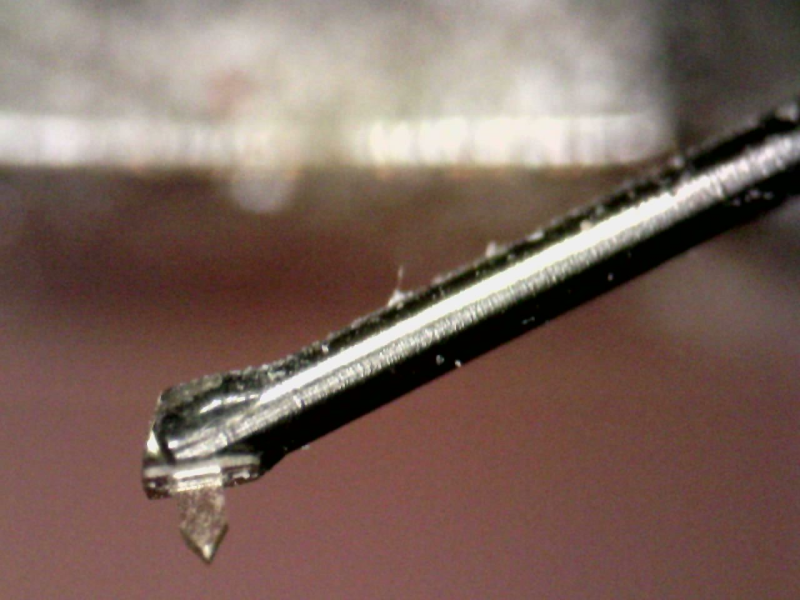
20251201_070636680.png
20251130_141827674.png

This stylus shape delivers:
  • higher resolution
  • faster transient behavior
  • cleaner microdynamic shading
  • more holographic imaging and spatial precision
These stylus differences explain much of the familiar-but-elevated character the Platinum exhibits compared with the Gold.

Two Weeks with the Signature Platinum — The Gold, Elevated​


I installed the My Sonic Lab Signature Platinum two weeks ago, and I immediately heard the same familiar MSL “house sound” I loved in the Gold — just elevated in every meaningful way. The Platinum improves each aspect of performance by roughly 10–20%, depending on the recording:
  • Greater delicacy and nuance
  • Stronger macro and micro-dynamics
  • Higher clarity and transparency
  • A larger, more holographic soundstage
  • Better layering front-to-back and side-to-side
  • More liquidity, smoothness, and overall musical ease
What impressed me most was how natural the improvement felt. The Platinum doesn’t change the character of the Gold — it expands and elevates it. All the warmth, dimensionality, and musical flow I loved in the Gold are preserved, but with more truth, more space, and greater emotional immediacy, without becoming analytical or sterile.

A small setup note: I settled on 2.11g VTF, which brought out ideal midrange balance and locked in the presentation.

Final Thoughts​


What impresses me most is how proportional the improvement is. The Platinum costs more, but the performance gain feels fully justified. It’s not one of those upgrades where the price increases dramatically but the improvement is subtle. Instead, it delivers more of everything that made the Gold so compelling — greater refinement, dimensionality, realism, and emotional engagement.

I’m extremely happy with the cartridge. The Platinum feels like the natural evolution of everything I loved about the Gold — familiar in its musical soul, but elevated in every meaningful sonic dimension.
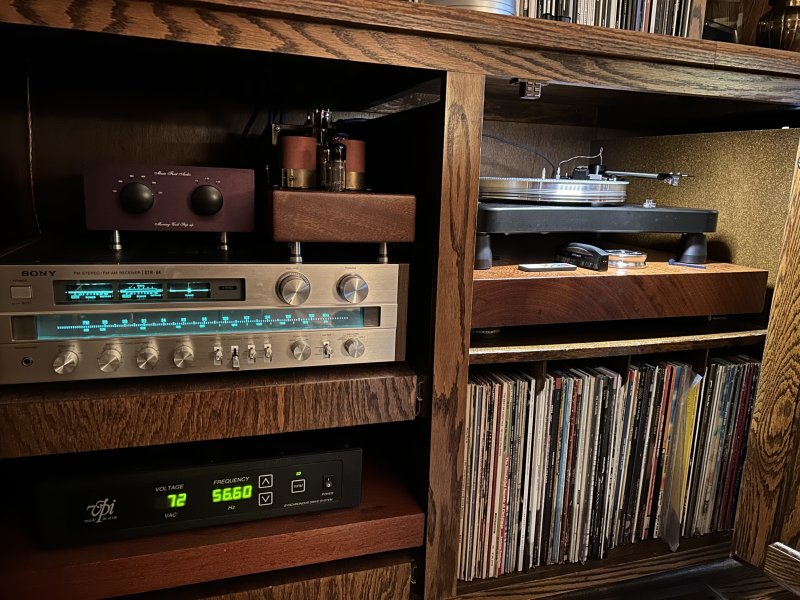
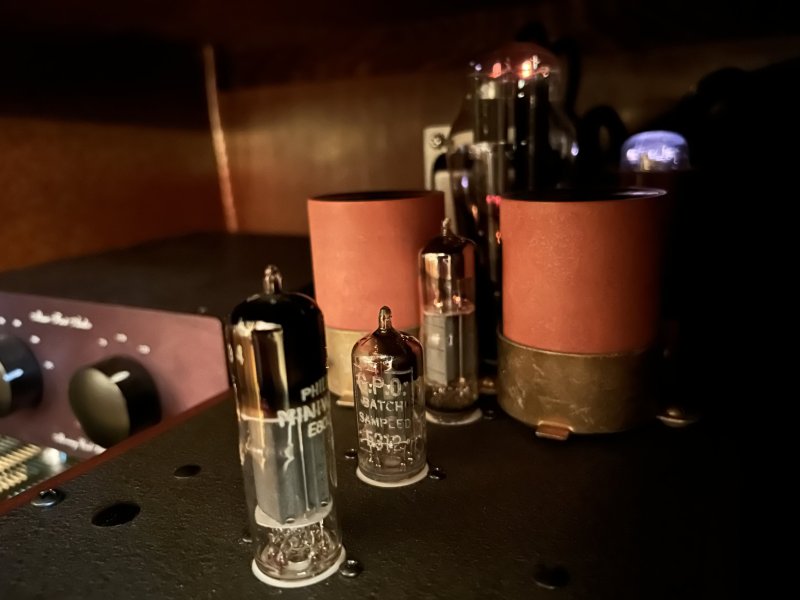
IMG_4822.jpgIMG_4823.jpgIMG_4560.jpg
 
Last edited:
@surfers5 GREAT write-up. I initially started with the Sig Gold, then after many months, bought a Sig Platinum. Now listening to the Sig Diamond. Here are my thoughts on the 3 in my system.

The Platinum offers a bit more low-level detail—nothing dramatic, but noticeable—and presents more micro-information throughout. With both MSL cartridges (Gold & Platinum), the sound between the speakers becomes strikingly un-hi-fi: less mechanical and far more “you are there.”

From my perspective, the Gold remains the more musical of the two, with a slightly euphoric character that I personally enjoy. The Platinum is more even across the frequency range, and I suspect classical listeners may prefer its balance.

Both cartridges convey an impressive sense of physical presence, as if real human bodies and instruments occupy the recorded space—a trick no other cartridge I’ve owned has managed. Overall, the Platinum comes across as a bit more polite (relative only to the Gold), well-mannered, highly detailed, and capable of producing a large, expansive soundstage.

As for the MSL Sig Diamond ……. Well combine both the Gold and Platinum and add some fairy dust (or diamond dust) and be prepared to require Depends during your listening sessions. Not much more I can say other than try and get one to hear, it will not disappoint.

Of note: for some reason, I liked the Platinum better on the CS Port AFU-1 linear tracker than on the Kuzma Safir arm. The Diamond sings on either.
 
Last edited:
@SOS Thanks for the kind words — I really enjoyed reading your impressions. They track closely with what I’ve heard as well, especially your descriptions of the Gold vs. Platinum personalities and that uncanny sense of physical presence both cartridges convey.

I very much look forward to eventually adding a Signature Diamond to complete the My Sonic Lab journey I’m on, and I’ll be sure to share a similarly detailed post when that time comes. See you all in 1,500+ listening hours.

Follow-up / clarification:

In my earlier post, I used the term primary impedance when referring to the Music First SUT. What I meant more precisely was its very low primary winding DC resistance (~1.3 Ω). The My Sonic Lab Signature is specified at ~1.4 Ω internal impedance, which in this very low-inductance MC design is effectively dominated by DC resistance across the audio band. It was this close relationship at the electrical interface between the cartridge’s generator coils and the SUT’s primary winding that I was describing. On first listen, it felt like a perfect handshake — freer current flow, reduced damping, better microdynamics, a lower perceived noise floor, and faster, more natural transients. Apologies for the loose terminology; the listening impressions remain unchanged.

IMG_4222.jpeg


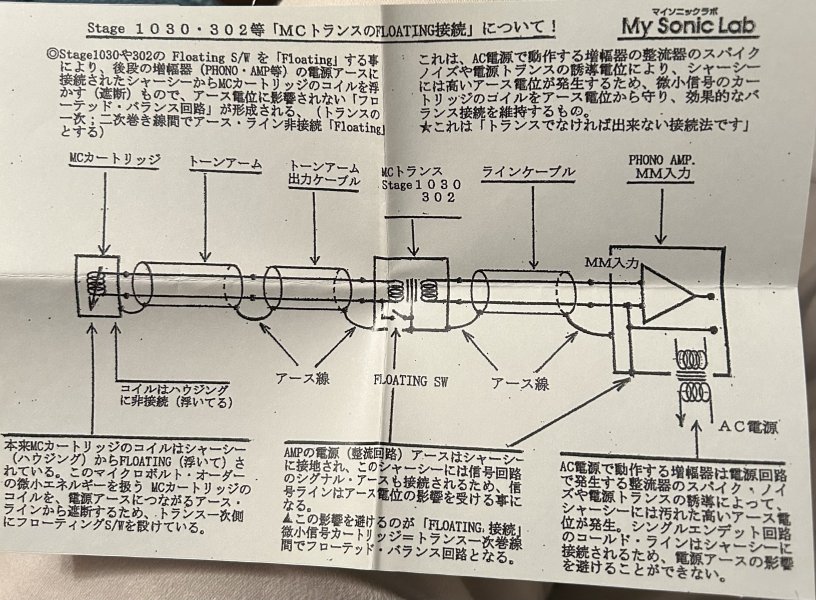
The Japanese sheet included with the Signature Platinum describes My Sonic Lab’s own MC step-up transformer and emphasizes the importance of maintaining a floating connection at the cartridge interface. It assumes that a SUT is part of the signal path and focuses on keeping the cartridge’s generator coils electrically isolated until they reach the SUT primary, preserving signal integrity and providing galvanic isolation from the phono stage’s ground and power supply. While not stated as a hard requirement, the explanation strongly suggests that the Signature cartridges are designed and voiced with transformer coupling in mind.

VTF findings: Gold vs Platinum

Another big finding for me was VTF, especially with the Signature Platinum. I ran the Signature Gold at 2.0 g, which was ideal in my system. With the Platinum, after more than 14 hours over two days dialing things in, I ended up higher — first 2.11 g, now settled around 2.09 g. To my ears, the Platinum really comes alive at ~2.05–2.10 g. At 2.0 g it sounded more neutral and aligned with most Gold-vs-Platinum descriptions, but adding 0.05–0.10 g brought back the Gold’s warmth, liveliness, and midrange density while keeping the Platinum’s added refinement and detail.

Why higher VTF makes sense with the Platinum

Technically, this makes sense. The Platinum’s stiffer titanium body has less self-damping than the Gold’s aluminum body, so more energy is reflected back into the cantilever-generator system. Combined with a very stiff, low-damping boron cantilever, the Platinum benefits from slightly higher VTF to improve groove contact and mechanical stability under dynamic load. The Gold reaches that balance at 2.0 g thanks to its higher damping; the Platinum needs a bit more force to fully lock in. What I heard — more body, cleaner transients, and noise that starts and stops more decisively — fits that picture well.

Different tonearms and cantilevers

@SOS Regarding your arm observations, I think the difference between the Signature Platinum (boron cantilever) and the Signature Diamond (solid tapered diamond cantilever) explains what you’re hearing. Boron, while very stiff, is still more sensitive to skating forces and energy return from the arm, which can favor a linear tracker like the CS Port AFU-1. The Diamond’s diamond cantilever is stiffer, faster, and stores less energy, making it far less dependent on arm type — hence why it “sings” on both the AFU-1 and the Kuzma Safir. I also find the simple, rigid design of my VPI JMW-9 unipivot to be an excellent match for My Sonic Lab cartridges, very much in line with Yoshiaki Matsudaira’s preference for stiff, straightforward arms without added voicing. More generally, unipivots tend to sound more alive because their minimal bearing structure lets groove energy flow more freely, which pairs beautifully with the Signature cartridges’ “you are there” presentation.

Based on all this, I actually expect the Signature Diamond to be an even better match for my JMW-9 than the Signature Platinum. Its stiffer, faster, lower-energy-storage cantilever should be more self-stabilizing and less sensitive to the unipivot’s lateral freedom, allowing the system to behave more coherently overall.
 
Last edited:
  • Like
Reactions: SOS

About us

  • What’s Best Forum is THE forum for high end audio, product reviews, advice and sharing experiences on the best of everything else. This is THE place where audiophiles and audio companies discuss vintage, contemporary and new audio products, music servers, music streamers, computer audio, digital-to-analog converters, turntables, phono stages, cartridges, reel-to-reel tape machines, speakers, headphones and tube and solid-state amplification. Founded in 2010 What’s Best Forum invites intelligent and courteous people of all interests and backgrounds to describe and discuss the best of everything. From beginners to life-long hobbyists to industry professionals, we enjoy learning about new things and meeting new people, and participating in spirited debates.

Quick Navigation

User Menu

Steve Williams
Site Founder | Site Owner | Administrator
Ron Resnick
Site Owner | Administrator
Julian (The Fixer)
Website Build | Marketing Managersing