










Active Crossovers
- Thread starter Kingrex
- Start date
You are using an out of date browser. It may not display this or other websites correctly.
You should upgrade or use an alternative browser.
You should upgrade or use an alternative browser.
A passive does not have EQ and it doesn't really have timing. Although the cutoff slope will alter phase.Building a cross over may not be too hard., once one knows what they want (or need)..
Or course know what is needed, and what to build, may be very difficult.

Yeah - but one can apply timing with a DSP.A passive does not have EQ and it doesn't really have timing. Although the cutoff slope will alter phase.
And using that data, one could likely noodle out how to stagger the drivers mechanically/spatially to achive the delays accousicly.
So once a decent sound is achieved, then iterate on putting the drivers in some “box” to match.
Good point. I just bought that little Dayton crossover.Yeah - but one can apply timing with a DSP.
And using that data, one could likely noodle out how to stagger the drivers mechanically/spatially to achive the delays accousicly.
So once a decent sound is achieved, then iterate on putting the drivers in some “box” to match.
REW can use external signal with loop back to the software. A sine wave sweep is better as it can then be transformed into an impulse response.Why Bluetooth. Qobuz has pink noise. A laptop with REW and a microphone don't need a connection to the audio system or DAC? Do they?
I got a Daytoon Audio DSP 408 and tried it out. Interesting. Very different than passive. I tried biamping with my Musical fidelity A3cr and the Blade tube amp. I did this before, all passive. The stock crossover has biamp capability. It was a disaster. The bass was heavy and thick and out of balance volume wise.
With the DSP 408, I used only the A3cr through the DSP to the 15 inch woofers. The Blade tube amp still went direct to the passive crossover and was fed direct from the preamp. The Blade powers the 10 inch and the horn tweeter. This time the sound was?????? It wasn't thick. It wasn't thin. There was more bass, but it was not better bass. I then put my horn sub through the DSP. When I added that in, I was shocked how much more natural the bass sounded. Much more real. This was not at all what I hear when I have the entire speaker through the tube amp. With the speaker all on the Blade tube amp, the bass becomes more pronounced with the horn sub, but it is more natural and real from the start, so that does not stand out as an attribute of adding in the sub.
When I turned it up, it got horrible. Just gross. I turned it off and walked away. I need to go back and test some more. I also need to get REW set up on my laptop and start using an AI to model my speaker placement. I think what this taught me was, my setup really sucks. My room is a disaster.
With the DSP 408, I used only the A3cr through the DSP to the 15 inch woofers. The Blade tube amp still went direct to the passive crossover and was fed direct from the preamp. The Blade powers the 10 inch and the horn tweeter. This time the sound was?????? It wasn't thick. It wasn't thin. There was more bass, but it was not better bass. I then put my horn sub through the DSP. When I added that in, I was shocked how much more natural the bass sounded. Much more real. This was not at all what I hear when I have the entire speaker through the tube amp. With the speaker all on the Blade tube amp, the bass becomes more pronounced with the horn sub, but it is more natural and real from the start, so that does not stand out as an attribute of adding in the sub.
When I turned it up, it got horrible. Just gross. I turned it off and walked away. I need to go back and test some more. I also need to get REW set up on my laptop and start using an AI to model my speaker placement. I think what this taught me was, my setup really sucks. My room is a disaster.
Mixing amp technology for active biamp usually doesn’t sound very good. At least get a second Blade amp. I thought you had concluded that the MF amp sounded like crap anyway?I got a Daytoon Audio DSP 408 and tried it out. Interesting. Very different than passive. I tried biamping with my Musical fidelity A3cr and the Blade tube amp. I did this before, all passive. The stock crossover has biamp capability. It was a disaster. The bass was heavy and thick and out of balance volume wise.
With the DSP 408, I used only the A3cr through the DSP to the 15 inch woofers. The Blade tube amp still went direct to the passive crossover and was fed direct from the preamp. The Blade powers the 10 inch and the horn tweeter. This time the sound was?????? It wasn't thick. It wasn't thin. There was more bass, but it was not better bass. I then put my horn sub through the DSP. When I added that in, I was shocked how much more natural the bass sounded. Much more real. This was not at all what I hear when I have the entire speaker through the tube amp. With the speaker all on the Blade tube amp, the bass becomes more pronounced with the horn sub, but it is more natural and real from the start, so that does not stand out as an attribute of adding in the sub.
When I turned it up, it got horrible. Just gross. I turned it off and walked away. I need to go back and test some more. I also need to get REW set up on my laptop and start using an AI to model my speaker placement. I think what this taught me was, my setup really sucks. My room is a disaster.
Kingrex, I know you are much more savy when it comes to audio than me even though i have been in high end audio for a long time. I have found passive room equalization for me the best way to remedy deficiences in my sonics. any kind of active equalization can be immediately noticed. in looking at your system it's quite exotic. i have tried to keep my system as simple as possible. i use nothing but audioquest topline which means my system uses wel signature and dragons largely and Niagara power conditioners. I use mcintosh tubes An gear, high power mcintosh tube amp, and Wilson speakers. with the proper room passive equalization to my ears i have a beautiful sound top to bottom. i don't know but perhaps your system is too exotic. baffeless speakers, Audion set amp , Found very low power expensive tube pentode/triode amp but top quality, etc. there comes a time when systems are too boutique. on paper your system is "perfect". you belive your problem is purely your room??
Charles Updated System: Wilson McIntosh Audioquest HiFi Rose
Amps: McIntosh: MC3500MKII (2); MC1.25KW (2); MC2.1KW Anniversary
Preamp: C-12000 Anniversary
Sources: MCD12000 Anniversary; MVP881; MVP851; MR87; Marantz 510LV; Lenovo Yoga laptop
Speakers: Wilson Chronosonic XVX
Sub-Woofer: Wilson Thor’s Hammer; Wilson ActivXO Stereo Electronic Crossover
Cables Main System AQ: WEL Signature speaker cables; 24’ balanced IC; balanced 1-meter Dragon IC ; WEL Signature digital, Coffee digital coaxial cables; Diamond optical (2); Diamond USB; Dragon (5 HC, 3 source cords); Thunder & Monsoon power cords
Cables Subwoofer System AQ: Redwood speaker cable; Wolf balanced subwoofer IC; Wind balanced IC to ActivXO; Hurricane HC; Firebird HC; Firebird Source; Dragon HC, power cords
Power Conditioners: AQ Niagara 7000; Niagara 5000 (3); (4) dedicated 20-amp lines.
Streaming System: Hi Fi Rose 130RS Network Transport; Samsung internal SSD; Audioquest Wel Signature digital balanced 1-meter IC; Audioquest Diamond 1.5-meter USB cable; Audioquest Dragon 2-meter source power cord; HDMI cable 24’ for music videos, recent internet upgrade with two eero Max7's added
Isolation: Wilson Pedestals; Bassocontinuo McIntosh Ultra Feet; X-material plinth
Cabinet: Double Custom Woodwork & Design (CWD)
Acoustic Treatments: Room and Echo Tunes
Charles Updated System: Wilson McIntosh Audioquest HiFi Rose
Amps: McIntosh: MC3500MKII (2); MC1.25KW (2); MC2.1KW Anniversary
Preamp: C-12000 Anniversary
Sources: MCD12000 Anniversary; MVP881; MVP851; MR87; Marantz 510LV; Lenovo Yoga laptop
Speakers: Wilson Chronosonic XVX
Sub-Woofer: Wilson Thor’s Hammer; Wilson ActivXO Stereo Electronic Crossover
Cables Main System AQ: WEL Signature speaker cables; 24’ balanced IC; balanced 1-meter Dragon IC ; WEL Signature digital, Coffee digital coaxial cables; Diamond optical (2); Diamond USB; Dragon (5 HC, 3 source cords); Thunder & Monsoon power cords
Cables Subwoofer System AQ: Redwood speaker cable; Wolf balanced subwoofer IC; Wind balanced IC to ActivXO; Hurricane HC; Firebird HC; Firebird Source; Dragon HC, power cords
Power Conditioners: AQ Niagara 7000; Niagara 5000 (3); (4) dedicated 20-amp lines.
Streaming System: Hi Fi Rose 130RS Network Transport; Samsung internal SSD; Audioquest Wel Signature digital balanced 1-meter IC; Audioquest Diamond 1.5-meter USB cable; Audioquest Dragon 2-meter source power cord; HDMI cable 24’ for music videos, recent internet upgrade with two eero Max7's added
Isolation: Wilson Pedestals; Bassocontinuo McIntosh Ultra Feet; X-material plinth
Cabinet: Double Custom Woodwork & Design (CWD)
Acoustic Treatments: Room and Echo Tunes
Last edited:
Sounds like the first time you tried this with the stock crossover, you needed to do some level matching (your description sounds like the amp driving the bass was making too much power).I got a Daytoon Audio DSP 408 and tried it out. Interesting. Very different than passive. I tried biamping with my Musical fidelity A3cr and the Blade tube amp. I did this before, all passive. The stock crossover has biamp capability. It was a disaster. The bass was heavy and thick and out of balance volume wise.
With the DSP 408, I used only the A3cr through the DSP to the 15 inch woofers. The Blade tube amp still went direct to the passive crossover and was fed direct from the preamp. The Blade powers the 10 inch and the horn tweeter. This time the sound was?????? It wasn't thick. It wasn't thin. There was more bass, but it was not better bass. I then put my horn sub through the DSP. When I added that in, I was shocked how much more natural the bass sounded. Much more real. This was not at all what I hear when I have the entire speaker through the tube amp. With the speaker all on the Blade tube amp, the bass becomes more pronounced with the horn sub, but it is more natural and real from the start, so that does not stand out as an attribute of adding in the sub.
When I turned it up, it got horrible. Just gross. I turned it off and walked away. I need to go back and test some more. I also need to get REW set up on my laptop and start using an AI to model my speaker placement. I think what this taught me was, my setup really sucks. My room is a disaster.
But- Sounds like the horn sub is more efficient. So you need an electronic crossover with a level control to blend it with your main speakers. I don't think you could just hook the Blade up to it while it was also driving the main speakers.
Did the crossover you were using for the Blade limit bass to the crossover frequency?
Generally using an electronic crossover you have to adjust levels as well as the crossover frequency. I'd get an app that makes pink noise to drive your system and place a microphone at the listening position and see what you've got. This is pretty easy to do with an iPad. I don't trust the microphone in the iPhone that much but at this sort of thing its likely better than doing it by ear. That approach makes it much easier to set things up.
I believe you are all correct. Blending amps is a problem. My system is too boutique. At least as far as the speaker is concerned. I have altered it on an extreme level. I have not applied all the changes that have been suggested to me by others. So I am in a limbo land.
Ralph, I bought the DSP as its $100 and it was to level match the A3cr to the Blade. I crossed it at the same point as the passive. 600 to 700 hertz. Then adjusted the gain. That's all I did. What surprised me was how sonically different the sound was between the active and passive crossover. I think. I have to listen again. I think the passive was much thicker sounding and sort of grainy. The active is more thin and less grain. Less body and warmth.
I will most likely fiddle a little. But in the end, I have to get my room in order. New flooring. Some treatments. Then use the Blade amp only, my horn sub, and then try and add a couple other subs to reach lower in hertz. I was reading in another forum how a member is using AI to great affect. The AI analyzes the plots and graphs from REW, then tells you where to move your speakers. How to toe the speaker in. Then helps integrate the subs. As in placement as well as all the DSP settings. I asked my AI if it could help and it said absolutely.
I don't see any reason why a nice little 6 channel amp and a active crossover would not give great sound. DSP might be very useful. Jason the Audiophile Junkie has raved about active for years. Another guy I know is doing the same now and at the moment is very much liking what he hears. Using this cheap Dayton DSP.
I don't know that either passive or active in the end it better. I am sensing it will come down to taste. And how involved do you want to get.
I do believe I need to get into the passive crossover and replace some of the components with better parts. I was a bit surprised how much the 15 inch woofers going to 600 hertz influence the purity and natural sound of bass. Duuuuhh, Right!!!!! Those parts need to be as good as the parts going to the 10 and the horn.
Ralph, I bought the DSP as its $100 and it was to level match the A3cr to the Blade. I crossed it at the same point as the passive. 600 to 700 hertz. Then adjusted the gain. That's all I did. What surprised me was how sonically different the sound was between the active and passive crossover. I think. I have to listen again. I think the passive was much thicker sounding and sort of grainy. The active is more thin and less grain. Less body and warmth.
I will most likely fiddle a little. But in the end, I have to get my room in order. New flooring. Some treatments. Then use the Blade amp only, my horn sub, and then try and add a couple other subs to reach lower in hertz. I was reading in another forum how a member is using AI to great affect. The AI analyzes the plots and graphs from REW, then tells you where to move your speakers. How to toe the speaker in. Then helps integrate the subs. As in placement as well as all the DSP settings. I asked my AI if it could help and it said absolutely.
I don't see any reason why a nice little 6 channel amp and a active crossover would not give great sound. DSP might be very useful. Jason the Audiophile Junkie has raved about active for years. Another guy I know is doing the same now and at the moment is very much liking what he hears. Using this cheap Dayton DSP.
I don't know that either passive or active in the end it better. I am sensing it will come down to taste. And how involved do you want to get.
I do believe I need to get into the passive crossover and replace some of the components with better parts. I was a bit surprised how much the 15 inch woofers going to 600 hertz influence the purity and natural sound of bass. Duuuuhh, Right!!!!! Those parts need to be as good as the parts going to the 10 and the horn.
You really need to get the bass right. If that's not right, if its lacking, the system can sound thin. If too much the system can sound muffled.I believe you are all correct. Blending amps is a problem. My system is too boutique. At least as far as the speaker is concerned. I have altered it on an extreme level. I have not applied all the changes that have been suggested to me by others. So I am in a limbo land.
Ralph, I bought the DSP as its $100 and it was to level match the A3cr to the Blade. I crossed it at the same point as the passive. 600 to 700 hertz. Then adjusted the gain. That's all I did. What surprised me was how sonically different the sound was between the active and passive crossover. I think. I have to listen again. I think the passive was much thicker sounding and sort of grainy. The active is more thin and less grain. Less body and warmth.
I will most likely fiddle a little. But in the end, I have to get my room in order. New flooring. Some treatments. Then use the Blade amp only, my horn sub, and then try and add a couple other subs to reach lower in hertz. I was reading in another forum how a member is using AI to great affect. The AI analyzes the plots and graphs from REW, then tells you where to move your speakers. How to toe the speaker in. Then helps integrate the subs. As in placement as well as all the DSP settings. I asked my AI if it could help and it said absolutely.
I don't see any reason why a nice little 6 channel amp and a active crossover would not give great sound. DSP might be very useful. Jason the Audiophile Junkie has raved about active for years. Another guy I know is doing the same now and at the moment is very much liking what he hears. Using this cheap Dayton DSP.
I don't know that either passive or active in the end it better. I am sensing it will come down to taste. And how involved do you want to get.
I do believe I need to get into the passive crossover and replace some of the components with better parts. I was a bit surprised how much the 15 inch woofers going to 600 hertz influence the purity and natural sound of bass. Duuuuhh, Right!!!!! Those parts need to be as good as the parts going to the 10 and the horn.
You might be dealing with a standing wave in your room. No amount of DSP can fix that if the standing wave is cancelling bass energy. The DSP will simply tell the amp to make more power until it runs out of gas and it still won't be fixed.
The trick is to use the sub in a way that does not set up standing waves. Since bass below about 80Hz in most rooms is 100% reverberant you may have a way of doing this fairly simply. Aim the sub at a 45 degree angle to any wall (so the bass bounced like a cue ball) and see if that sorts it out; as long as its not active above 80 Hz getting it to blend should be easy. At about that frequency and above it can attract the ear's attention. You want it to work so you're not aware of its location. I'm having trouble with the idea of a horn loaded sub- a proper horn to go to 20Hz is usually quite large! So could you explain more about this sub- how low does it go and is it really a horn sub?
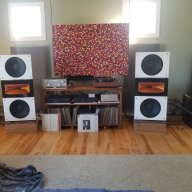
Your main speakers have rear firing information. On that account they need to be at least 5 feet from the wall behind them. Are they?
I took a listen again last night. I sort of fly off the rails when things are new, and quite different. I was sort of surprised. There is more there to like than I remember from the first listen. At lower volumes, its pretty good. As the volume goes up, it falls apart. There must be some sort of bass modes there. I am no where near trying to tune that out of the room. A bunch of floor and wall damping needs to be done.
My sub is already in a corner as its a horn and the corner is an extension of the throat.
I am 5 feet or more from the front wall.
My sub is already in a corner as its a horn and the corner is an extension of the throat.
I am 5 feet or more from the front wall.
I just realized why people don't like DSP. Why they say they can never get it dialed the way they want it. Why they say they are never 100% satisfied. Its not because there is a problem with DSP. Its because you can hear change you make. Adjusting only the gain of the woofers brings a pronounced change to the whole of the voice of the speaker. No one can do that with a passive speaker. Sure you can adjust the levels with resistors. But you can't immediately defeat, then turn back on the woofers. You can't shift the gain by 6 db, then back. You don't have immediate, very audible feedback on what you did. Even a half db is heard.
The impedance also impacts the sound. I had the drivers wired in series, 16 ohms. I was starting to feel it was ok. Then I tried parallel for 4 ohms. Yuck. Slow and tubby. I put it back to 16. Then I started to dial it back in as I also changed the wire from 14 to 12 awg. Sitting for a 4th time with it now I am getting a handle on the very simple software. I can easily defeat the woofers as well as the subwoofer. With the sub off I stated messing with the gain again. Its shocking how much it changes the voice of the speaker to boost or buck the 15 inch woofers that are crossed at 600 hertz with a 12 degree slope. Big changes. Heavy impact on vocals.
Now that I have more a handle on this device, I'm liking it. The woofers are more alive via DSP and a SS amp. There are less passive crossover losses/distortions/colors. The A3cr through the DSP sounds less obstructed. There is admittedly more power to the woofers. I have effectively doubled the power to the speakers. The woofers sound more clean yet a bit heavy weighted. There is more bass. But its is a little slower and less natural sounding than the Blade amp doing all the work. Its still good in its own way. I would not say its so far out its not integrating well. I think it could be a little better. And seeing how important the woofers are, a better crossover may be a benefit. But surprisingly, this one is not a wipe out. Its been a very useful tool.
The impedance also impacts the sound. I had the drivers wired in series, 16 ohms. I was starting to feel it was ok. Then I tried parallel for 4 ohms. Yuck. Slow and tubby. I put it back to 16. Then I started to dial it back in as I also changed the wire from 14 to 12 awg. Sitting for a 4th time with it now I am getting a handle on the very simple software. I can easily defeat the woofers as well as the subwoofer. With the sub off I stated messing with the gain again. Its shocking how much it changes the voice of the speaker to boost or buck the 15 inch woofers that are crossed at 600 hertz with a 12 degree slope. Big changes. Heavy impact on vocals.
Now that I have more a handle on this device, I'm liking it. The woofers are more alive via DSP and a SS amp. There are less passive crossover losses/distortions/colors. The A3cr through the DSP sounds less obstructed. There is admittedly more power to the woofers. I have effectively doubled the power to the speakers. The woofers sound more clean yet a bit heavy weighted. There is more bass. But its is a little slower and less natural sounding than the Blade amp doing all the work. Its still good in its own way. I would not say its so far out its not integrating well. I think it could be a little better. And seeing how important the woofers are, a better crossover may be a benefit. But surprisingly, this one is not a wipe out. Its been a very useful tool.
The Dayton is $200 new. A great tool to learn with. The guy I know likes it so much, he does not use the passive one with his speaker. He can't get a passive to dial in as precisely.
Get a used Behringer DCX 24/96. Extremely flexible digital crossover, no computer needed. It can also be modded to bypass the crappy op amps for a much better sound. But as a design tool it’s super easy and flexible.
Why
I have read where people say, crossing in the signal is just as bad a crossing after the amp. Some like the amp side better. They say you just need a more powerful amp. Thoughts
Why buy another crappy design tool. I have one already. I would rather spend the money on a quality crossover when ready.Get a used Behringer DCX 24/96. Extremely flexible digital crossover, no computer needed. It can also be modded to bypass the crappy op amps for a much better sound. But as a design tool it’s super easy and flexible.
I have read where people say, crossing in the signal is just as bad a crossing after the amp. Some like the amp side better. They say you just need a more powerful amp. Thoughts
What crappy design tool do you have?Why
Why buy another crappy design tool. I have one already. I would rather spend the money on a quality crossover when ready.
I have read where people say, crossing in the signal is just as bad a crossing after the amp. Some like the amp side better. They say you just need a more powerful amp. Thoughts
If you don't think you need something like this to get your system dialed-in then why all this gnashing of teeth from you about how to get this right? Maybe you just need to get someone over who knows his way around active setups to help you get it right?Why
Why buy another crappy design tool. I have one already. I would rather spend the money on a quality crossover when ready.
I have read where people say, crossing in the signal is just as bad a crossing after the amp. Some like the amp side better. They say you just need a more powerful amp. Thoughts
I started with the DCX 2496, it was a great design tool, very fast at finding the right xover points and slopes. In between I used a mini-DSP nano-digi with two DACs, that sounded great with digital but not great with analog (I needed a great A/D converter but didn't have one). Now I use an Accuphase F15L active crossover with an Ayon Spark SET on my mid-bass drivers and a Silvercore 2A3 SET on my horn tweeters. Crossover is 3rd order butterworth at 800Hz...similar settings to the last digital xover I used.
My endgame will likely be a Marchand X126 tube xover because I hear some negative effects from the transistor based Accuphase.
IMO, you could use your Blade and your SETs with a good active xover and forget using the crappy SS amp or class D amp in the Dayton.
I have the Dayton DSP 408. Its super fast and easy to dial in the slope, gain, phase, crossover point. Even has a full EQ. Can cut top and bottom on a 3 way. Its a nice tool. All I am saying is why buy another tool. I have one. If I proceed, I will eventually go active analog. Like a Merchand tube. Even those need to be modified. OCD Mike has a video on how his is built. No op amps.What crappy design tool do you have?
I will try the Blade and the 845. I don't think its going to work. Whats that Amp Ralph talks about. Dynaco ST70. I still think about a CJ Classic 62 SE for the woofers. Maybe a good 300B for the top and the Blade on the woofers. But the Blade has always been more detailed than rich. I am looking for a richer amp on those woofers. I think. Still learning where the music is most important. I am very surprised how important 600 hertz and down is for vocal and really the whole of the music.
Last edited:
Similar threads

- Replies
- 24
- Views
- 3K

- Replies
- 1
- Views
- 482
- Replies
- 0
- Views
- 969
 | Steve Williams Site Founder | Site Owner | Administrator |  | Ron Resnick Site Owner | Administrator |  | Julian (The Fixer) Website Build | Marketing Managersing |