





What's Best - Streamer / DAC / Preamp - Your Suggestions Please

Hear Here

Well-Known Member
Feb 14, 2020
950
596
205
Portsmouth, UK
Without busting the bank, I'm looking for a great all-in-one streamer / DAC / preamp.

I have no need for analogue so would prefer a digital only device, although bizarrely these seem scarce as hen's teeth, even in the 2020s!

What's out there of interest?

The Mark Levinson 519 looks ideal on paper, though a bit long in the tooth. Digital only so maybe top of my list!

Other costly options include Grimm MU2, Meitner MA3, Esoteric N-05XD, Lumin P1, Auralic Vega G2.2

More modern and better featured (and far less costly) options include the NAD M66, Eversolo MP-A10, HiFi Rose RS151, Cambridge Edge NQ

I'd love to think one of the lower priced devices would match the more costly ones, but I am prepared to consider all these and any others suggested, even if I have to search the used market.

This streamer preamp would be feeding a pair of Ralph's Atma-Sphere Class D mono amps (at least for the time being) and Avantgarde Duo XD speakers.

My speakers are full-range and very high sensitivity, but I have a pair of REL S812 subs that contribute virtually nothing at present as their gain (even at max volume) is far too low. DSP room correction is something I'm very wary of.

Music of various genres mainly from my ripped CD collection, or Qubuz. I'd need it to be controlled by user-friendly app that could be loaded onto Windows as well as iPad and Android, preferably without the additional hardware and subscription of Roon, though this isn't a deal-breaker as long as it's Room Ready.

If you have first-hand experience of any of these or other devices, or can offer advice, I'd be most grateful. Thanks.
 
A WADAX Studio Player may fit the bill. It has a streamer, DAC, CD/SACD player, but also a preamplifier section with adjustable output voltage and impedance …. Essentially 40k
 
Last edited:
  • Like
Reactions: mxk116
My favorite digital gear nothing comes close in long journey of digital devices
Review
 
Last edited:
dCS Lina Dac X is worth a look.
 
A friend lent me his Grimm MU2 and it is fantastic if you like Roon. Neither he nor I ever used the preamp function so no idea how good that is. If you are on a tight budget you can't go too wrong with the Eversolo A8 or A10. The Eversolo units don't reach the upper levels of sonic performance but are quite competitive with units costing twice as much. I use my A8 primarily as a Roon endpoint and I'm not a fan of the app but it is fully functional. I never used the A8 as a preamp.
 
You might consider a dcs Bartok. It has a good volume control and balanced output stages that can drive power amps directly. The DAC is very good, particularly after the Apex upgrade. The app is also good and dcs just released a firmware update to take advantage of Qobuz connect. I used it as a preamp for a time and it performed well. You could find a good used unit for $12-13k I would think, just make sure its the Apex version.
 
I am an ideal person to chat about this. I have the Esoteric streamer, and I use the Atma-Sphere Class D monos. I think the Esoteric is the contender to beat. There are some available used or demo for significantly less. I could send you some directions to look. I also have high sensitivity speakers that are 27hz to 30khz.

I moved from a Innuos Pulsar streamer, Holo Audio May Kitsune edition DAC, and Wyred 4 Sound STP-SE Stage 2 preamp.

We've used my Esoteric streamer for several digital shootouts and events with the Audiophile Society, and the consensus was that it was an excellent package that played well above its price point. Most people love the looks.

I've done extensive comparisons of my individual components to the same function of the Esoteric. The Esoteric DAC uses a scaled down circuit of the Master Sound Discreet DAC used in their reference. Comparing the Esoteric DAC against my May DAC, the Esoteric was even more organic and resolving, with better bass and treble extension. It also had a wider deeper more solid sound stage and image precision/density.

Compared to my Innuos Pulsar, the streaming is on par with one exception, streaming the same files from a local source vs Qobuz, the Pulsar won by a small amount. With the Pulsar there was no difference between streaming and local files through Roon, and there are very few streamers I've heard that can do this. This difference was minor, and in my case not a common occurrence as I listen mostly to local files, and when I find a streaming album I like on Qobuz, I usually buy the files for my local system. The ergonomic benefit of having the DAC and Pre in the same box as the streamer was also a big plus over separates. Much easier to control with one remote.

Comparing preamps, it was no contest, the Esoteric was quieter, more natural, significantly more dynamic with more slam, and better extensions top and bottom. All over just better. The Esoteric uses a scaled down circuit as that used in the Grandioso and it shows. I also use the XLR or RCA input of the Esoteric preamp to connect to my phono stage, where it words really well. The self noise of the preamp is among the lowest I've heard, even turned all the way up. It also has tons of noise free gain on the top (unlike my phono stages).

Together it was a fairly large leap up from my previous separates. Overall the sound is very organic with wide and deep soundstage, very refined highs, and full tight bass and lots of natural resolution. There is open liquid quality to it that is very addictive. Liquid is one of the words most people say when they hear it. It complements really nicely with the Class Ds. The last person to hear my system said that one word kept coming back to him - Beautiful. the So the Esoteric is a great match, and very much what I was looking for.

I have also started experimenting with external clocks and these have added an increased sense of analog clarity, resolution and liquidity to the sound. And I don't even have one of the better models. So there is further to go sonically, later, if you want more improvements.
 
Last edited:
  • Like
Reactions: Rexp
I am an ideal person to chat about this. I have the Esoteric streamer, and I use the Atma-Sphere Class D monos. I think the Esoteric is the contender to beat. There are some available used or demo for significantly less. I could send you some directions to look. I also have high sensitivity speakers that are 27hz to 30khz.

I moved from a Innuos Pulsar streamer, Holo Audio May Kitsune edition DAC, and Wyred 4 Sound STP-SE Stage 2 preamp.

We've used my Esoteric streamer for several digital shootouts and events with the Audiophile Society, and the consensus was that it was an excellent package that played well above its price point. Most people love the looks.

I've done extensive comparisons of my individual components to the same function of the Esoteric. The Esoteric DAC uses a scaled down circuit of the Master Sound Discreet DAC used in their reference. Comparing the Esoteric DAC against my May DAC, the Esoteric was even more organic and resolving, with better bass and treble extension. It also had a wider deeper more solid sound stage and image precision/density.

Compared to my Innuos Pulsar, the streaming is on par with one exception, streaming the same files from a local source vs Qobuz, the Pulsar won by a small amount. With the Pulsar there was no difference between streaming and local files through Roon, and there are very few streamers I've heard that can do this. This difference was minor, and in my case not a common occurrence as I listen mostly to local files, and when I find a streaming album I like on Qobuz, I usually buy the files for my local system. The ergonomic benefit of having the DAC and Pre in the same box as the streamer was also a big plus over separates. Much easier to control with one remote.

Comparing preamps, it was no contest, the Esoteric was quieter, more natural, significantly more dynamic with more slam, and better extensions top and bottom. All over just better. The Esoteric uses a scaled down circuit as that used in the Grandioso and it shows. I also use the XLR or RCA input of the Esoteric preamp to connect to my phono stage, where it words really well. The self noise of the preamp is among the lowest I've heard, even turned all the way up. It also has tons of noise free gain on the top (unlike my phono stages).

Together it was a fairly large leap up from my previous separates. Overall the sound is very organic with wide and deep soundstage, very refined highs, and full tight bass and lots of natural resolution. There is open liquid quality to it that is very addictive. Liquid is one of the words most people say when they hear it. It complements really nicely with the Class Ds. The last person to hear my system said that one word kept coming back to him - Beautiful. the So the Esoteric is a great match, and very much what I was looking for.

I have also started experimenting with external clocks and these have added an increased sense of analog clarity, resolution and liquidity to the sound. And I don't even have one of the better models. So there is further to go sonically, later, if you want more improvements.

Thanks Tuckers foir your comprehensive description of the Esoteric. I presume you are describing the N05-XD. This is on my short-list though I've just looked at Esoteric's website to read more - and a few posts about it on anothe high-end forum.

To that forum I unkindly wrote:

Pity about the grotty front panel screen. Is it realy a monochrome text-only display with no album artwork? If so, can it squirt album artwork artwork or other information to a connected TV? I don't think so with no HDMI socket. Can one see what music a classical radio station is playing for example?

I think for these reasons alone, I'll continue looking elsewhere - unless the Esoteric has a trick up its sleeve that I've missed. Thanks


And now I read your glowing recomendation! What do I think? I must say, I'd be very reluctant to consider any streamer that can't show me (and fellow listeners) what we're listening to, or what music a radio station is playing. The app is not much help if others can't see the iPad screen, but maybe Esoteric has an answer I've overlooked. I'd welcome your comments on this conundrum!

PS - This is also why the Innuos range isn't on my short-list.
 
Thanks Tuckers foir your comprehensive description of the Esoteric. I presume you are describing the N05-XD. This is on my short-list though I've just looked at Esoteric's website to read more - and a few posts about it on anothe high-end forum.

To that forum I unkindly wrote:

Pity about the grotty front panel screen. Is it realy a monochrome text-only display with no album artwork? If so, can it squirt album artwork artwork or other information to a connected TV? I don't think so with no HDMI socket. Can one see what music a classical radio station is playing for example?

I think for these reasons alone, I'll continue looking elsewhere - unless the Esoteric has a trick up its sleeve that I've missed. Thanks


And now I read your glowing recomendation! What do I think? I must say, I'd be very reluctant to consider any streamer that can't show me (and fellow listeners) what we're listening to, or what music a radio station is playing. The app is not much help if others can't see the iPad screen, but maybe Esoteric has an answer I've overlooked. I'd welcome your comments on this conundrum!

PS - This is also why the Innuos range isn't on my short-list.
Looks like that Esoteric unit is Roon ready, so you have tons of display options. Use a tablet with Roon, use a TV as a display, etc, etc.

 
  • Like
Reactions: Hear Here
Yes, you are correct the Esoteric display is not made to display album information, and indeed its not a strong point of the device in any way. I do use Roon, and in Roon you can select a display if that display accepts Google Chromecast type data (there may be other types of TV OS that work as well, but I have a Sony Google TV). You could also setup a small android/Samsung tablet and use Roon to connect to that display for always on display info. It might work with an iPad, but I just don't know much about Apple products.

I use a Samsung tablet to control Roon, and my Windows PC with a large screen in the room, and I get the amazing Roon interface to view Album info on both. iPads work great for that too. When I have guests, or a small party I send the display to big Sony TV that shows what playing from Roon. But have no need for it all the time.

Darko Audio (https://darko.audio/) has done some recipe videos about how to setup a small always on stand alone display to show Album info. I think you will find some good solutions there. I sit a fair distance from the rack and any streamer screen is too small for me to see well. So for me, I want the audio system to do audio best, and leave displays to something purpose built and larger to satisfy that need.

 
Last edited:
Yes, you are correct the Esoteric display is not made to display album information, and indeed its not a strong point of the device in any way. I do use Roon, and in Roon you can select a display if that display accepts Google Chromecast type data (there may be other types of TV OS that work as well, but I have a Sony Google TV). You could also setup a small android/Samsung tablet and use Roon to connect to that display for always on display info. It might work with an iPad, but I just don't know much about Apple products.

I use a Samsung tablet to control Roon, and my Windows PC with a large screen in the room, and I get the amazing Roon interface to view Album info on both. iPads work great for that too. When I have guests, or a small party I send the display to big Sony TV that shows what playing from Roon. But have no need for it all the time.

Darko Audio (https://darko.audio/) has done some recipe videos about how to setup a small always on stand alone display to show Album info. I think you will find some good solutions there. I sit a fair distance from the rack and any streamer screen is too small for me to see well. So for me, I want the audio system to do audio best, and leave displays to something purpose built and larger to satisfy that need.

Thanks again Tuckers - I don't use Roon as the streamer I currently use has an excellent control app that's available on all 4 main platforms. It offers everything that Roon does apart from Roon's "radio" feature. It has a 7" front panel display and can send this display information to an HDMI-attached TV when I have guests. Roon would add extra hardware and a subscription, so I'm really hoping to find a good streamer that offers greater user-friendliness!

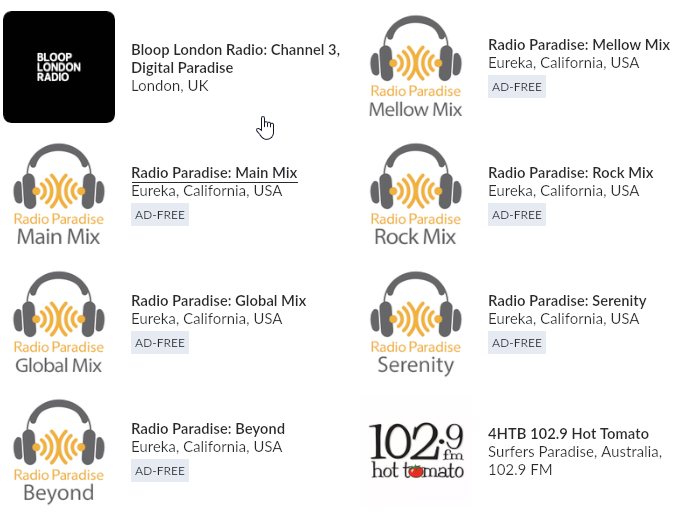
Incidentally, I presume the Esoteric can access Paradise Radio via Roon. I often listen to one of the RP stations as background when working at my desk.
 
I didn't know Radio Paradise, so I looked it up on Roon. I'll have to give it a listen:

1754346614382.png
 
Last edited:
Sound quality remarkably good, no ads, no DJ babble. If you don't like one track, you can skip to the next. Can also Pause but not go back or repeat a track.

I listen to the Global Mix mostly but occasionally venture into their other options.
 
  • Like
Reactions: The Knife
Interesting thread. I've also been searching for a device that could serve both as a streamer and a high-quality preamp for now. If it also includes a good DAC, all the better. Today, I brought home the NAD M66 on loan from the distributor. I'm listening to it right now — although it's already past midnight here in Stockholm and I have work tomorrow — and I have to say, it just sounds good!

What I’m really looking for is a machine that can handle up to four subwoofers. I’ve settled on the mighty 125kg YG Anat Reference II speakers, which come with active 10-inch bass drivers for the lower frequencies. These benefit greatly from a device that can properly route a dedicated sub signal. The M66 seems like a perfect match, offering four separate subwoofer outputs — RCA or XLR, your choice.

I’m currently running a Bowers & Wilkins DB1D subwoofer and am considering adding a final one to complete the soundstage and build a stable, undeniable low-end foundation. So, in this regard, the M66 definitely checks the box. It also seems to have a true preamp section with analog volume control, which is important to me.

Talking DAC:
The M66 includes the ESS ES9038PRO, an 8-channel DAC. NAD uses it in mono-mode, summing multiple internal DAC channels together to drive each stereo output (left and right) independently. This reduces according to NAD thermal noise, quantization distortion and output impedance variation. By summing channels (e.g., 4 per stereo side), NAD achieves a lower noise floor and greater linearity, especially in low-level signals — which is critical for microdynamics and background silence. This design is also used in high-end DACs from T+A, Esoteric, and dCS, so NAD is in serious company here.

NAD also incorporates what they call Dynamic Digital Headroom (DDH), which preserves transient dynamics by eliminating inter-sample peak clipping — a subtle but impactful improvement, especially with dynamic content. Seems to work, which also professional reviewers have testified.

Obviously, there are more exotic DACs out there, but I believe NAD offers a very compelling, well-rounded package in the M66.

And here's something few others offer: The M66 comes with Dirac Live and Dirac Base Control, something I plan to explore in the coming week. For me — already running three serious, large subwoofers, and considering a fourth — this might turn out to be the most crucial feature. I've tried digital room correction before, and I always prefer it (when done properly) over untreated, “naked sound". If your system can "hear the Room" and optimize each element to send out the exact right amount of energy this should cater for a more engaging and enveloping experience. At least these are my findings from using other room correction software in the past. I’m hoping to achieve even better results in my listening room with the M66.

So far — and this is without enabling any DSP or room correction — I believe I’m hearing: dead-silent backgrounds — even at high gain, exceptional microdetail — subtle reverb tails and instrument decay clearly audible. Fast transients — especially on percussion, thanks to DDH and low-latency DAC filtering. Natural tonality — no “digititis” or harsh highs. It all sounds very analog indeed.

To me, this indicates that NAD’s package of streaming, DAC implementation and preamp section is technically strong and musically engaging — a somewhat rare combination at this price point.

And as pointed out, I hope to create some good results when engaging with the rich DSP features this machine has to offer.

If anyone’s interested, I’d be happy to keep you posted.
 
Last edited:
  • Like
Reactions: Arif_in_Japan
Interesting thread. I've also been searching for a device that could serve both as a streamer and a high-quality preamp for now. If it also includes a good DAC, all the better. Today, I brought home the NAD M66 on loan from the distributor. I'm listening to it right now — although it's already past midnight here in Stockholm and I have work tomorrow — and I have to say, it just sounds good!

What I’m really looking for is a machine that can handle up to four subwoofers. I’ve settled on the mighty 125kg YG Anat Reference II speakers, which come with active 10-inch bass drivers for the lower frequencies. These benefit greatly from a device that can properly route a dedicated sub signal. The M66 seems like a perfect match, offering four separate subwoofer outputs — RCA or XLR, your choice.

I’m currently running a Bowers & Wilkins DB1D subwoofer and am considering adding a final one to complete the soundstage and build a stable, undeniable low-end foundation. So, in this regard, the M66 definitely checks the box. It also seems to have a true preamp section with analog volume control, which is important to me.

Talking DAC:
The M66 includes the ESS ES9038PRO, an 8-channel DAC. NAD uses it in mono-mode, summing multiple internal DAC channels together to drive each stereo output (left and right) independently. This reduces according to NAD thermal noise, quantization distortion and output impedance variation. By summing channels (e.g., 4 per stereo side), NAD achieves a lower noise floor and greater linearity, especially in low-level signals — which is critical for microdynamics and background silence. This design is also used in high-end DACs from T+A, Esoteric, and dCS, so NAD is in serious company here.

NAD also incorporates what they call Dynamic Digital Headroom (DDH), which preserves transient dynamics by eliminating inter-sample peak clipping — a subtle but impactful improvement, especially with dynamic content. Seems to work, which also professional reviewers have testified.

Obviously, there are more exotic DACs out there, but I believe NAD offers a very compelling, well-rounded package in the M66.

And here's something few others offer: The M66 comes with Dirac Live and Dirac Base Control, something I plan to explore in the coming week. For me — already running three serious, large subwoofers, and considering a fourth — this might turn out to be the most crucial feature. I've tried digital room correction before, and I always prefer it (when done properly) over untreated, “naked sound". If your system can "hear the Room" and optimize each element to send out the exact right amount of energy this should cater for a more engaging and enveloping experience. At least these are my findings from using other room correction software in the past. I’m hoping to achieve even better results in my listening room with the M66.

So far — and this is without enabling any DSP or room correction — I believe I’m hearing: dead-silent backgrounds — even at high gain, exceptional microdetail — subtle reverb tails and instrument decay clearly audible. Fast transients — especially on percussion, thanks to DDH and low-latency DAC filtering. Natural tonality — no “digititis” or harsh highs. It all sounds very analog indeed.

To me, this indicates that NAD’s package of streaming, DAC implementation and preamp section is technically strong and musically engaging — a somewhat rare combination at this price point.

And as pointed out, I hope to create some good results when engaging with the rich DSP features this machine has to offer.

If anyone’s interested, I’d be happy to keep you posted.

Knife - I'm pleased to hear you are trying out the M66. I bought this unit a couple of weeks ago and indeed the sound quality and features including Dirac Live and DLBC are exceptional at this price point - or even at 2 or 3 times the price.

However - there are one or two shortfallings with the NAD that owners of genuinely full-range main speakers need to be aware of. I have to go out now but will get back to explain, hopefully later in the day. Enjoy your listening tests in the meanwhile.
 
  • Like
Reactions: The Knife
I'm back to deliver the not-so-good news about the NAD Master Sries M66 when used with Subs. I'll copy a post of an M66 thread I started on another audio forum:

I was so excited when I first heard about this streamer preamp from NAD’s Master Series. As a Master Series user for the last few years (M12 preamp, M32 all-in-one and currently the excellent M33 all-in-one), there seemed to be an opportunity to upgrade my electronics at reasonably modest cost, as I already have a pair of Atma-Sphere Class D mono power amps waiting in the wings.

The spec looked attractive, even for a digital-only user such as myself. One big new feature is its 4 subwoofer outputs, available from both XLR and single-ended sockets. Also included are Dirac Live DSP and Dirac Live Bass Control – the latter a feature I know very little about, apart from its claimed ability to maintain timing accuracy when subs are present.

All good stuff – at least on paper, particularly as I recently bought a pair of REL S812 subs with their twin 12” drivers. My Avantgarde Duo XD speakers also feature twin 12” bass drivers so they really don’t need more bass to deliver furniture-rattling and neighbour-disturbing music! The subs are perhaps best thought of as fillers-in of room modes that may require attention via subs.

However, when looking more closely at how the M66 works, a few very disturbing facts emerge. Look at the back panel and you’ll see that the Sub Outs are labelled simply 1, 2 ,3 and 4. THEY ARE ALL MONO - not stereo - even if you tell the M66 that there is more than a single sub present! Why not keep 2 or 4 subs as stereo?

OK, here’s the even more disturbing discovery – Tell the M66 that there are subs present (any number of them) and you have to specify a crossover and this XO applies to the Main speakers as well as the Subs. That would be good in many systems where subs are added to provide bass for a stand-mount speaker system that may be suffering overload distortion from their small bass drivers. However, a disaster for anyone with genuinely full-range main speakers such as my Duos. Why should I spend a ton of dosh on full-range speakers, only for the M66 to cripple them by applying the same XO as the subs? I don’t want to deprive my main speakers of bass, particularly then the bass sent to the subs is mono

This came as a bit of a shock as my earlier NAD M12 preamp (and for that matter the M32) allowed the Main Outputs optionally to remain full-range, while the Sub Outs could have any XO between 40 and 200 Hz applied. Not so with the M66, or as I’ve recently discovered, my own M33. Why cannot the Main Outs remain full-range with these newer NAD units?


This bizarre and undisclosed dirty little secret feature of the M66 has possiby ruled it out as an upgrade for me. However, as I've now bought it, I've worked out an arrangement whereby the Mains continue to receive the full range (in stereo) while the subs rely on their own built-in XO to control their signal, also in stereo. However this means that the hyped 4 Sub Outs remain unused, as the Subs are wired into the speaker-level signal - as recommended by REL as it happens. Dirac Live can be applied (it would measure and adjust each main speaker together with its matching sub as a single speakers), but as far as I can see DLBC (and the promised DLART upgrade) can't be applied as these rely on Subs being connected to the Sub Outs.

With your main speakers with their 10" drivers, you may find the NAD method advantageous if you set the Sub XO low. Choose 50 or 60 Hz and the Mains get all the rest, while the subs (up to 4 of them) get only those very low frequencies. Then both DL and DLBC can be applied to get all speakers to sing in harmony, by measuring and adjusting each speaker on its own - up to 6 of them! Good luck
 
Last edited:
I'm back to deliver the not-so-good news about the NAD Master Sries M66 when used with Subs. I'll copy a post of an M66 thread I started on another audio forum:

I was so excited when I first heard about this streamer preamp from NAD’s Master Series. As a Master Series user for the last few years (M12 preamp, M32 all-in-one and currently the excellent M33 all-in-one), there seemed to be an opportunity to upgrade my electronics at reasonably modest cost, as I already have a pair of Atma-Sphere Class D mono power amps waiting in the wings.

The spec looked attractive, even for a digital-only user such as myself. One big new feature is its 4 subwoofer outputs, available from both XLR and single-ended sockets. Also included are Dirac Live DSP and Dirac Live Bass Control – the latter a feature I know very little about, apart from its claimed ability to maintain timing accuracy when subs are present.

All good stuff – at least on paper, particularly as I recently bought a pair of REL S812 subs with their twin 12” drivers. My Avantgarde Duo XD speakers also feature twin 12” bass drivers so they really don’t need more bass to deliver furniture-rattling and neighbour-disturbing music! The subs are perhaps best thought of as fillers-in of room modes that may require attention via subs.

However, when looking more closely at how the M66 works, a few very disturbing facts emerge. Look at the back panel and you’ll see that the Sub Outs are labelled simply 1, 2 ,3 and 4. THEY ARE ALL MONO - not stereo - even if you tell the M66 that there is more than a single sub present! Why not keep 2 or 4 subs as stereo?

OK, here’s the even more disturbing discovery – Tell the M66 that there are subs present (any number of them) and you have to specify a crossover and this XO applies to the Main speakers as well as the Subs. That would be good in many systems where subs are added to provide bass for a stand-mount speaker system that may be suffering overload distortion from their small bass drivers. However, a disaster for anyone with genuinely full-range main speakers such as my Duos. Why should I spend a ton of dosh on full-range speakers, only for the M66 to cripple them by applying the same XO as the subs? I don’t want to deprive my main speakers of bass, particularly then the bass sent to the subs is mono

This came as a bit of a shock as my earlier NAD M12 preamp (and for that matter the M32) allowed the Main Outputs optionally to remain full-range, while the Sub Outs could have any XO between 40 and 200 Hz applied. Not so with the M66, or as I’ve recently discovered, my own M33. Why cannot the Main Outs remain full-range with these newer NAD units?


This bizarre and undisclosed dirty little secret feature of the M66 has possiby ruled it out as an upgrade for me. However, as I've now bought it, I've worked out an arrangement whereby the Mains continue to receive the full range (in stereo) while the subs rely on their own built-in XO to control their signal, also in stereo. However this means that the hyped 4 Sub Outs remain unused, as the Subs are wired into the speaker-level signal - as recommended by REL as it happens. Dirac Live can be applied (it would measure and adjust each main speaker together with its matching sub as a single speakers), but as far as I can see DLBC (and the promised DLART upgrade) can't be applied as these rely on Subs being connected to the Sub Outs.

With your main speakers with their 10" drivers, you may find the NAD method advantageous if you set the Sub XO low. Choose 50 or 60 Hz and the Mains get all the rest, while the subs (up to 4 of them) get only those very low frequencies. Then both DL and DLBC can be applied to get all speakers to sing in harmony, by measuring and adjusting each speaker on its own - up to 6 of them! Good luck
Thanks for the discussion and for sharing that information! It’s quite concerning, and honestly, it could be a deal breaker for me. The YG subwoofers are designed to operate in stereo—each aligned with its corresponding monitor speaker. While they are subwoofers and require a subwoofer signal, they are not intended to run in mono.

What’s your take on Dirac Live and how it affects overall performance? This evening I managed to create a filter, by using the included (lower-quality) microphone that comes with the unit. I suspect results could be improved with a proper mic in the 200usd range. I got mixed results depending partly on chosen music. Eager to hear your opinion.
 
Thanks for the discussion and for sharing that information! It’s quite concerning, and honestly, it could be a deal breaker for me. The YG subwoofers are designed to operate in stereo—each aligned with its corresponding monitor speaker. While they are subwoofers and require a subwoofer signal, they are not intended to run in mono.

What’s your take on Dirac Live and how it affects overall performance? This evening I managed to create a filter, by using the included (lower-quality) microphone that comes with the unit. I suspect results could be improved with a proper mic in the 200usd range. I got mixed results depending partly on chosen music. Eager to hear your opinion.
As a post script to my post above, I'm wondering if the new Version 2 of the excellent all-in-one M33 may not be a better bet - for me at least. It has a marginally better DAC than the M66 (ESS 9039 vs 9038) and offers 200 watts into 8 ohms from its Second Generation Purifi Eigentakt amp section - more than enough for my 107 dB speakers - or it could be used as a preamp.

It offers only 2 Sub outs (RCA) but also Pre-outs in XLR and RCA, plus Dirac Live and DLBC, so subs could be connected in a variety of ways. I believe the M33 V2 may allow album artwork, etc to be displayed on an HDMI-connected TV, as the V1 does - but sadly this feature is absent from the M66.

In response to your comments above, the stereo vs mono situation is probably academic as deep bass is non-directional.

I've experimented with a few "room correction" DSPs (surely the least accurate desciption in audio) and have always ended up using No Filter. Room Perfect (Lyngdorf) was bad, MARS (Micromega) was better and Dirac Live (NAD) was quite good. I've not experimented with DLBC but by all accounts it adds a degree of refinement over DL, as it ensures time alignment of all speakers and subs is perfectly synchronised (as I understand it).

My DL version (supplied with my M33) can only adjust sub 200 Hz, but the entire signal has to pass through this signal processor and in my experience does the top end no favours. On careful listening to exciting music with plenty of top end detail, there seems to be a slight dulling of this top end - so fewer goosebumps. I can only conclude that (like tone control, graphic qualisers, etc) it is always best not to introduce any unnecessary signal processing. Leave DSP to the AV / HT crowd with their multiple speakers that can't be set up effectively except by experts or DSP!

I bought a UMIC-1 mic for use with DL or REW to measure speaker response, but I've abandoned the whole idea of DL as I believe my room doesn't need much "improvement" by DSP. However, I really should get round to taking a few more measurements now the subs are in the syatem. Please let me know what you find regarding the top end with and without a DL filter.

PS - Please don't give up on the NAD Master Series. It is exceptional stuff offered at very reasonable prices. Despite the snags I've discovered with the M66 (and no one else seems to have spotted them), it's a great bit of kit with features galore, some unique to this unit.
 
Last edited:

Thanks Hear Here. There might be light in the tunnel. As my first impressions indicated, I actually believe that the preamp-section of the M66 is pretty good and a nice match to my Essence-amp. Also on low listening levels I feel the heavy weight of the music. Also, the M66 as a stand alone preamp with features, is generally regarded as a more audiophile product then the M33. Beyond just the DAC chip, the M66 brings several enhancements:

  • Analog preamp stage & stepped-ladder volume control, avoiding reliance on digital attenuation and enhancing signal purity SoundStage GlobalSound Advice.
  • Upgraded A-to-D and DSP circuitry, plus licensing for full-bandwidth Dirac Live Room Correction and Bass Control (which costs extra for the M33) SoundStage GlobalSound Advice.
  • NAD explicitly mentions that the M66’s DAC and signal path improvements represent a meaningful upgrade over the M33 “and several other components in the digital signal path” Sound Advice.
I use my beloved pure Class A Gryphon Essence as amplifier rendering that typical "liquid and flowing" sound, hence can afford to go "all in" on the pre-amp section only. When it comes to directing a signal to the YG´s subwoofer's, one, and maybe the most natural way to keep the stereo perspective intact, could be to utilize the Pre-out section on the M66, and have the left channel cater for the left YG subwoofer and the right channel to cater for the right YG subwoofer. Connecting like this, the M66 should now see the YG right and left stack as two full range speakers, and play in stereo? Potentially two DB1Ds could be connected to the Sub outs. Would be interesting to use Dirac for such as setup, where the M66 now "handles" two full range speakers and two proper subs. What do you think?
 
Last edited:
Without busting the bank, I'm looking for a great all-in-one streamer / DAC / preamp.

I have no need for analogue so would prefer a digital only device, although bizarrely these seem scarce as hen's teeth, even in the 2020s!

What's out there of interest?

The Mark Levinson 519 looks ideal on paper, though a bit long in the tooth. Digital only so maybe top of my list!

Other costly options include Grimm MU2, Meitner MA3, Esoteric N-05XD, Lumin P1, Auralic Vega G2.2

More modern and better featured (and far less costly) options include the NAD M66, Eversolo MP-A10, HiFi Rose RS151, Cambridge Edge NQ

I'd love to think one of the lower priced devices would match the more costly ones, but I am prepared to consider all these and any others suggested, even if I have to search the used market.

This streamer preamp would be feeding a pair of Ralph's Atma-Sphere Class D mono amps (at least for the time being) and Avantgarde Duo XD speakers.

My speakers are full-range and very high sensitivity, but I have a pair of REL S812 subs that contribute virtually nothing at present as their gain (even at max volume) is far too low. DSP room correction is something I'm very wary of.

Music of various genres mainly from my ripped CD collection, or Qubuz. I'd need it to be controlled by user-friendly app that could be loaded onto Windows as well as iPad and Android, preferably without the additional hardware and subscription of Roon, though this isn't a deal-breaker as long as it's Room Ready.

If you have first-hand experience of any of these or other devices, or can offer advice, I'd be most grateful. Thanks.
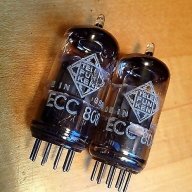
The auralic vega 2.2 is very good and does inc an analog input for records.
roon ready and its own lightning app great sound and a step up from the 1st version.
Rose 150b is also a lovely sounding unit with great features and display does youtube videos into a tv too with
hifi sound
also nad (as you know ) M33 V2 on order as dirac is good in some rooms
 
  • Like
Reactions: The Knife

About us

  • What’s Best Forum is THE forum for high end audio, product reviews, advice and sharing experiences on the best of everything else. This is THE place where audiophiles and audio companies discuss vintage, contemporary and new audio products, music servers, music streamers, computer audio, digital-to-analog converters, turntables, phono stages, cartridges, reel-to-reel tape machines, speakers, headphones and tube and solid-state amplification. Founded in 2010 What’s Best Forum invites intelligent and courteous people of all interests and backgrounds to describe and discuss the best of everything. From beginners to life-long hobbyists to industry professionals, we enjoy learning about new things and meeting new people, and participating in spirited debates.

Quick Navigation

User Menu

Steve Williams
Site Founder | Site Owner | Administrator
Ron Resnick
Site Owner | Administrator
Julian (The Fixer)
Website Build | Marketing Managersing