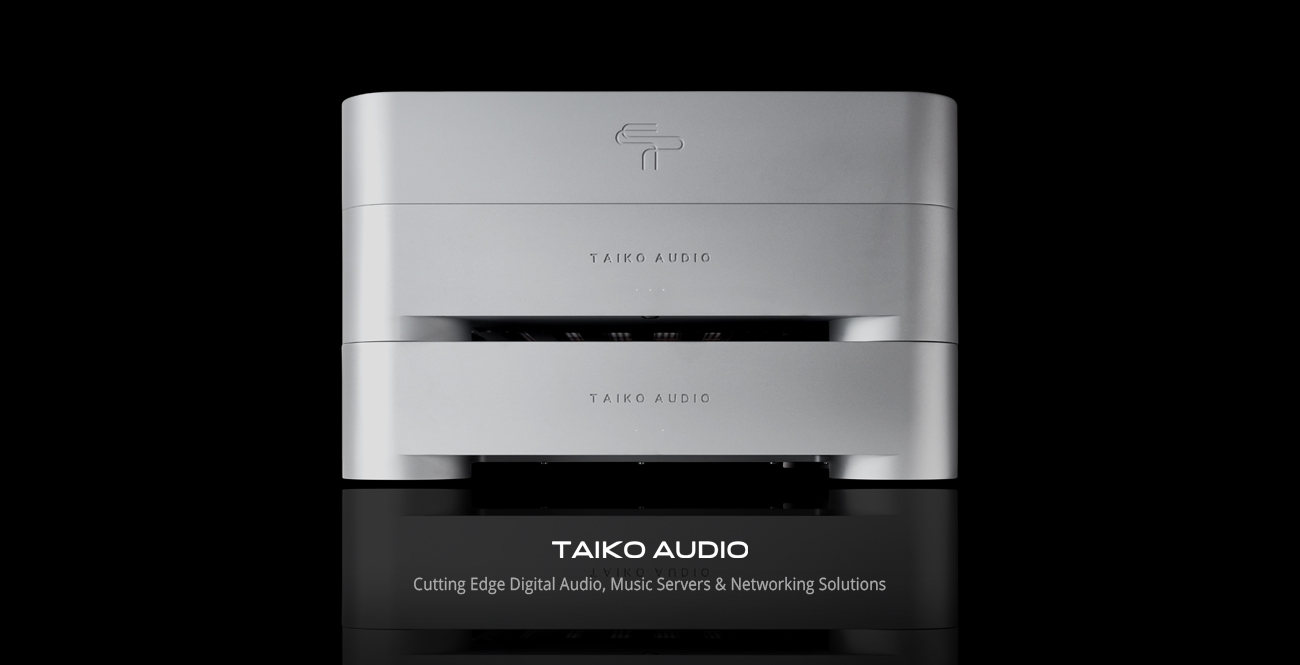
Introducing Olympus & Olympus I/O - A new perspective on modern music playback

I installed the MSB card on my I/O on Friday (with great help from Ted) and connected the I/O to my MSB Cascade. It is the best Christmas present I have received since I was a child. It is a major step up from the USB connection with my Ansuz Gold Signature cable. The vocals and instruments are more lifelike, the soundstage wider, and the noise floor lower than I thought possible. If there are any digital artifacts on the recordings, I cannot hear them.

I am extremely grateful for Taiko's hard work in making this possible. It was definitely worth the long wait.

Please forgive me for not comparing the MSB card to the analogue card.
Throw away your USB cable. You’ll never use it again
 
I installed the MSB card on my I/O on Friday (with great help from Ted) and connected the I/O to my MSB Cascade. It is the best Christmas present I have received since I was a child. It is a major step up from the USB connection with my Ansuz Gold Signature cable. The vocals and instruments are more lifelike, the soundstage wider, and the noise floor lower than I thought possible. If there are any digital artifacts on the recordings, I cannot hear them.

Thanks for posting - I’m so looking forward to hearing for myself!
 
Merry Christmas to you all, your families and Team Taiko. I hope they all are rejuvenating and getting time to spend with their loved ones after no doubt working around the clock this past year for all of us. May Christmas continue to come throughout 2025!
IMG_8233.jpeg
And Merry ‘festive season’ from Saudi Arabia!
 
Last edited:
@Taiko Audio
I'm using a Samsung tablet. Can't see the nitty gritty.
I looked in the manual for the answer to my question.
The far left white led on front.
Will that slow flash till 7am whether or not it is fully charged?
 
@Taiko Audio
I'm using a Samsung tablet. Can't see the nitty gritty.
I looked in the manual for the answer to my question.
The far left white led on front.
Will that slow flash till 7am whether or not it is fully charged?

It will flash as long as it charges, till it’s full. That will occur somewhere before 7AM depending on the output module used, with the current analogue output module around 5AM.
 
Marty Meyers came to my place a few weeks ago and blew my mind by playing the same tracks comparing the Wav and Flac versions. The Wav files were night and day better than the Flac versions. I never paid attention prior to Wav vs Flac but I know Marty is investigating this along with some others at Taiko. This listening was done on both the Extreme and the O-I/O.
I´m very intrigued by this.

I´ve always thought that flac might be flat and "dead" compared to wav, but also that also that when one converts flac files back to wav, it´s important which prog is being used to do so. Let me know what your take is on this
 
Xdmi analog installed and playing ...
This is the best dac I've ever heard.
There's not a chance I'll ever put back the xdmi digital.
I can't imagine what it will be like (in three weeks) with run in..
Ymmv
Update:
This xdmi analog really seems to be the anti - dac.
I keep trying to hear digi artifacts. I'm looking for them, just can not hear any.
As it runs in, I hear the soundstage blossom into a pretty 3d picture. The timbre and timing are the best I've heard from a dac.
Probably (?) the best digital vocals I've ever encountered..

All I got....
Ymmv
 
Update:
This xdmi analog really seems to be the anti - dac.
I keep trying to hear digi artifacts. I'm looking for them, just can not hear any.
As it runs in, I hear the soundstage blossom into a pretty 3d picture. The timbre and timing are the best I've heard from a dac.
Probably (?) the best digital vocals I've ever encountered..

All I got....
Ymmv
Exactly what I hear in my system/room.
In my opinion, the credits are essentially due to the direct connection into the XDMI board. Less cables, less gear, the beauty of simplicity. I wonder how it can evolve with an even better chip DAC, XLR outputs and volume control all inside the Taiko Olympus.
Maybe in a near future…
 
Update:
This xdmi analog really seems to be the anti - dac.
I keep trying to hear digi artifacts. I'm looking for them, just can not hear any.
As it runs in, I hear the soundstage blossom into a pretty 3d picture. The timbre and timing are the best I've heard from a dac.
Probably (?) the best digital vocals I've ever encountered..

All I got....
Ymmv
IMHO the XDMI analog output card is a dac-killer!

I really want to know whether the XDMI digital output (coaxial or aes/ebu) cards and the specific XDMI digital connection cards for Lampizator/MSB/Aries Cerat can save some top dacs in the market or not.
Eagerly waiting for WBF brothers to report the result of a direct comparison.
:cool:
 
Exactly what I hear in my system/room.
In my opinion, the credits are essentially due to the direct connection into the XDMI board. Less cables, less gear, the beauty of simplicity. I wonder how it can evolve with an even better chip DAC, XLR outputs and volume control all inside the Taiko Olympus.
Maybe in a near future…
If there's a v2 coming? I don't see anything surviving the culling of the heard.
 
If there's a v2 coming? I don't see anything surviving the culling of the heard.
Time will tell. At this level it's going to be interesting to "hear" the different observations. Tube DAC, board, system, room, ears, tastes...
 
Exactly what I hear in my system/room.
In my opinion, the credits are essentially due to the direct connection into the XDMI board. Less cables, less gear, the beauty of simplicity. I wonder how it can evolve with an even better chip DAC, XLR outputs and volume control all inside the Taiko Olympus.
Maybe in a near future…
I understand the sentiment but I'm not at all certain where you will find a better chip DAC. There are currently only AKG, ESS and Rohm in general usage and availability. Many others have been absorbed by other manufacturers (Cirrus Logic taking over Wolfson, Texas Instruments taking over Burr-Brown, etc).

It is of course possible to parallel more than one chip for some gains in performance but at the cost of increased complexity and perhaps more importantly, increased current consumption, hence noise. And FPGA chips such as the Xilinx family have much greater current requirements in operation than any chip DAC I am aware of.

Emile was of the opinion that the DAC chip itself only contributes a minor portion of ultimate sound quality compared to other design considerations. Granted, we are audiophiles and so we are by definition obsessed by every possible incremental gain in SQ but it may be very expensive to realize any meaningful gains by pursuing other chipsets or multiple paralleled chips. I recall that Emile stated he was concerned about increasing the current damand from simply doubling the analog output stage to provide balanced output in the first generation of XDMI analog.

I'm sure there are some inventive ideas in the pipeline from Taiko. We might have to wait for awhile to find out what they are.

Steve Z
 
...no doubt, the Taiko analog output sounds excellent here, but not ready to sell the farm just yet! I would like to hear the MSB solution, which is en route. I'm not from Missouri (the Show Me state), but I gotta hear that little piggie at my place. Maybe NY is the "Hear Me" state? Not sure we're gettin any traction with that on a license plate.
 
I understand the sentiment but I'm not at all certain where you will find a better chip DAC. There are currently only AKG, ESS and Rohm in general usage and availability. Many others have been absorbed by other manufacturers (Cirrus Logic taking over Wolfson, Texas Instruments taking over Burr-Brown, etc).

It is of course possible to parallel more than one chip for some gains in performance but at the cost of increased complexity and perhaps more importantly, increased current consumption, hence noise. And FPGA chips such as the Xilinx family have much greater current requirements in operation than any chip DAC I am aware of.

Emile was of the opinion that the DAC chip itself only contributes a minor portion of ultimate sound quality compared to other design considerations. Granted, we are audiophiles and so we are by definition obsessed by every possible incremental gain in SQ but it may be very expensive to realize any meaningful gains by pursuing other chipsets or multiple paralleled chips. I recall that Emile stated he was concerned about increasing the current damand from simply doubling the analog output stage to provide balanced output in the first generation of XDMI analog.

I'm sure there are some inventive ideas in the pipeline from Taiko. We might have to wait for awhile to find out what they are.

Steve Z
Steve you are so well versed in this technical area. From my very amateur wheelhouse/perspective I would think doubling the analog output stage to provide balanced is no easy application. Would the I/0 be beneficial/easier to incorporate a balanced output stage? What I am asking is: By having the I/0 would this perhaps make implementing Balanced easier...
 
Personal preference will always trump all else.
Exactly what I hear in my system/room.
In my opinion, the credits are essentially due to the direct connection into the XDMI board. Less cables, less gear, the beauty of simplicity. I wonder how it can evolve with an even better chip DAC, XLR outputs and volume control all inside the Taiko Olympus.
Maybe in a near future…
I believe that there is truth to both these statements. I have said previously (in jest of course) as my system is 100% tube that if there is only a way to add a tube to the analogue board that would be the true giant slayer.

I would have to think the analogue board will definitely evolve with volume control, XLR and/or SE outputs and as od mustang says there are only a handful of chipmakers BUT every year these chip makers bring to market better chips than their previous versions.That is how Lampi has evolved. Also these chips according to Lukasz contain so many untapped functions that can be employed . Only Emile has the key to all of this in his brain which Im betting will be tapped into . Im even more anxious now to hear the analogue board in my system .......if I only weren't 100% tubes.....so yes, personal preference will trump all else. There is no one right answer. It's what floats one's auditory nerve. Yet to have a one step solution where a DAC and a preamp becomes unnecessary, and who knows an integrated which also has an amp would be a solution difficult to resist
 
Steve you are so well versed in this technical area. From my very amateur wheelhouse/perspective I would think doubling the analog output stage to provide balanced is no easy application. Would the I/0 be beneficial/easier to incorporate a balanced output stage? What I am asking is: By having the I/0 would this perhaps make implementing Balanced easier...
Thank you for the kind words, John but you give me too much credit. From a theoretical standpoint it seems to me that there would be advantages and perhaps a few disadvantages to having a more feature-laden XDMI analog section in the I/O rather than the Olympus. More real estate to work with in the I/O for heat sinks/heat removal, and able to perhaps accommodate a larger XDMI analog board being two that come to mind.

But current demand is current demand and with it comes more noise to be dealt with. That occurs regardless of where the XDMI analog board is physically located. One of the main reasons for I/O is to remove some of the pieces of the Olympus system from the noisier environment near the computer motherboard.

Also, going to a larger XDMI analog board means increased development costs meaning higher prices for customers, though if it is only the daughter card that grows and the exisiting XDMI PCIe card can continue to be used, that would contain some of the costs.

I've no doubt Emile and his team are working on these issues as we post these speculations. It remains to be seen if it is feasible to bring v2 in at a price enough people will be willing to pay to cover the development costs, production expense, get people paid and keep the lights on in the factory.

Steve Z
 

About us

  • What’s Best Forum is THE forum for high end audio, product reviews, advice and sharing experiences on the best of everything else. This is THE place where audiophiles and audio companies discuss vintage, contemporary and new audio products, music servers, music streamers, computer audio, digital-to-analog converters, turntables, phono stages, cartridges, reel-to-reel tape machines, speakers, headphones and tube and solid-state amplification. Founded in 2010 What’s Best Forum invites intelligent and courteous people of all interests and backgrounds to describe and discuss the best of everything. From beginners to life-long hobbyists to industry professionals, we enjoy learning about new things and meeting new people, and participating in spirited debates.

Quick Navigation

User Menu

Steve Williams
Site Founder | Site Owner | Administrator
Ron Resnick
Site Owner | Administrator
Julian (The Fixer)
Website Build | Marketing Managersing