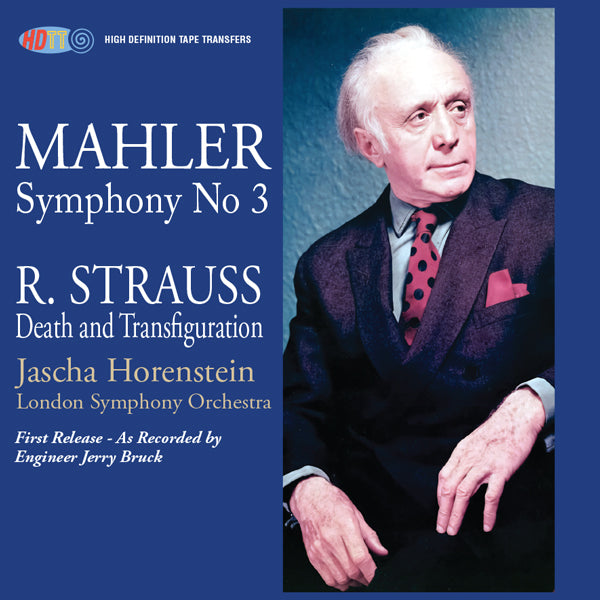
Oooh, that Horenstein Mahler 3 HDTT release!

Kjetil

Well-Known Member
Oct 28, 2022
293
365
135
Hamar, Norway
I bought and downloaded the PCM 24/192 2.0 and 4.0 bundle:
This particular recording has maybe the best sound of a large orchestra (plus two choirs and a vocal soloist) that I have ever heard. And in 2.0 you hear what two microphones picked up. In 4.0 you hear what four microphones picked up (I haven't heard that one yet).
Things don't get much more minimalist audiophile than this. Props to High Definition Tape Transfers for making a commercial offering of the recording Jerry Bruck did beside the official Unicorn/Nonesuch back in 1970. He really was on to something.

screenshot-bruck-horenstein-hdtt-cover.png
 
Last edited:
And in 2.0 you hear what two microphones picked up. In 4.0 you hear what four microphones picked up (I haven't heard that one yet).
N.B.: The 4.0 was not miked with the commonly-expected quad layout as it was recorded in 4 channels with the microphones in a tetrahedral array. Default routing will offer a nicely expanded soundspace with a multichannel playback system but that is not exactly how it was intended.

In the delivered multichannel files, left and right front are as expected. What is conveyed by the right rear channel is from a third microphone that was above the first two and aimed straight up. The left rear channel is from the fourth microphone in the same horizontal plane as the L/R but aimed towards the back of the hall, away from the orchestra. Proper rendition of this requires some rerouting of the signals.
 
  • Like
Reactions: Rushton and Kjetil
I was hoping to get to hear the 4.0 played through a normal 4.0 setup this week, but it will have to wait to find out if TM to RR and RM to RL is confusing or not. I doubt it is since these returns should quite diffused, but it should be proven.
(My friend’s rear speakers are not easily moved. All his speakers are heavily modified Maggies with four extra 12” in a baffle, all DSP crossovers, plus a DBA below 120 Hz.)
 
I was hoping to get to hear the 4.0 played through a normal 4.0 setup this week, but it will have to wait to find out if TM to RR and RM to RL is confusing or not. I doubt it is since these returns should quite diffused, but it should be proven.
(My friend’s rear speakers are not easily moved. All his speakers are heavily modified Maggies with four extra 12” in a baffle, all DSP crossovers, plus a DBA below 120 Hz.)
Your premise is correct and you will enjoy what it delivers. However, remapping is an improvement.

I don't move my speakers but I have the ability (via a mapping matrix) to reroute channels, sending TM to my center channel speaker and RM to both my SR/SL speakers.
 
The same should be possible at my friends’ place. I’m not quite sure if routing TM to C yields the best result one could achieve. I think I would try to route both TM and RM at -6 dB to RL+RR as a test.

I very much look forward to comparing the sound and placement of the off stage Flügelhorn in the third movement. In 2.0 it’s completely diffuse, maybe not so in 4.0.
 
I did the editing and restoration of the Jerry Bruck Mahler 3. I suspended a matching speaker with matching electronics overhead when working on this, so I could hear it exactly as recorded. I found that routing the "up" and rear channels to the L and R rear channels sounded just as good as having a channel overhead. There is really no audible difference to the listener. Here's why. Both of the "ambiance" channels (with one exception, noted below) are capturing only reflected sounds in the hall, as reflected back to the listening position (not as captured from the rear or ceiling, as from mics placed in those distant locations, which makes little sense). The exception is the flugelhorn, which was placed in a balcony in the hall at the recording, so its sound is captured directly by the ambiance channels. Otherwise, all direct signals are coming from the front, as captured in wonderful detail by the front L and R channels (which is what is heard in the 2 channel version). The distance from the rear wall to the listening position (where the tetrahedral mic array was located) was almost the same as from the ceiling to the listening position, so what we are getting is the reflected sound coming to the listener as reflected from two vantage points out in the hall. The two ambient channels are very similar in nature--there is nothing that can be identified as "uppiness" in the up channel. So putting the two ambient channels as the L and R rear channels works really well. Listening today on a conventional arrangement with separate rear speakers (very few systems have a speaker mounted overhead), we are still getting all of the hall reflections that were captured, in the same balance as if hearing the up channel from above. I do not recommend routing one of the ambient channels to a center speaker located in the front. I tried this, and all it accomplished was muddying up the almost perfect phase coherence Bruck captured in the front channels, which as recorded resulted in a very detailed and specific sonic soundstage. The sound as reflected to a listener in the hall (or in this case his or her substitute, the tetrahedral mic array) is utterly different from the sound coming off the stage in the hall (the front in the recording). This is why we rejected attempts to mix any of the rear signal into the front channels to create the two channel version. That always resulted in a loss of clarity with no corresponding benefit. The rear ambiance channels are of course way out of phase with the two front channels. The effect of hearing the four channel version is experiencing the hall "filling up with sound" in loud passages, and otherwise, perhaps unexpectedly, an added dimension of clarity overall. This is due to excellent phase coherence Jerry Bruck captured. If you want to hear what extensive multi-miking accomplished, just compare to the murky Unicorn recording, which was recorded in something like 16 channels. It is also noticeably compressed, which of course we did not do.
 
My friend died this March, and as usual in such circumstances the equipment is realized piecemal.
Over the winter and before his death I got to hear the whole recording in his room once, and the Comodo Scherzando a couple of more times, comparing 4.0 and 2.0. The 4.0 routed as intended by @jhaleyesq sounded fantastic in my friend's room and so does the 2.0 both in his room and (to a lesser extent I admit) in mine. Of course the sense of envelopment is far greater in 4.0 than 2.0, and it is especially noticeable when the off stage Flügelhorn does it's magic.
I've played the Bruck recording to Mahlerites (and nonesuch), people who know the Unicorn (I don't and I don't care.) and they've been over their heads, at least those with an ear for what a stereo can do. This recording really is something and the interpretation too of course.
Anything I want different? Yes. I want to move Norma Procter from her position at the Unicorn soloist microphone front right, where Bruck's FR mic was pointing, to a spot between the orchestra and the choirs. Too late of course, and also not something Bruck could do.

A heartfelt thank you to everyone involved.
 
Dear Kjetil, My condolences for the loss of your friend. Thanks very much for your kind words, and it is gratifying to hear that so many people are enjoying this recording. I sure like it myself, but I might be just a little prejudiced. RE the location of Norma Procter, Unicorn may well have had a solo mic on her, I don't know, but in Jerry Bruck's recording, there were no solo mics. Everything is as captured by his array of four mics located close together, two pointing forward, one up and one back. All the mics were about a meter apart, and because of their tetrahedral positioning (like a pyramid but with a triangular bottom), they captured a hemisphere of sound with no nulls, one mic picking up where the nearest ones left off. There is a photo from the sessions showing that Norma Procter was located right where we hear her in the Bruck recording, to the mid-right, actually up in the orchestra a bit. I don't know why they put there there, but I have seen a number of comments from listeners saying that she sounds noticeably better as captured by Bruck than she does in the Unicorn recording. BTW, anyone can download the 16 page booklet for free, here: https://cdn.shopify.com/s/files/1/0778/3319/files/Mahler-3rd-Horenstein-Booklet.pdf?v=1707833794 .
 
  • Like
Reactions: Kjetil
Thank you.
A comment on the dynamics of this release: This recording is one of the very few that I play at full volume. The calculated system peak RMS is 107 dB in the listening position.
 
  • Like
Reactions: SCAudiophile
Both Bob Witrak at HDTT and I were astonished by the complete absence of audible distortion in the original Bruck-recorded tapes, at every dynamic level, so the sound at "full blast" remains as clean and clear as it does at all other times. Things like the harmonics of the bass fiddles remain audible even in loud parts, and likewise the harps always remain audible (moving the harps to the front was the one concession that was made at the recording sessions in the seating of the orchestra, probably at Horenstein's request but certainly with his approval). The result is a recording that is without any kind of "listening fatigue." Remember that these tapes are more than 50 years old, recorded at a time when digital recording did not exist. The lack of distortion is a tribute to two factors: (1) Bruck's complete mastery as an audio engineer in understanding exactly what was possible using the analog equipment of the day, including his favored Schoeps microphones, and (2) the outstanding playback of the tapes today using dual Merrill tape preamps (for the four channels) to reveal the full glory that is captured on the tapes, unlike most other electronic options available today for dubbing tapes, including of course the decades-old electronics found in the old tape transports of choice still in widespread use today.
We are very close to releasing another great Horenstein/LSO Mahler recording, unfortunately not recorded by Jerry Bruck but still caught in fine stereo sound, the historic 1959 live performance of Mahler 8 in London's Royal Albert Hall. We have a superior tape source, and with careful restoration, the sound quality is quite noticeably better than in any prior release of this famous performance. I will post it here when it is available. We have already released a fine live 1969 performance of Horenstein's Mahler 9 with the American Symphony Orchestra, a first release that is a much better performance than the one from the day before released in past years by M&A and others. We restored it to good sound from the original tapes recorded surreptitiously in Carnegie Hall; it does not boast Bruck-like sound quality but is nevertheless enjoyable. It can be found here, with a free download of a sample: https://www.highdeftapetransfers.ca...ra?_pos=1&_psq=Horenstein+Mahler&_ss=e&_v=1.0
 
Both Bob Witrak at HDTT and I were astonished by the complete absence of audible distortion in the original Bruck-recorded tapes, at every dynamic level, so the sound at "full blast" remains as clean and clear as it does at all other times. Things like the harmonics of the bass fiddles remain audible even in loud parts, and likewise the harps always remain audible (moving the harps to the front was the one concession that was made at the recording sessions in the seating of the orchestra, probably at Horenstein's request but certainly with his approval). The result is a recording that is without any kind of "listening fatigue." Remember that these tapes are more than 50 years old, recorded at a time when digital recording did not exist. The lack of distortion is a tribute to two factors: (1) Bruck's complete mastery as an audio engineer in understanding exactly what was possible using the analog equipment of the day, including his favored Schoeps microphones, and (2) the outstanding playback of the tapes today using dual Merrill tape preamps (for the four channels) to reveal the full glory that is captured on the tapes, unlike most other electronic options available today for dubbing tapes, including of course the decades-old electronics found in the old tape transports of choice still in widespread use today.
We are very close to releasing another great Horenstein/LSO Mahler recording, unfortunately not recorded by Jerry Bruck but still caught in fine stereo sound, the historic 1959 live performance of Mahler 8 in London's Royal Albert Hall. We have a superior tape source, and with careful restoration, the sound quality is quite noticeably better than in any prior release of this famous performance. I will post it here when it is available. We have already released a fine live 1969 performance of Horenstein's Mahler 9 with the American Symphony Orchestra, a first release that is a much better performance than the one from the day before released in past years by M&A and others. We restored it to good sound from the original tapes recorded surreptitiously in Carnegie Hall; it does not boast Bruck-like sound quality but is nevertheless enjoyable. It can be found here, with a free download of a sample: https://www.highdeftapetransfers.ca...ra?_pos=1&_psq=Horenstein+Mahler&_ss=e&_v=1.0
I'm a big fan of HDTT releases, but I'm a little confused by this one and hope you can clarify. On the site it says

"Transfer of session tapes by Robert Witrak, Chief Engineer, HDTT, at 24/192 (late 2020)"

And a bit lower it says

"Analog: Transferred using an Otari 1/2" 4-channel Professional tape deck modified by JRF Magnetics feeding two Merrill Tape Preamps
Digital: Merging Hapi Analog to Digital Converter clocked by an Antelope Audio 10MX Atomic Clock"


Does the latter refer to the 24/192 of 2020? IOW, is the native digital capture from the tape 24/192? It wasn't done again later at a higher res (or DSD)?
 
Hi, Tony. The 2020 digital dub of the session tapes was done at 24/192--yes, that is the native digital capture. The norm for HDTT is either an initial digital dub at DSD256 or PCM 24/352.8. In this case, however, it was decided to do the initial dub at 24/192 because of (1) the length of this symphony (plus the Strauss D&T)--the Mahler 3 is the longest symphony in the symphonic canon and Mahler's longest work, (2) we necessarily had to deal with this project at every step of the way in all four channels, and (3) the resulting restoration had to be manageable as a download by HDTT's customers. And keep in mind that the session tapes were for three days of sessions--there were more than a dozen large tapes that had to be dealt with. in the editing, to come up with the correctly edited final recorded performances. Consequently, the highest resolutions in which this release is offered are PCM 24/192 and DSD128. For the various options, please see the drop-down menu on the webpage, near the top, under "Order a Digital Download or Physical Disc." The webpage is here: https://www.highdeftapetransfers.ca...enstein-lso?_pos=1&_psq=Mahler+3&_ss=e&_v=1.0
Thanks, John
 
  • Like
Reactions: tony22
Thank you John.
 
I pulled out my Unicorn CD set after being away from it for a long time, and was horrified to find that both CDs had oxidzed and were mostly unplayable. Online seeking a remedy, I discovered HDTT, learned about the Jerry Brock recording, and purchased the 2-channel FLAC.

It's a wonderful revelation; hard to believe the original is 50 years old. Not complaining, but I'd like to understand the probable origin of an artifact I hear, mostly in the left channel. A rumble which is easiest to notice when it stops, during quiet passages, and with headphones. Examples: in the second movement, at 8 seconds, also at 21 seconds. Easiest to hear when it stops and restarts during the brief clarinet figure at about 30-35 seconds. Ideas?

Years ago, after about my third listen to the Nonesuch vinyl, I realized that I pulled my headphones off at the same moment in the 3rd movement every time, thinking someone's trying to get my attention. There's maybe a cough in there. Fortunately, Brock's microphone placements reduce the audibility of that quite a bit, but a whisper of it still lingers at about 12 min 54 sec.
 
  • Like
Reactions: Young Skywalker
Thanks for your comments. I restored this recording, as well as edited it from the session tapes (which was arduous), being certain that what we released is the same recorded performance that was approved by Maestro Horenstein (which it is) for the unelated simlutaneous Orion recording. Not that I am complaining--I wish every project I work on could sound like this one! I have just looked at the waveform for what you mention in the 2d and 3d movements and of course have listened carefully. Like a great many older tapes, these tapes exhibited a certain amount of LF noise at the very bottom that has nothing to with the music. It is generally not intrusive but things do sound better when it can be removed, because excellent systems are "wasting energy" trying to reproduce it. I generally do remove it, where I am sure that doing so will not affect the "room tone" for the lower frequencies that are present in the recording, and of course where removing it will not affect the actual lower frequencies of the music themselves (the noise is generally much lower than any musical tones can go); such noise is generally down around 10 Hz and lower. I can see faint shadows in the spots you mention in the 2d movement but those will not be audible. My guess is that perhaps your headphones are reacting to any content down there below 20 Hz, even very soft, by generating some distortion of their own. It is asking quite a lot of the very small speakers that are necessarily found in headphones to accurately reproduce extremely low frequencies. Regarding the noise spot at about 12:54 in the third movement, I checked that out, and I simply can't hear or see anything there. It is possible that I removed a cough at that spot, but I don't see or hear any evidence of it. This is the passage where the first violins are playing F# (above middle C) to the D above, then the same F# to the F# an octave above, against dissonant brass notes.

My warning is to not try to play the Unicorn CD of this Mhaler 3 on a good system. Both the older version and the newer one (which appears identical) contain a lot of uncorrected pure DC at the very bottom that can damage your system. My large sub freaked out the first time I tried to play it, actually locking up. Of course I immediately stopped it and thankfully things were OK with the sub. I had to rip the CD and fix it, just to hear this recording. and I recommend that you do the same if you want to play it. Most systems do not reach down to the very bottom of the spectrum, and on systems with some limitation at the bottom, the CD will ought to play witrhout killing anything. The reality is that musical content down below 20 Hz is extremely rare, and a system that won't go way down there is just fine. But as an audio restorer, I find it essential for me to have a good sub for the bottom octave, as recordings that i restore can have problems way down there. I can often tell when somebody else has restored a recording without having a good sub in their playback system--believe it or not, that's not so rare.
 
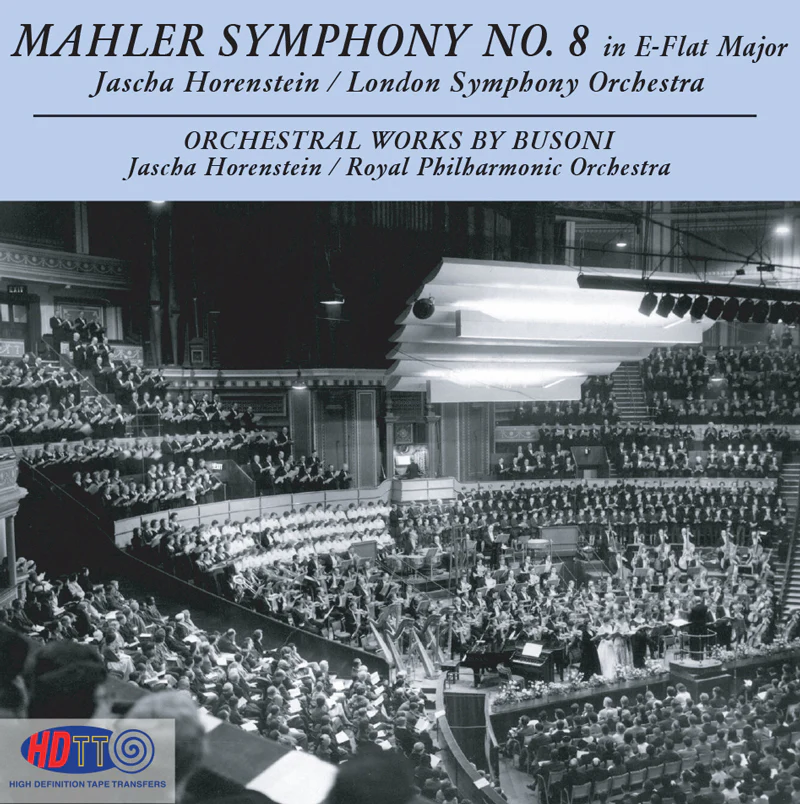
I promised to post when my restoration of Horenstein's magnificent live performance of Mahler 8 has been released, which now it has. It is here:


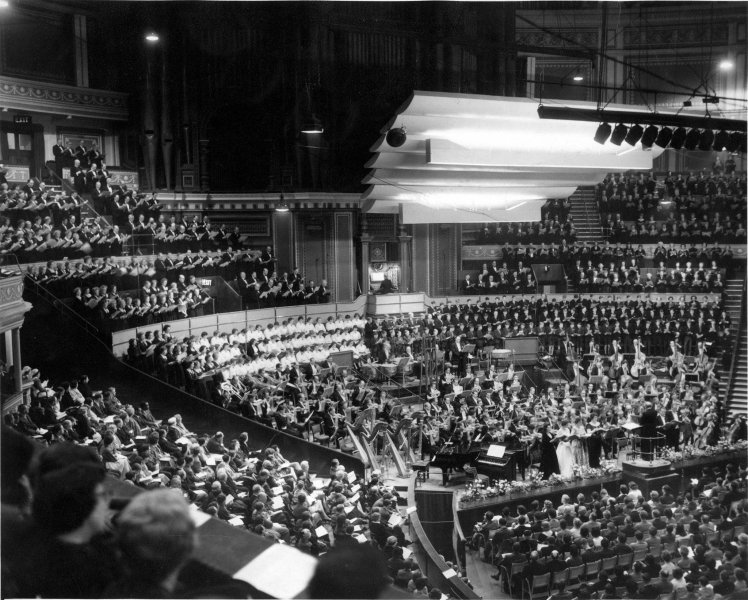
It is available as a download in a variety of high res formats, as well as on CD. Be sure to download (for free) the original program booklet (which is in a pop-up on the webpage at the above link), to read the wonderful original Deryck Cooke program notes, which include full texts and translations. This PDF of the booklet is courtesy or Misha Horenstein, the conductor's counsin, to whom we are very grateful. I am attaching a photo of the performance, in the masstive Royal Albert Hall, attended by 6000.

After restoration (from what appears to be a different tape than what was used for the three-decade-old BBC Classics restoration and the decade-old Pristine Classical restoration), this 1959 live stereo recording, which was said at the time to be experimental, sounds remarkably good, at least to me. It does not sound like Jerry Bruck's fabulous Mahler 3 recording from 1970, but I am pleased with the result. It is also pitch-corrected, apparently for the first-time. Obviously, recording more than 750 performers posed quite a challenge, but the BBC engineers achieved an admirable result with lots of good clarity and detail. Forgive me for crowing about my own project, but I feel like the new restoration ,done from HDTT engineer Bob Witrak's expert high res dub of the tape, opens new windows and doors on this classic older recording. And for me, you just can't beat the truly overwhelming quality of Horenstein's fantastic performance.

An excellent review can be found here:


and I am pasting in below another great review by Henry Fogel for Fanfare magazine:
---------------------------------
MAHLER Symphony No. 81. BUSONI Die Brautwahl: Suite. Berceuse élégiaque. Eine Lustspielouvertüre — Jascha Horenstein, cond; 1Joyce Barker, Beryl Hatt, Agnes Giebel (sop); 1Kerstin Meyer, Helen Watts (alt); 1Kenneth Neate (ten); 1Alfred Orda (bar); 1Arnold van Mill (bs); 1BBC Ch, BBC Choral Society, Goldsmith’s Choral Union, Hampstead Choral Society, Emanuel School Boys’ Ch, Orpington Junior Singers; London SO — HIGH DEFINITION TAPE TRANSFERS 23399 stereo/mono (2 CDs: 135:59) Live: 1Royal Albert Hall, London 3/20/1959

Jascha Horenstein’s 1959 BBC broadcast performance of Mahler’s gargantuan Symphony No. 8 is considered by many to have been a groundbreaking moment for shifting public and critical opinion about the composer. It may be hard for younger music lovers to comprehend, but at that time performances of all Mahler symphonies still tended to be rare, especially when it came to the “Symphony of a Thousand.” By 1958 the Eighth, composed in 1908, had been played a total of three times in London: in 1913 and 1936 under Henry Wood and in 1948 under Adrian Boult.
In 1958 Robert Simpson, a senior producer for the BBC as well as a serious scholar and a fine composer in his own right, persuaded the BBC authorities to mount a complete Mahler cycle in concert. It was wonderful serendipity when the BBC’s Controller discovered that the organization would underspend its allotment for the fiscal year ending in April 1959. Unless they spent up to their allotment, government subsidy for the network would likely be cut for the following year. A search was instituted for an expensive project, and what was more expensive than presenting the “Symphony of a Thousand”? The miracle is that the whole project was put together in the span of a few months. At the center was the choice of Horenstein to conduct.
The result was a storybook success. The audience of about 6,000 in Royal Albert Hall roared in approval for almost a half hour after the last bar of music The live broadcast made a huge impression on the British music-loving public. Leonard Bernstein is given much of the credit for bringing Mahler into the mainstream canon, as he deserves. But Horenstein’s broadcast played a significant role as well. The live broadcast was monaural, but the BBC also taped a stereo version, which was broadcast for the first time in 1997. It appeared on a few unauthorized record labels but finally was issued in very good sound by the BBC in 1998 on its BBC Legends label (BBCL 4001). This was subsequently remastered by Pristine (PASC 440) in somewhat improved fidelity, particularly in terms of a warmer orchestral sonority.
Now High Definition Tape Transfers (HDTT), which has already done some stunning work on Horenstein’s behalf , has raised the bar considerably. John Haley, who prepares source material for HDTT, was given access to a different set of tapes than the one used before (perhaps it originated with one of the BBC’s radio stations). I compared this directly with the BBC Legends and the Pristine releases, listening over speakers and headphones, and the difference is significant. Haley has corrected some pitch issues that afflict the prior releases, and he has come up with a wider sound stage that has greater separation between left and right channels. The orchestral and choral sound is fuller than on any prior issue. That, in fact, was a gamechanger for me, the equivalent of a restored Old Master painting that reveals a full spectrum of colors.
With Mahler in general, but particularly with this sprawling symphony, the challenge for conductors is to observe and respect the individual moments of drama and excitement without turning the music into a fragmented series of disconnected incidents. Even though this was Horenstein’s first time leading the Mahler Eighth, his long experience with the composer’s music allowed him to develop the needed sense of proportion. For example, the opening of the symphony here is perhaps a bit understated compared to more volatile readings (Solti’s, for instance). But Horenstein knows that the journey is over 80 minutes long, and he leaves room for the dramatic intensity to grow.
Horenstein’s understanding of the architecture of the score avoids the episodic impression that frankly most performances give. There is a rightness, a natural flow, to his choice of tempos and the shape of phrases that makes you feel that this is exactly the way the music should go. The quiet sections are glowing, and the climaxes are grand rather than forced.
The singing from the soloists and choral forces is on a generally high level, including the children, who sound uncommonly beautiful and ethereal. Not all of the soloists are ideal (tenor Kenneth Neate bleats and baritone Alfred Orda sounds underpowered), but Agnes Giebel, Helen Watts, and Kerstin Meyer are superb. I find astonishing how well the LSO plays a work that it had never performed before, featuring excellent solos from wind principals and a luscious blend of string tone.
The triumph is not, however, in those details but in Horenstein’s remarkable ability to mold this musical behemoth into a journey that is always headed for its logical conclusion. There are recordings with more viscerally exciting moments and some with finer individual vocal contributions. I know of none, however, that offer a more thoroughly convincing and satisfying journey from beginning to end.
The Busoni recordings that open CD 1 are studio recordings made in 1965 for broadcast by the BBC but have never before been released. Given Horenstein’s relationship with Busoni and his music, this is a terrific extra. At the end of CD 2 HDTT adds a bonus track of Deryck Cooke’s spoken introduction to the original 1959 Mahler broadcast.
HDTT releases are available from their website, highdeftapetransfers.ca. A variety of digital formats is offered, as well as on CD, which is what I listened to. HDTT includes a free pop-up link to a PDF of the original 1959 program booklet, including Deryck Cooke’s superb notes, texts, and translations courtesy of Misha Horenstein, along with a collection of contemporaneous reviews.
I nominated the BBC Legends release of this performance for Fanfare’s Hall of Fame, and this new restoration surely belongs there as well. It will certainly appear on my Want List for 2026. Henry Fogel
5 stars: A release of historic importance
...

 

Attachments

  • Mahler 8 good photo to use.jpg
    Mahler 8 good photo to use.jpg
    475.9 KB · Views: 3
...the Jerry Brock recording...I'd like to understand the probable origin of an artifact I hear, mostly in the left channel. A rumble which is easiest to notice when it stops, during quiet passages, and with headphones. Examples: in the second movement, at 8 seconds, also at 21 seconds. Easiest to hear when it stops and restarts during the brief clarinet figure at about 30-35 seconds.
I reviewed this album when it HDTT first released it, so your post made me curious because I also listened to this with headphones (Stax SR-009S). So, I've just now replayed the passages to which you refer both at my "normal" listening level and again at a vastly higher listening level. I cannot hear any rumble or other artifact at 8 seconds, 21 seconds, or 30-35 seconds in my system. Only the plucked strings. I played all the way through the first minute in case our timing marks were not matching up -- still no rumble.
 
Adrian, the Barcley-Crocker R2R tape is just the Orion recording. I think that might be the best version of that recording, if that is the version that you want to listen to.
 

About us

  • What’s Best Forum is THE forum for high end audio, product reviews, advice and sharing experiences on the best of everything else. This is THE place where audiophiles and audio companies discuss vintage, contemporary and new audio products, music servers, music streamers, computer audio, digital-to-analog converters, turntables, phono stages, cartridges, reel-to-reel tape machines, speakers, headphones and tube and solid-state amplification. Founded in 2010 What’s Best Forum invites intelligent and courteous people of all interests and backgrounds to describe and discuss the best of everything. From beginners to life-long hobbyists to industry professionals, we enjoy learning about new things and meeting new people, and participating in spirited debates.

Quick Navigation

User Menu

Steve Williams
Site Founder | Site Owner | Administrator
Ron Resnick
Site Owner | Administrator
Julian (The Fixer)
Website Build | Marketing Managersing