









I recently stumbled upon the parenting milestone of dealing with Gen Alpha slang. My son, when asked to put down his iPad, used language which left me perplexed and uneasy. What is this idiocy and which damn kid did he learn that from? Why can't they just talk in a respectful way and use normal English especially in front of their dad? Later that night, after I calmed down and had 2 glasses of wine, I started researching how to deal with kids and their distorted lingo and learned, much to the realization of my ignorance, that slang can be appropriate and useful among the younger generation in how they communicate.
Which brings me to this review. Just like language I take for granted everyday, for almost three decades I have increasingly gone deeper down the audiophile rabbit hole and religiously believed that "everything matters" -- components must be shielded and grounded from environmental noise, isolated from mechanical vibrations, supplied with the cleaning possible power via cables that minimize interactions with anything else around it. In our collective pursuit of uber excellence in the era of digital streaming, this means dedicated audiophile-grade network cables, routers, switches, servers and streamers floating on isolation platforms and driven by exotic power supplies augmented by equally-exotic power conditioners, fuses and power cords, all sorts of signal isolation, clocks and conversions to make sure those little 1s and 0s are interpreted as perfectly as possible. I drank the Kool-Aid and even contributed towards this effort with my review of the Network Acoustics tempus, and have owned 3 different switches (Innuos, Network Acoustics, and Taiko) and several power supplies in this never-ending pursuit. I would put my listening room in a Faraday cage if it was possible.
What if something came along and just makes you question if all that we have accepted in high-end audio is.... well, maybe not-so-absolute?
Courtesy warning: The rest of this post will be heresy to some audiophiles. It is so against the grain that perhaps I will be dismissed and shunned, and therefore to protect the credibility of other WBF members involved I will defer to their willingness to post on their own. Oh well -- here it is...
First, I cannot claim credit for any of this discovery. A saavy audiophile has a German website with electrical measurements of various switches and found that common mode noise is inherent in physically-connected switches, and that while Wifi can theoretically eliminate this interference, the key is in the implementation: using a low-energy minimalist wireless router in client mode under pure battery power. This was introduced to me by a WBF member and over the past two months an increasing number of us have been trialing this Wifi network setup in our various systems and have found results that I felt necessary to share in the spirit of the audio community.
For background, the incoming Comcast cable goes to my living room where the Motorola modem directly connects to an Orbi Mesh router. This then connects via a switch and in-wall cabling to my listening room where there is another switch -- at this point a QSA-Lanedri ethernet cable goes to my Taiko Audio Extreme Switch or Network Acoustic Tempus switch and a Network Acoustics Muon Pro filter and then my streamer which relies on Roon / Qobuz and sends music to my Lampizator Horizon. This has sounded so enjoyable that I have preferred streaming over locally-stored playback for the past year. While my peers have additional upstream audiophile routers, switches and optical moats, I am absolutely satisfied with this setup and felt I was done. Until this past month.
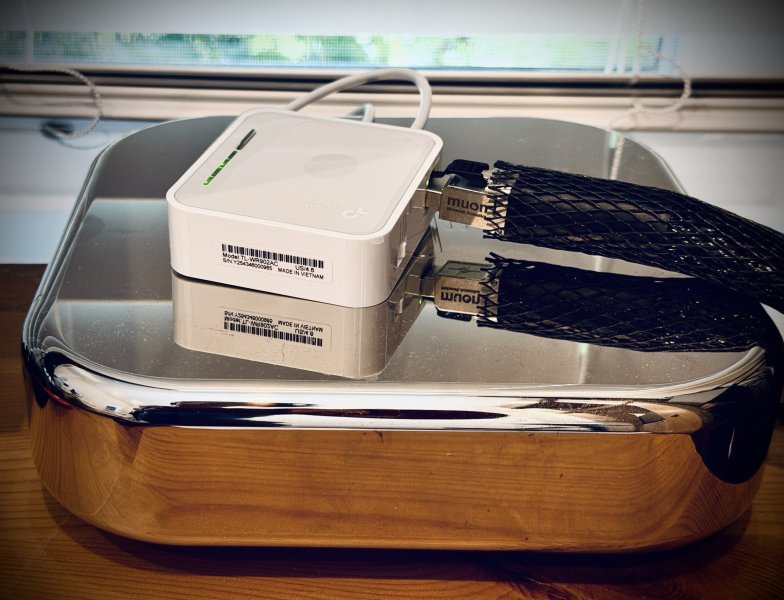
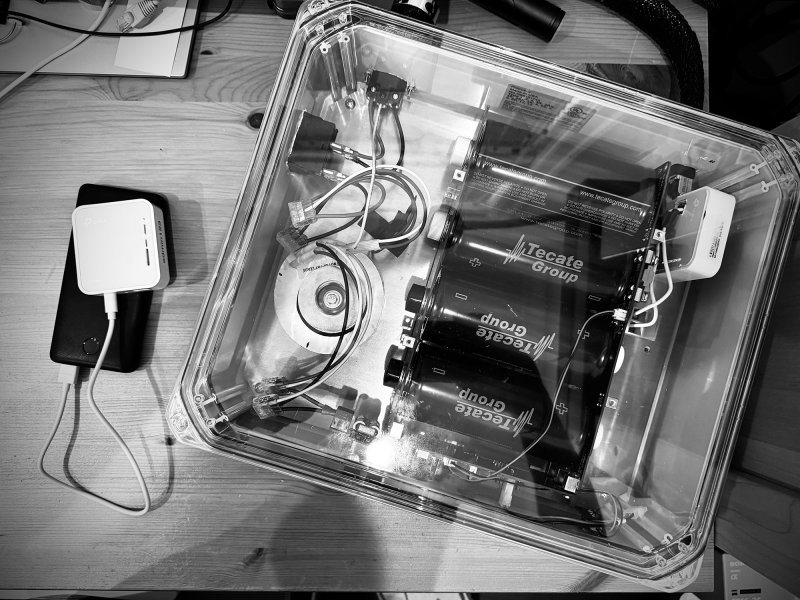
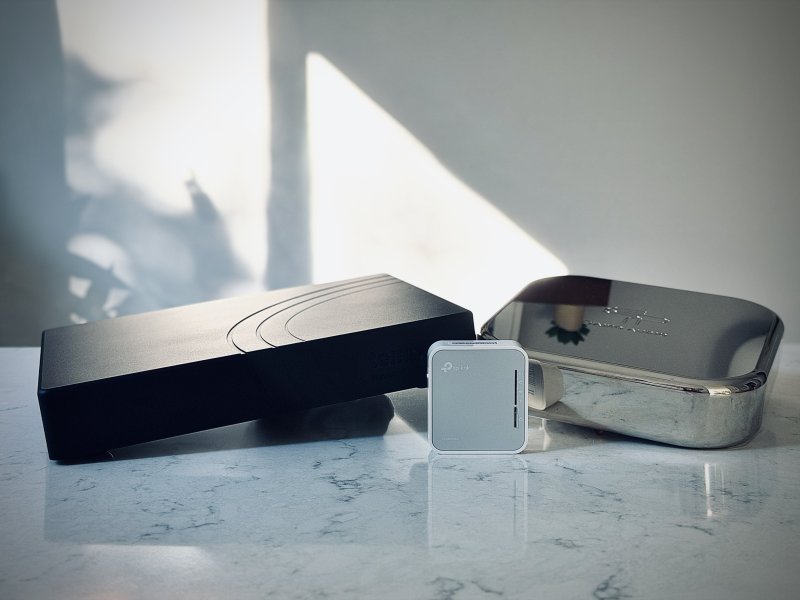
Instead of all the above, I am now using a $30 TPLink WR902AC wireless router powered by a $50 Anker battery pack to supply streaming data to my server. You read that correctly. This is the kind of device that people use at a coffee shop when working on their laptop... except with some easy software options used to tune it for optimal audio streaming use.*