Introducing Olympus & Olympus I/O - A new perspective on modern music playback

There’s no difference depending on the music you’re playing but the (relative) gain(s) can be configured by Lampizator. There are high and low gain versions of the H360 specifically which affects USB, but not XDMI.
I'ved had my H360 sent to factory and the gain reduced to "industry standard". But that was due to USB clipping on my preamp. I don't think this has anything to do with difference in max volume on USB vs XDMI.
Especially when the difference is so significant depending on dynamic range of a track I'm playing.

It would be normal if the volume difference was fixed regardless of track played.
I would like to get explanation how it is possible to have big difference in volume matching of USB vs XDMI on different dynamic ranges.
 
I'ved had my H360 sent to factory and the gain reduced to "industry standard". But that was due to USB clipping on my preamp. I don't think this has anything to do with difference in max volume on USB vs XDMI.
Especially when the difference is so significant depending on dynamic range of a track I'm playing.

It would be normal if the volume difference was fixed regardless of track played.
I would like to get explanation how it is possible to have big difference in volume matching of USB vs XDMI on different dynamic ranges.

I cannot offer an explanation for that as the gain is fixed.
 
Ok, that's a shame. I'll do the same experiment with XDMI analog to see if it's Lampizator related or Olympus related. In any case it's quite strange.

If it’s a subjective effect, a likely explanation is USB doesn’t sound louder because of the music data, but because of how USB sends it. USB works in rapid bursts, and each burst adds a bit of electrical noise into the DAC. You don’t hear that noise directly, but it slightly unsettles the DAC’s internal workings, which the ear can pick up as extra edge or hardness in the higher frequencies.

This can even seem “more dynamic”, simply because those sharper edges make the sound feel more energetic, though it’s really the DAC operating under a bit more electrical stress.
 
If it’s a subjective effect, a likely explanation is USB doesn’t sound harder because of the music data, but because of how USB sends it. USB works in rapid bursts, and each burst adds a bit of electrical noise into the DAC. You don’t hear that noise directly, but it slightly unsettles the DAC’s internal workings, which the ear can pick up as extra edge or hardness in the higher frequencies.

This can even seem “more dynamic”, simply because those sharper edges make the sound feel more energetic though it’s really the DAC operating under a bit more electrical stress.
Wouldn't such "digital pollution" on USB add like 1-2 db max? Here I'm talking about 6db difference between low dynamic vs high dynamic track.
I'm using a decibel meter to capture max peak volume of some track's section (let say 30 seconds) and then try to find same peak volume on the other interface to match the volumes. This way I can be sure I'm listening to both at the same volume and there is no subjective effect involved.
I can clearly hear the digital pollution on USB. It sounds "fuzzy" and stressed compared to XDMI. XDMI is a clear winner without a doubt. I'm just puzzled about this dynamic volume difference.
 
Last edited:
Wouldn't such "digital pollution" on USB add like 1-2 db max? Here I'm talking about 6db difference between low dynamic vs high dynamic track.
I'm using a decibel meter to capture max peak volume of some track's section (let say 30 seconds) and then try to find same peak volume on the other interface to match the volumes. This way I can be sure I'm listening to both at the same volume and there is no subjective effect involved.
I can clearly hear the digital pollution on USB. It sounds "fuzzy" and stressed compared to XDMI. XDMI is a clear winner without a doubt. I'm just puzzled about this dynamic volume difference.

That is really strange, it’s not DSD versus PCM? Only thing left I can think of..
 
  • Like
Reactions: audio42 and John T
That is really strange, it’s not DSD versus PCM? Only thing left I can think of..
Ha, yes that was it. Just did a quick retest on PCM high dynamic range and volume difference is 6db. I did not realize this before :).
So the conclusion is that on Lampizator Horizon we have USB vs XDMI 6db difference on PCM and cca 10-12db difference on DSD.
This is quite interesting.

Thank you ;)
 
  • Like
Reactions: John T
That is really strange, it’s not DSD versus PCM? Only thing left I can think of..
Does XDMI analog attenuate DSD, if yes is it -6dB?
 
Last edited:
Ha, yes that was it. Just did a quick retest on PCM high dynamic range and volume difference is 6db. I did not realize this before :).
So the conclusion is that on Lampizator Horizon we have USB vs XDMI 6db difference on PCM and cca 10-12db difference on DSD.
This is quite interesting.

Thank you ;)

Ah yes, that is normal, DSD has less usable headroom than PCM, so it’s normalized 6 dB lower to prevent distortion and allow safe modulation.

This is why DACs typically output DSD about 6 dB quieter unless they internally convert it to PCM and re-normalize.

That leaves the 6dB absolute difference which is a matter of configuration on the H360 side.
 
  • Like
Reactions: StefanK
Thank you

Thank you. That's why I did as well. I found it took a lot of adjusting to get the foot to lock with the mounting plate. Especially hard given the weight and limited room in the back of the rack. But eventually all four feet seemed locked in.
I offer this for anyone else who might get some HifiStay racks, and I strongly recommend that you do, they are amazing. The improvement in sound will be immediately apparent, and no I don't have any relationship with Hifistay, just a VERY satisfied customer.
First, if you are going to have two racks, set the bottom rack down and adjust the legs to the size/spacing you want, let's say this is the left rack, then set the bottom rack for the right rack on top of the this one and adjust it to fit. Now both racks sets will be the exact same size so you can move subsequent upper racks to either side and they will fit perfectly. Then take the components that go on the bottom racks and set them somewhere upside down. Now take the rack and turn it upside down and place it on the upside down component to line up the Perfect points with the feet of the component. This is much easier if you have the discs screwed into the bottom of the component. Then just build your rack up fitting each component while upside down, after you fit the rack to the one below first. Now you won't have to fiddle with trying to fit the component while in the rack, right side up, which is a total pain.
I hope this helps someone.
 
  • Like
Reactions: engadin and ctydwn
I offer this for anyone else who might get some HifiStay racks, and I strongly recommend that you do, they are amazing. The improvement in sound will be immediately apparent, and no I don't have any relationship with Hifistay, just a VERY satisfied customer.
First, if you are going to have two racks, set the bottom rack down and adjust the legs to the size/spacing you want, let's say this is the left rack, then set the bottom rack for the right rack on top of the this one and adjust it to fit. Now both racks sets will be the exact same size so you can move subsequent upper racks to either side and they will fit perfectly. Then take the components that go on the bottom racks and set them somewhere upside down. Now take the rack and turn it upside down and place it on the upside down component to line up the Perfect points with the feet of the component. This is much easier if you have the discs screwed into the bottom of the component. Then just build your rack up fitting each component while upside down, after you fit the rack to the one below first. Now you won't have to fiddle with trying to fit the component while in the rack, right side up, which is a total pain.
I hope this helps someone.
It does..
Mine will be delivered on Thursday.. Hopefully..
 
  • Like
Reactions: ctydwn
I'm curious to know what situations you rack users moving to HiFi Stay are moving from? The floor of my listening room is one big concrete block (carpeted) that the house is set on, so I have not been sure if I'd benefit from adding racks - all advice / input welcome as I'm looking to make sure the O & I/O (and amps and DAC) have the best possible environment to perform.
 
  • Like
Reactions: ctydwn
I'm curious to know what situations you rack users moving to HiFi Stay are moving from? The floor of my listening room is one big concrete block (carpeted) that the house is set on, so I have not been sure if I'd benefit from adding racks - all advice / input welcome as I'm looking to make sure the O & I/O (and amps and DAC) have the best possible environment to perform.
Me thinks you're in an optimal situation Dave. I don't have a lot of experience with racks (audio) lol, but I do with concrete. Those HiFi Stay Racks do look impressive. Talk to Marc @RUIN*ish after he gets setup or the other gentleman @kadiddle. Which ever you use decoupling becomes an important aspect. Depending on the rack's design, the rack itself may need decoupling and certainly the components. Your on your own adventure regarding the myriad of different choices there.

Concrete provides the optimal substrate do to its Mass, and Rigidity. Its excellent for limiting vibration.
 
  • Like
Reactions: ctydwn and DW101
I'm curious to know what situations you rack users moving to HiFi Stay are moving from? The floor of my listening room is one big concrete block (carpeted) that the house is set on, so I have not been sure if I'd benefit from adding racks - all advice / input welcome as I'm looking to make sure the O & I/O (and amps and DAC) have the best possible environment to perform.
Well, I could tell a long tale about this topic. I came from Adona racks, before that a Sanus table. The Adona was definetely an upgrade over the Sanus. Our system in our previous home was in a very wide basement room, about 42', and about 25' deep. The system was on the long wall. The floor was a concrete basement slab with glue down vinyl flooring in the area under the stereo equipment with carpet in the rest of the room. We had to cut out the carpet in the area where we installed the Vinyl flooring. We decided to move the system to a smaller room with bare concrete floors so we put down and area rug over the concrete for the equipment to sit on (not the speakers). After doing so, we lost most of the bass output, I mean to the point that it was intolerable. We couldn't understand why. So we moved back into the large room and took the area rug with us and put it under the equipment but not the speakers. Surprisingly, we still didn't have any bass. The only thing that had we done differently was put the rug under the equipment stands (Adona at this time). So we removed the rug, the bass was back. Moral of the story is let your stands (speakers too) "couple" with a firm, hard floor.
We have since built a new home with a dedicated listening/theater room. Again it's a concrete basement floor, glue down vinyl in the equipment area with carpet in the rest. Walls and ceiling are made with ACS Iso wall (like Robert Harley's room).
As for the hifistay racks, I saw them at Capital Audio fest 2024 and was impressed with the technology. When I decided to upgrade racks this year I first thought I would do Artesania, but I couldn't get the memory of the Hifistay racks out of my head, so I pulled the trigger and ordered two 3 level racks and a pair of amp stands. I could go on and on with all the usual audiophile rhetoric about the ways it improved the sound, suffice it say, you can have these racks when you pry them from my cold, dead hands. This was a MAJOR upgrade and improved the sound in many ways. Highly recommended. Just ask Vassil (@nenon).
 
  • Like
Reactions: RUIN*ish and DW101
Well, I could tell a long tale about this topic. I came from Adona racks, before that a Sanus table. The Adona was definetely an upgrade over the Sanus. Our system in our previous home was in a very wide basement room, about 42', and about 25' deep. The system was on the long wall. The floor was a concrete basement slab with glue down vinyl flooring in the area under the stereo equipment with carpet in the rest of the room. We had to cut out the carpet in the area where we installed the Vinyl flooring. We decided to move the system to a smaller room with bare concrete floors so we put down and area rug over the concrete for the equipment to sit on (not the speakers). After doing so, we lost most of the bass output, I mean to the point that it was intolerable. We couldn't understand why. So we moved back into the large room and took the area rug with us and put it under the equipment but not the speakers. Surprisingly, we still didn't have any bass. The only thing that had we done differently was put the rug under the equipment stands (Adona at this time). So we removed the rug, the bass was back. Moral of the story is let your stands (speakers too) "couple" with a firm, hard floor.
We have since built a new home with a dedicated listening/theater room. Again it's a concrete basement floor, glue down vinyl in the equipment area with carpet in the rest. Walls and ceiling are made with ACS Iso wall (like Robert Harley's room).
As for the hifistay racks, I saw them at Capital Audio fest 2024 and was impressed with the technology. When I decided to upgrade racks this year I first thought I would do Artesania, but I couldn't get the memory of the Hifistay racks out of my head, so I pulled the trigger and ordered two 3 level racks and a pair of amp stands. I could go on and on with all the usual audiophile rhetoric about the ways it improved the sound, suffice it say, you can have these racks when you pry them from my cold, dead hands. This was a MAJOR upgrade and improved the sound in many ways. Highly recommended. Just ask Vassil (@nenon).
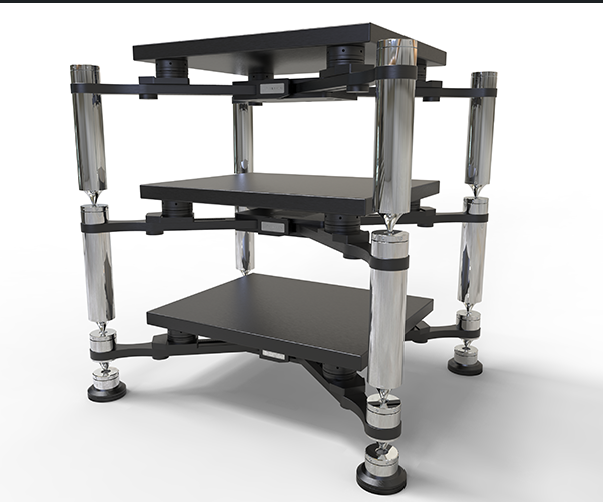
Interesting! I'm quite certain the Hifistay racks have a spikes that go into a decoupling mechanism between the floor and the spikes. Is this how yours is configured?
 
  • Like
Reactions: DW101
Interesting! I'm quite certain the Hifistay racks have a spikes that go into a decoupling mechanism between the floor and the spikes. Is this how yours is configured?
My racks looks like these but without the platforms on each level. Our equipment sits directly on the Perfect Points. We have the same Ballerino Tripple Swing 80 footers shown in the picture (the things on the floor) There are no spikes on the floor since ours sits on a hard floor. These footers need a hard floor. You could possibly get some kind of spike footer to fit under them, Iso Acoustics sells them. I have a set I need to get rid of ;-). This would penetrate through the carpet to the concrete.
 

Attachments

  • hifistay.png
    hifistay.png
    210.8 KB · Views: 12
  • Like
Reactions: John T and DW101
Well, I could tell a long tale about this topic. I came from Adona racks, before that a Sanus table. The Adona was definetely an upgrade over the Sanus. Our system in our previous home was in a very wide basement room, about 42', and about 25' deep. The system was on the long wall. The floor was a concrete basement slab with glue down vinyl flooring in the area under the stereo equipment with carpet in the rest of the room. We had to cut out the carpet in the area where we installed the Vinyl flooring. We decided to move the system to a smaller room with bare concrete floors so we put down and area rug over the concrete for the equipment to sit on (not the speakers). After doing so, we lost most of the bass output, I mean to the point that it was intolerable. We couldn't understand why. So we moved back into the large room and took the area rug with us and put it under the equipment but not the speakers. Surprisingly, we still didn't have any bass. The only thing that had we done differently was put the rug under the equipment stands (Adona at this time). So we removed the rug, the bass was back. Moral of the story is let your stands (speakers too) "couple" with a firm, hard floor.
We have since built a new home with a dedicated listening/theater room. Again it's a concrete basement floor, glue down vinyl in the equipment area with carpet in the rest. Walls and ceiling are made with ACS Iso wall (like Robert Harley's room).
As for the hifistay racks, I saw them at Capital Audio fest 2024 and was impressed with the technology. When I decided to upgrade racks this year I first thought I would do Artesania, but I couldn't get the memory of the Hifistay racks out of my head, so I pulled the trigger and ordered two 3 level racks and a pair of amp stands. I could go on and on with all the usual audiophile rhetoric about the ways it improved the sound, suffice it say, you can have these racks when you pry them from my cold, dead hands. This was a MAJOR upgrade and improved the sound in many ways. Highly recommended. Just ask Vassil (@nenon).
No experience with the HiFiStay racks here, but I can vouch for the efficacy of concrete floors and ASC's Iso-Wall construction.

I moved my system from our living room (solid wood floor, two layer subfloor on posts and beams) to a music room I built in our large garage on the concrete slab. ASC Iso-Wall construction throughout.

Since I changed a bunch of variables all at once with the move I can't attribute the overall improvement in music to specific elements of construction, but it has been a very large improvement. I've heard the same sort of improvement before though not as large in magnitude, when I moved a system from the first floor (carpet, wood floor on joists) to the basement (poured concrete slab) in another house.

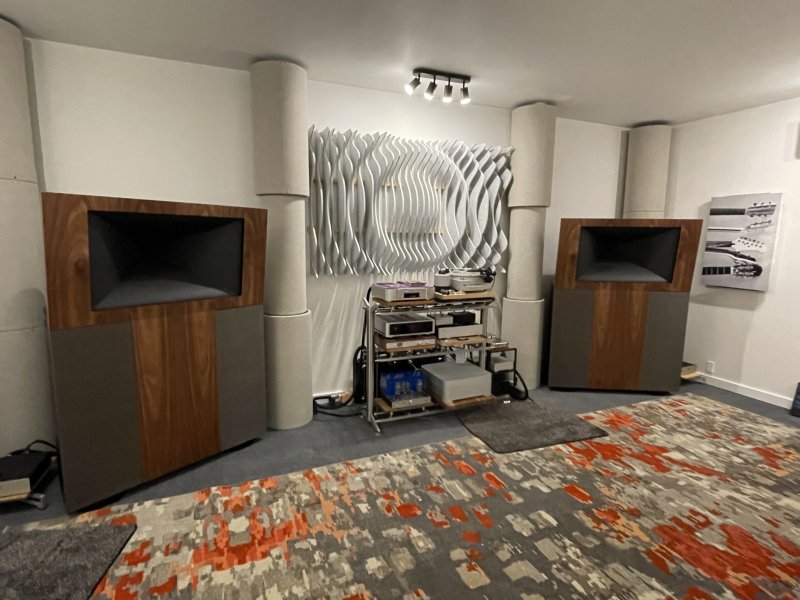
Here's the current setup:


IMG_3224.JPG

Much as I'd love to try out the HiFiStay rack system I haven't worn out my Stillpoints ESS rack yet, so that will have to wait. . .

Steve Z
 
My racks looks like these but without the platforms on each level. Our equipment sits directly on the Perfect Points. We have the same Ballerino Tripple Swing 80 footers shown in the picture (the things on the floor) There are no spikes on the floor since ours sits on a hard floor. These footers need a hard floor. You could possibly get some kind of spike footer to fit under them, Iso Acoustics sells them. I have a set I need to get rid of ;-). This would penetrate through the carpet to the concrete.
Very nice, I understand. I have seen them like yours and without the bottom configuration in some other pics...
 
No experience with the HiFiStay racks here, but I can vouch for the efficacy of concrete floors and ASC's Iso-Wall construction.

I moved my system from our living room (solid wood floor, two layer subfloor on posts and beams) to a music room I built in our large garage on the concrete slab. ASC Iso-Wall construction throughout.

Since I changed a bunch of variables all at once with the move I can't attribute the overall improvement in music to specific elements of construction, but it has been a very large improvement. I've heard the same sort of improvement before though not as large in magnitude, when I moved a system from the first floor (carpet, wood floor on joists) to the basement (poured concrete slab) in another house.

Here's the current setup:


View attachment 162739

Much as I'd love to try out the HiFiStay rack system I haven't worn out my Stillpoints ESS rack yet, so that will have to wait. . .

Steve Z
You did it!!! Well done, absolutely stunning!!! Last I checked in you were positioning...Beautiful
 
  • Like
Reactions: oldmustang

About us

  • What’s Best Forum is THE forum for high end audio, product reviews, advice and sharing experiences on the best of everything else. This is THE place where audiophiles and audio companies discuss vintage, contemporary and new audio products, music servers, music streamers, computer audio, digital-to-analog converters, turntables, phono stages, cartridges, reel-to-reel tape machines, speakers, headphones and tube and solid-state amplification. Founded in 2010 What’s Best Forum invites intelligent and courteous people of all interests and backgrounds to describe and discuss the best of everything. From beginners to life-long hobbyists to industry professionals, we enjoy learning about new things and meeting new people, and participating in spirited debates.

Quick Navigation

User Menu

Steve Williams
Site Founder | Site Owner | Administrator
Ron Resnick
Site Owner | Administrator
Julian (The Fixer)
Website Build | Marketing Managersing