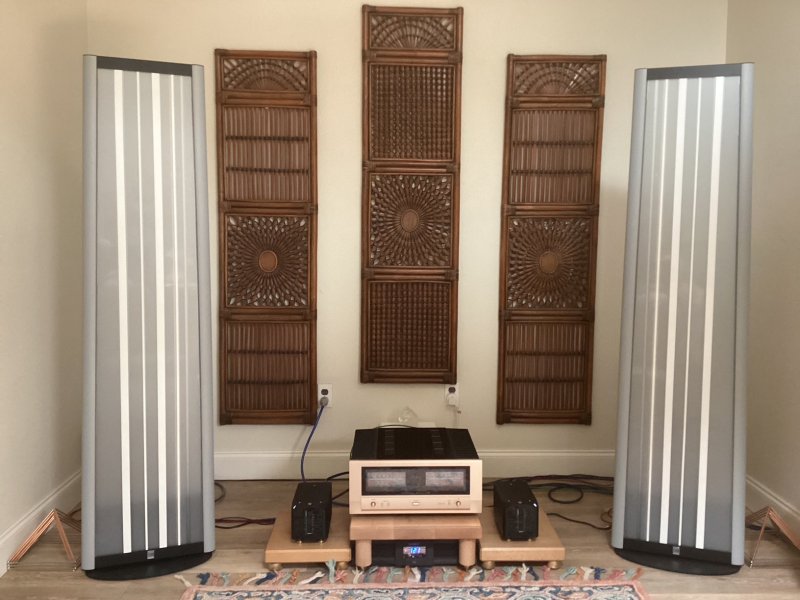






Bass is not one of the shortcomings of the Final Audio M35s. In fact I would argue that at least the early version of the speaker that I have overemphasizes the bottom end a little bit and in my room there is a hump between 50-100Hz that I have tried to tame with PEQ in Roon. Now it is possible that is just a artifact of the room but @Riverdinaudio has also noted it in conversations with me. I also feel the top end is a bit rolled off for my tastes and overall (again in my room) the speakers measure as if they were designed with more of a Harman curve frequency response rather than flat. To some extent I suspect that is an overreaction to popular concerns about electrostatics being too bright and bass light which is certainly not the case with the M35s I have. However, even without any tuning the M35s have notably better and more textured and tuneful bass than the Magnepan 20.7s that I used previously which were no slouch. The M35s do provide a fantastic soundstage that is deep and wide and very precisely positioned and detailed. They are very holographic, although still not quite at the eerie level of a Quad 57. And I simply love the timbre and tone of the M35s. Listening to a track like this is practically orgasmic on well set up M35s. https://open.qobuz.com/track/6825966 Things like drum skins, chimes, tenor sax etc. is fantastic. I love "Seven Pillars" but the "mARImbA" https://open.qobuz.com/track/130093496 track sounds truly special and there is no lack of bass or dynamics playing any of the album.Hei,
I haven't heard the Final speakers yet. But I'd like to. I recently heard Popopri, which I liked a lot. The newer ESLs use new materials that improve the sound of the ESLs.
But I'd like to share my personal impressions of ESLs with you. Of my ESLs. I myself have Audiostatics. More specifically, Geschka ESLs, which were an improved Audiostatic versions. However, these older ESLs aren't quite comparable to the quality of newer ESLs. But the newer ESLs still have to contend with the same physics. So mine can serve as an example.
My problem for a long time was the somewhat ethereal sound. Of course, they were fast and spacious. But they always lacked a certain physicality, which offer other speaker principals, such as dynamic speakers. But Peter Walker once said, that the height of the ESLs represents the dynamics, and the surface represents the bass. So I got a second pair for the bass range only. In my case, from just below 40 Hz to 500 Hz. I use two amplifiers for this.
Even after adding a bass ESL, I still don't have dynamic speakers. But the sound is now much more grounded. And that's what I was aiming for. And to some extent, I got it. Especially as my ESLs lack of volume in the 100–300 Hz range. I still cant keep up with a newer ESL, but that was not to expect.
What I want to say overall is, that many of the small and narrow ESLs, which are often made for WAF reasons, probably still can't provide enough substance to the soundscape, despite the latest materials. And that's the impression many people may get at HiFi shows. And now back to the Final M35. These wings alone will help improve the fundamental tone. Additional their bigger surface area than the smaller models supports Walker's approach.
Even nowadays, it's just not possible to buy narrow and small-area ESLs or panels, if you have high expectations. So you need the likes like M35, a large Popori, or another large panel. Bigger helps a lot. I can't say whether hybrids are a solution, I had not the chance to listen to them at home. But companies like Martin Logan get a lot of credit.
But what I also get with the second pair of ESL is what Magnepan calls power response. The way the room is filled. I think it has to do with the amount of air which is moved. And this is more easy achieved with enough driver surface. Therefore my bass panels fill the room more gracefully. Even dynamic speaker profit from this. That is why Final sells a bass tower. A single driver cannot do this. I heard smaller speakers dry to do this by using a bass driver which larger membrane strokes, but as soon it gets louder, they always sounded kind of strained to my ears. But if you are used to the rather gentle movement of big driver surfaces, you cannot go back to this smaller kind of athletics loudspeaker. This is only my impression.
Greetings Wolfgang
Still, dynamics aren't as good as what a truly excellent box speaker provides but for the kind of music I listen to that isn't much of an issue. Where the M35s are lacking is in the attack and transients that a great "fast" speaker provides. Recently I set up a pair of Klipsch La Scala's in my second system with a well integrated subwoofer and even though they are clearly not as "good" as the M35s they are very fun to listen to on some music largely because of the sense of immediacy, and their better attack, transients and dynamics. However, I have auditioned both systems for a half dozen people and there is no question that the M35s are better.
I heard the smallest Popori WR3 at T.H.E. show last month and was quite impressed with it. It also has excellent bass response and is a bit cheaper than the M35. I suspect the higher end WR1 with its ribbon tweeter is very good but at a significantly higher price. I also heard the Diptyque REFERENCE MK2 which is their top end model at $60K. It was well set up and sounded very good but for whatever reason didn't captivate me. The Clarisys Studio Plus was also excellent and also in the $60-70K price range. None of those speakers had any noticeable deficiency in bass. I think in general the technology in the latest generation of panel speakers has gone a long way toward overcoming most of the criticisms of the past. Which one you prefer is probably a question of personal preference and budget.